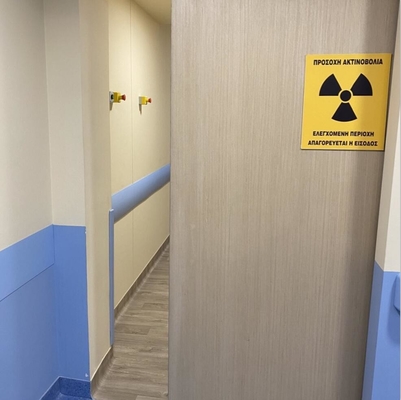

|
Product Details:
|
| Product Name: | 5% Borated Polyethylene Shielding Sheet Blocks For Medical Door | Material: | 100% Virgin PE |
|---|---|---|---|
| Color: | Black | Size: | 1220mm*2440 Mm |
| Thickness: | 5-200mm | Processing Service: | Cutting, Moulding |
| Application: | Nuclear Reactors,Medical Vaults,X-Ray Facilities | ||
| Highlight: | Borated Polyethylene Shielding Sheet Blocks,5 borated polyethylene,5 borated polyethylene sheets |
||
Section 1 - Attribute records
This listing covers a neutron-shielding block, model number Borated Polyethylene Shielding Sheet Blocks, made by Tangyin Taixing Engineering Plastics Co., Ltd. from 100 percent virgin PE with 5 percent boron by weight, supplied black in 1220 x 2440 mm sheets from 5 mm to 200 mm thick, for nuclear reactor, medical vault and X-ray facility work. The recorded processing service is cutting and moulding, and the recorded application is a shielding build rather than a wear part.
| Attribute | Recorded value |
|---|---|
| Model number | Borated Polyethylene Shielding Sheet Blocks |
| Manufacturer | Tangyin Taixing Engineering Plastics Co., Ltd. |
| Product name on record | 5% Borated Polyethylene Shielding Sheet Blocks For Medical Door |
| Material | 100% virgin PE |
| Boron content of this listing | 5% by weight, as stated in the product name and the description |
| Colour | Black |
| Sheet size | 1220 x 2440 mm |
| Thickness | 5 - 200 mm |
| Processing service | Cutting, moulding |
| Application | Nuclear reactors, medical vaults, X-ray facilities |
| Certification | ISO9001 quality management system |
| Place of origin | China |
| Minimum order quantity | 50 kilograms |
| Price basis | Negotiable |
| Payment terms | T/T, Western Union |
| Supply ability | 5000 kilograms per month |
| Delivery time | 15 - 20 days after deposit received |
| Packaging | Wooden crate or pallet |
Three records needed reconciling. The attribute size is 1220 x 2440 mm with a thickness of 5 - 200 mm, while the description's size table lists blocks of 700 x 500 mm and 1000 x 500 mm between 10 mm and 70 mm; the attribute record governs the sheet supplied under this listing, and the smaller blocks are reproduced below as recorded cut block sizes rather than as the sheet format. Boron content is 5 percent in this listing, while the description states that the company's standard range is 2 percent to 30 percent; the 5 percent figure is the one recorded for this part. Finally, the description's property table carries scrambled units, tensile strength printed in percent and elongation in p.s.i., which is recorded as it stands and read as a unit error rather than as data.
| Property | Unit as printed | Result as printed |
|---|---|---|
| Notched Izod impact | ft.lbs/in2 | No break |
| Vicat softening temperature | deg C (deg F) | 89 deg C (192 deg F) |
| Tensile strength at break | printed as % in the source | > 140 |
| Elongation at yield | printed as p.s.i. in the source | > 300 |
| Shore hardness | Shore D | 64 |
| Flexural modulus | p.s.i. | 3000 |
The description lists a second table of blocks in millimetres. Both length columns are recorded, with the thicknesses repeated across them.
| Block family | 10 mm | 20 mm | 25 mm | 30 mm |
|---|---|---|---|---|
| 700 x 500 mm | 700 x 500 x 10 | 700 x 500 x 20 | 700 x 500 x 25 | 700 x 500 x 30 |
| 1000 x 500 mm | 1000 x 500 x 10 | 1000 x 500 x 20 | 1000 x 500 x 25 | 1000 x 500 x 30 |
Thicknesses of 40, 50, 60, 65 and 70 mm are also recorded for both block families in the same table, so a shielding build can be assembled from a set of standard thicknesses instead of one heavy slab. Sheet thickness under this listing runs further, to 200 mm, and that is the range a door or a wall lining is cut from.
Section 2 - Construction
A borated polyethylene shield does two jobs at once. The hydrogen in the polyethylene slows fast neutrons down, and the boron absorbs the slowed, thermal neutrons, which is the sequence the description sets out when it says boron has a large reaction cross section and absorbs neutrons that hydrogen has already moderated. Neither job is done by a coating or a facing: the boron has to be distributed through the whole thickness, which is why the part is supplied as a solid block rather than a laminate with a loaded skin.
This listing records 5 percent boron by weight, and the description records that the company's standard range runs from 2 percent to 30 percent with the boron source selectable among boron carbide, boron trioxide, borax, boric acid, lead powder and lithium carbonate. The consequence for a buyer is that boron content is a specification line on the order, not a generic property: a 5 percent block and a 30 percent block of the same thickness are different shielding components made to the same drawing.
Because the loading is through the section, the block can be cut, drilled and edge-machined without exposing an unloaded core. That is what allows the description to state that the shielding performance survives splicing: a cut face presents the same boron-loaded material as the original face, so a joint is a geometric discontinuity rather than a material one.

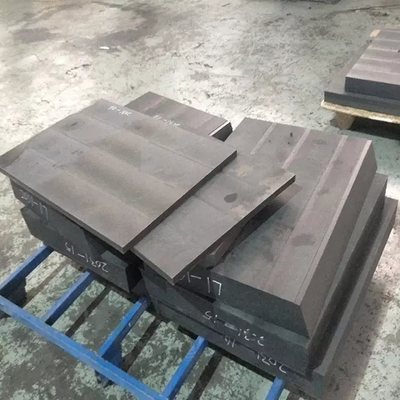
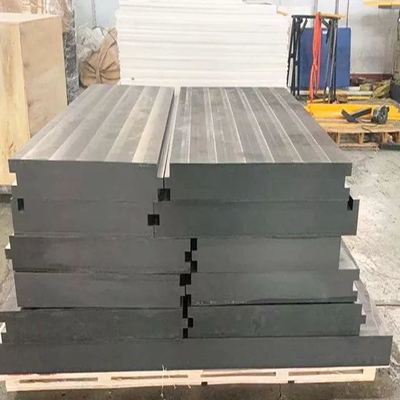
Thickness is recorded from 5 mm to 200 mm for the sheet, and the description's block table repeats 10, 20, 25, 30, 40, 50, 60, 65 and 70 mm for both 700 x 500 mm and 1000 x 500 mm blocks. A thick shield can therefore be built either as one heavy sheet or as a stack of thinner blocks, and the choice changes handling, not shielding principle: a stack needs its layers staggered and its edges overlapped, while a single sheet needs lifting equipment.
The description records that the design department produces a specific splicing plan and that shielding performance is not damaged after splicing. Read as an engineering statement, that means the joint layout is designed rather than improvised on site: joints are offset between layers, and the overlap at each joint is set on the plan. No overlap dimension is recorded for this listing, so the figure has to come from the plan issued for the project, not from this page.
The recorded processing service is cutting and moulding, and the material machines like a dense PE. Cutting and drilling produce a fine plastic dust carrying the boron compound, so the work should be done with extraction and respiratory protection, and the area cleaned before the block is offered up to the opening. A block that has been machined on site should be wiped down before installation, because dust in a joint gap holds the panels apart and opens a shielding path.
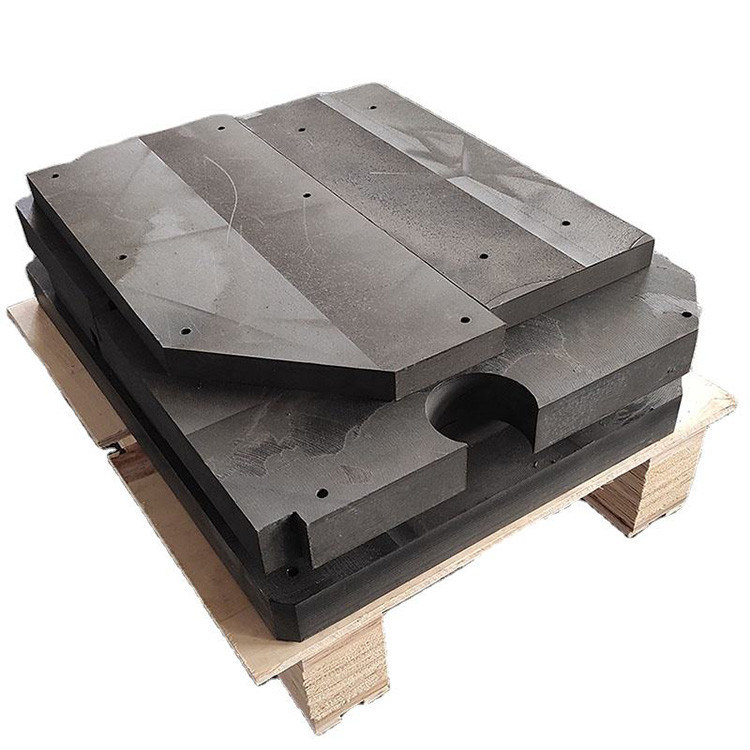
Edges are square cut as supplied. Where a block meets a frame or a door leaf, a slight chamfer on the leading edge helps the block enter the rebate without chipping, since a chipped corner on a 5 mm or 10 mm block is a real loss of section, while the same chip on a 70 mm block is cosmetic.
PE creeps under sustained load, so a heavy shield should be supported along its lower edge and restrained rather than hung from a few point fixings. Fixings need washers or a clamping strip to spread the load, because a bolt head pulled into the block loosens as the material relaxes. No fixing pattern is recorded for this listing; it is a design item for the shielding contractor.
Section 3 - Boundaries and installation
The recorded application for the Borated Polyethylene Shielding Sheet Blocks from Tangyin Taixing Engineering Plastics Co., Ltd. is nuclear reactors, medical vaults and X-ray facilities, and the description adds nuclear power plants, nuclear-powered ships, laboratories using radioactive installations, radiotherapy rooms and domestic use near a raised background. The material is a neutron shield: hydrogen moderates, boron absorbs.
Neutron fields are the design case, and within that, the part works where the block can be fitted as a continuous layer around the source side of a wall, a door or a maze. Medical vault doors, linac and radiotherapy room linings, and laboratory shielding around a neutron source are all consistent with the recorded application. A 5 percent boron block at the recorded 5 - 200 mm thickness is a modular element in that build, cut and jointed to the project plan.
Boron absorbs thermal neutrons; it does not stop gamma radiation, and this listing records no attenuation data, no half-value layer and no density figure for the compound. The description's statement that the right thickness and boron concentration can reduce active radiation by 100 percent is a marketing sentence, and it is not repeated here as a performance figure because nothing recorded for this product supports a number. A project that needs a quantified attenuation value has to obtain it from the shielding calculation for the installation, with the material data for the actual delivered batch.
Equally, the block is not a structural member and not a fire barrier: no fire rating is recorded. It should not be used to carry a door leaf or to replace a structural wall panel.
Set out the opening and confirm the plan revision before cutting. Cut blocks slightly oversize and trim to fit, rather than cutting to the opening and finding a gap, because a gap in a shield is a path. Stagger the joints between layers, keep the overlap as drawn, and fix with clamped strips rather than point bolts so the block is not crushed locally.
Keep the block dry and flat in store before installation. PE takes up very little water, but a block stored on edge for weeks will take a set, and a bowed block cannot be pulled flat into a door rebate without stressing the fixings.
Confirm the boron content on the delivery documents matches the 5 percent recorded for this listing. Check the thickness at several points on each block, since a stack of 20 mm blocks standing in for a 40 mm section only works if the thicknesses are honest. Walk every joint with a straight edge and look for a light gap, and confirm that no fixing or service penetration has been left unshielded.
Section 4 - Manufacturer
Tangyin Taixing Engineering Plastics Co., Ltd. is an engineering plastics manufacturer combining production, sales, design and processing, with more than 20 years of experience, a plant area of more than 25,000 square metres and an annual output of more than 8,000 tons. The stated range covers UHMWPE board, synthetic ice rink, PE marine fender, outrigger pad, UHMWPE liner, plastic conveyor roller, UHMWPE special-shaped parts, HDPE sheet, HDPE ground protection mat and dual colour HDPE sheet; the borated block is produced on the same sheet line as a compounded variant rather than as a separate process.
For a shielding part the relevant capability is the compounding and pressing step, which is what puts 5 percent boron through the full thickness of a 1220 x 2440 mm sheet up to 200 mm thick; the CNC precise finishing machine and CNC machining centres then cut the block to the project layout and machine any rebate or notch. AutoCAD based design support is the reason the description can promise a splicing plan: the joint layout is drawn before the blocks are cut. In the laboratory, the universal mechanical tester is the instrument behind the strength and hardness values in the description table, and the oxygen index tester is the one that would characterise the burning behaviour of a loaded PE compound.
ISO9001 is recorded for Tangyin Taixing Engineering Plastics Co., Ltd. as a quality management system covering the manufacture of polyethylene sheet and machined plastic products. It is a system certification, not a product approval and not a material test report. It is not a shielding performance certificate, and no attenuation, boron assay or nuclear-grade qualification is recorded for this product, so none is claimed here. The company profile page and the site footer also record Beijing Silk Road Enterprise Management Services Co. as the export-management name for the same business, describing one manufacturing and export organisation under two names.
| Term | Recorded value | What it means for a shielding project |
|---|---|---|
| Minimum order | 50 kilograms | Enough for a door set or a repair piece, not a whole vault |
| Supply ability | 5000 kilograms per month | Lower than the other sheet lines, so book capacity early |
| Delivery | 15 - 20 days after deposit | Cutting follows the approved splicing plan |
| Packaging | Wooden crate or pallet | Protects square edges, which the joints depend on |
| Payment | T/T, Western Union | Deposit date starts the delivery window |
| Price | Negotiable | Quoted from boron content, thickness and cut layout |
The 5000 kilogram monthly figure is the number to plan around. It is a specialised compound made in smaller volume than the plain sheet lines, so a vault package should be scheduled against that figure rather than assumed to ship at short notice, and a project that needs several tonnes of blocks should be discussed as a programme and not as a single order.
Section 5 - Buyer FAQ
The Borated Polyethylene Shielding Sheet Blocks in this listing are recorded at 5 percent boron by weight, which is the figure written into the product name and the description. The description also records that the company's standard range runs from 2 percent to 30 percent, so boron content is a specification the buyer sets rather than a property that comes with the material.
State the figure you need on the purchase order and on the drawing given to Tangyin Taixing Engineering Plastics Co., Ltd., because a block at 5 percent and a block at 30 percent look identical in black and cut the same way. The delivered documents for the Borated Polyethylene Shielding Sheet Blocks should repeat the boron content so the shielding calculation can be checked against what actually arrived.
Thickness is recorded from 5 mm to 200 mm for the sheet, and the description's block table repeats 10, 20, 25, 30, 40, 50, 60, 65 and 70 mm in both the 700 x 500 mm and the 1000 x 500 mm block families. The required thickness is set by the shielding calculation for the installation, not by this page, since no attenuation figure is recorded for this product.
What the range does allow is a build strategy. A single thick Borated Polyethylene Shielding Sheet Blocks section is simpler to fit but heavy to handle, while a stack of 20 mm or 25 mm blocks from Tangyin Taixing Engineering Plastics Co., Ltd. is easier to move through a building and lets the joints be staggered from layer to layer.
Because the boron is distributed through the whole thickness rather than concentrated in a skin. When a Borated Polyethylene Shielding Sheet Blocks panel is cut, the new face carries the same boron loading as the original face, so a joint between two blocks is a geometric seam rather than a point where the shielding material stops.
The description records that the design department issues a specific splicing plan, which is how the seam is kept from becoming a path: joints are placed and overlapped to the plan rather than wherever the sheet happens to end. Ask Tangyin Taixing Engineering Plastics Co., Ltd. for that plan with the order, and keep it on site, because a block cut off-plan is the usual cause of a gap found at commissioning.
The mechanism recorded in the description is neutron shielding: hydrogen in the polyethylene moderates fast neutrons, and the boron absorbs thermal neutrons because of its large reaction cross section. That is a neutron argument, and boron is not a gamma absorber in the way that lead or dense concrete is.
No attenuation data, half-value layer or density figure for the compound is recorded for the Borated Polyethylene Shielding Sheet Blocks from Tangyin Taixing Engineering Plastics Co., Ltd., so no gamma performance is claimed here, and the 100 percent reduction figure printed in the description is not repeated as a product claim. Where a mixed neutron and gamma field exists, the gamma part of the design has to come from the shielding engineer and from the other materials in the wall.
PE relaxes under a sustained load, so a shield should sit on a continuous support along its lower edge and be held by clamping strips rather than by a few bolts. A bolt head pulled straight into the block will loosen as the material creeps, and a loose block at a door is both a shielding gap and a handling hazard.
No fixing pattern is recorded for this listing, so the layout belongs to the shielding contractor and to the door or frame supplier. When the schedule is sent to Tangyin Taixing Engineering Plastics Co., Ltd., include the frame details, because the Borated Polyethylene Shielding Sheet Blocks are cut and drilled to fit an opening and the machining is done before the crate leaves the factory.
The minimum order quantity recorded for the Borated Polyethylene Shielding Sheet Blocks is 50 kilograms. For a dense PE block that is a small quantity, which makes it practical to order a door set, a repair piece or a trial block before a full vault package is released.
Because the figure is by weight, the number of blocks inside 50 kilograms depends on the thickness and size chosen. Confirm the unit mass with Tangyin Taixing Engineering Plastics Co., Ltd. once the layout is fixed, and use the small order to check that the delivered Borated Polyethylene Shielding Sheet Blocks match the plan before the bulk of the project is committed.
Monthly supply is recorded at 5000 kilograms and delivery at 15 - 20 days after the deposit is received. The supply figure is the one that matters on a larger project, because a borated compound is made in smaller volume than the plain sheet lines, so a multi-tonne vault package has to be scheduled rather than ordered at short notice.
The delivery window starts at the deposit, which means the splicing plan and the cut list should be approved before payment. For a programme with a fixed commissioning date, place the Borated Polyethylene Shielding Sheet Blocks order from Tangyin Taixing Engineering Plastics Co., Ltd. against the door and frame dates, and confirm how the tonnage will be split across shipments before the first one is released.
Cutting and drilling a loaded PE block produces fine dust carrying the boron compound, so the work should be done with dust extraction and respiratory protection, and the block wiped clean before it is fitted. Packaging is recorded as a wooden crate or a pallet, which keeps the cut edges square in transit, and square edges are what the joints rely on.
Store the crate flat and dry until installation. A Borated Polyethylene Shielding Sheet Blocks panel from Tangyin Taixing Engineering Plastics Co., Ltd. that has stood on edge for weeks will take a set, and a bowed block cannot be pulled into a rebate without loading the fixings and opening a gap at the next joint.
Section 6 - Receiving
Contact Person: Mr. Sales
Tel: +86 152 1104 0646


 English