
|
Product Details:
|
| Item: | Industrial Shielding UHMWPE Board Lead With 5% Boron Polyethylene Sheets | Material: | 100% Virgin PE |
|---|---|---|---|
| Color: | Black | Size: | 1220mm*2440 Mm |
| Thickness: | 5-200mm | Boron Content: | Boron 30% By Weight |
| Processing Service: | Cutting, Moulding | ||
| Highlight: | 5% Boron Polyethylene Sheets,Industrial Shielding UHMWPE Board,Boron Polyethylene UHMWPE Board |
||
Listing 37717251
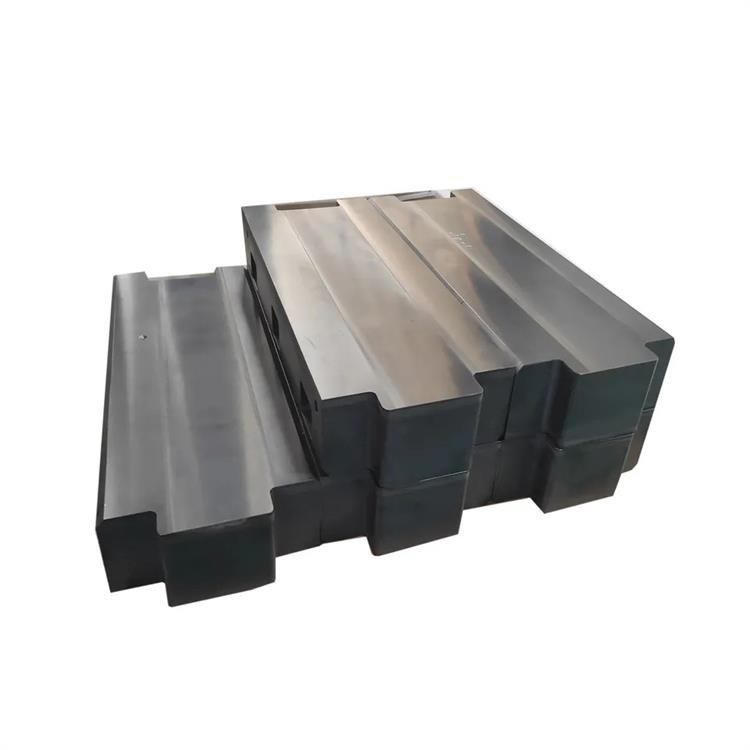
The 5% Boron Polyethylene Sheets supplied by Tangyin Taixing Engineering Plastics Co., Ltd. is a black borated polyethylene shield plate, recorded at 1220 x 2440 mm with a 5-200 mm thickness band, made from 100% virgin PE with boron added by weight, and offered with cutting and moulding as the processing services. The commercial record is a 50 kilogram minimum order, a 5000 kg per month supply ability, a 15-20 day delivery window after deposit and packaging in a wooden crate or on a pallet.
| Recorded field | Value held for this listing |
|---|---|
| Item | Industrial Shielding UHMWPE Board Lead with 5% Boron Polyethylene Sheets |
| Model Number | 5% Boron Polyethylene Sheets |
| Brand Name field | Empty in backend; manufacturer of record is Tangyin Taixing Engineering Plastics Co., Ltd. |
| Material | 100% virgin PE |
| Boron Content | Boron 30% by weight |
| Colour | Black |
| Size | 1220 x 2440 mm |
| Thickness | 5-200 mm |
| Processing Service | Cutting, Moulding |
| Certification | ISO9001 quality management system certification |
| Place of Origin | China |
| Minimum Order Quantity | 50 kilograms |
| Price | Negotiable |
| Payment Terms | T/T, Western Union |
| Supply Ability | 5000 kilograms per month |
| Delivery Time | 15-20 days after deposit received |
| Packaging Details | Wooden crate or pallet |
This listing is sold on a weight basis, not a piece basis: the minimum order is 50 kilograms and the supply ability is expressed in kilograms per month. That is the correct commercial unit for a shield plate, because the quantity that matters to the shielding designer is the mass of hydrogenous material in the shield, and mass is what a 5-200 mm thickness band and a 1220 x 2440 mm plate size translate into at the scale. A purchase order that names only a number of plates leaves the thickness, and therefore the mass, undefined.
| Parameter | Recorded value | How it is used on an order |
|---|---|---|
| Plate size | 1220 x 2440 mm | Recorded size field for this listing; a cut plate is a cutting-service item inside the same order. |
| Thickness | 5-200 mm | Recorded band; the actual section is named per plate because it drives the shield mass. |
| Boron content | Boron 30% by weight | Recorded composition value; see the reconciliation note below on the model designation. |
| Colour | Black | Single recorded colour; no other colour is offered on this listing. |
| Cut plate sizes carried in the source | 700 x 500 mm and 1000 x 500 mm at 10, 20, 25, 30, 40, 50, 60, 65 and 70 mm | Smaller plates listed in the original description; they sit inside the recorded cutting service rather than replacing the 1220 x 2440 mm record. |
| Order quantity basis | 50 kg minimum, 5000 kg per month | Weight basis; the plate count is derived from size x thickness x the material, not fixed in advance. |
No density value, attenuation figure, half-value layer, temperature limit or tolerance is recorded for this listing. The shielding performance of the 5% Boron Polyethylene Sheets therefore has to be calculated by the specifying engineer from the section and the boron content, not read from this page.
Two records disagree on boron. The model designation and the listing title carry a 5% figure, while the attribute record states Boron 30% by weight. The attribute record governs the material statement on this page, so the plate is described as carrying boron at 30% by weight, and the model string is kept exactly as recorded so that the part can be ordered and identified; a buyer whose shield calculation assumes 5% should raise the question with the supplier before the order is placed rather than assume either figure.
The original description also carries a material property table whose unit column does not match its properties - tensile strength is printed in percent and elongation at yield in psi - so the numeric rows are not reproduced here as specifications. The values this page relies on are the recorded size, thickness band, boron content, colour, process pair and commercial terms; any mechanical property needed for a design submission has to come from a test report issued for the actual lot.
The description further states that borated polyethylene can attenuate radiation by 100% at the right distance and thickness. No attenuation test result is recorded for listing 37717251, so this page makes no attenuation claim and leaves the calculation to the shielding engineer.

Construction
The 5% Boron Polyethylene Sheets from Tangyin Taixing Engineering Plastics Co., Ltd. is a shield plate, and a shield plate is judged by two things that have nothing to do with its surface: how much hydrogenous material sits between the source and the occupied space, and whether that material is continuous across the joints. The recorded build is a black virgin polyethylene plate of 1220 x 2440 mm, 5-200 mm thick, carrying boron at 30% by weight, produced by moulding and cut to size on request.
Polyethylene is a hydrogen-rich material, and hydrogen is what slows fast neutrons: a neutron loses energy most efficiently by colliding with a nucleus of similar mass, which is why a light element is the first layer of a neutron shield. Slowing a neutron is only half the job, because a slowed neutron is then captured, and the capture event releases a gamma ray. Boron-10 has a large capture cross-section for thermal neutrons and the capture produces a secondary gamma of lower energy than many alternatives, which is why boron is the additive in a hydrogenous shield rather than the base material.
The recorded boron content of 30% by weight therefore sets how much capture capacity is distributed through the plate, while the polyethylene matrix sets how much moderation happens before a neutron reaches that boron. A thicker plate at the same boron content adds moderation depth and hydrogen; a plate at a higher boron content adds capture capacity at the same thickness. Those are the two levers a designer has, and both are recorded quantities on this listing rather than inferred ones.
The recorded thickness band runs from 5 mm to 200 mm. A single moulded plate at the heavy end of that band is one continuous piece of material with no internal interface, which is the cleanest arrangement for shielding because there is no plane inside the shield where a gap can open. A stack of thinner plates reaches the same total thickness at lower piece weight and is easier to handle and to cut, but every interface in the stack is a potential leak path if the plates are not pulled flat against each other.
Where a design calls for a stack, the plates should be laid with the joints staggered so that no vertical seam runs through the full stack, and the stack should be compressed so that the interfaces close. The recorded processing service of cutting covers the plate sizes but does not record a bonding or a fastening method, so the way a stack is held together is a site decision rather than a supplied one.
A shield is only as good as its worst joint. Two 1220 x 2440 mm plates butted edge to edge leave a line where the thickness is zero, and a neutron streaming down that line sees no material at all. The practical remedies are an overlap, where one plate laps over the next by a distance the designer sets, or a cover strip of the same material set across the joint. Both use the same recorded plate and the same recorded 5-200 mm band, and both depend on the plate edges being square and straight enough to close.
At a corner where a wall meets a ceiling, the joint is the hard one, because the two plates approach at an angle and the outside of the corner is where a gap opens first. Cutting a plate to fit around a penetration - a pipe, a duct, a cable tray - creates a second class of joint, and the cut-out has to be closed with a collar of the same material rather than packed with a different one.
The plate is black, and the colour is in the material rather than on it, so a sawn edge shows the same black section as the face and a cut does not expose a different substrate. Both faces are moulded faces; no surface texture, groove or machined finish is recorded for this listing, so a plate that needs a specific face finish has to be ordered as a machined item.
Machining borated polyethylene produces a dust that contains boron, and the dust is the main workshop hazard with this material rather than the plate itself. Cutting and drilling should be done with extraction at the tool, and the swarf should be bagged rather than swept into a general waste stream. The recorded processing service is cutting and moulding, which is the factory route; site cutting is a separate operation and carries the same dust control requirement.
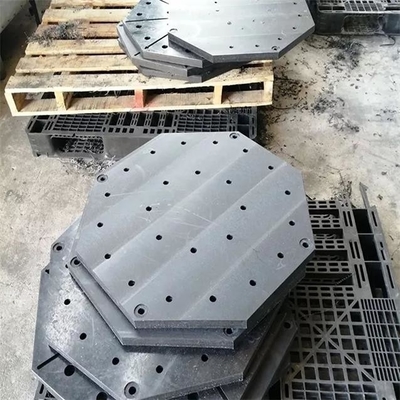
A 1220 x 2440 mm plate at the heavier end of the 5-200 mm band is a substantial piece of material, and it needs support along its length rather than at its corners alone. Fixings should pass through clearance holes rather than tapped holes, because a polyethylene plate creeps under a sustained load and a tapped hole loses its grip. Washers under the heads spread the clamp load so that the plate is not dimpled at each fixing, and the fixings should not be tightened to the point where the plate is visibly deformed around them.
Fit and fixing
The 5% Boron Polyethylene Sheets from Tangyin Taixing Engineering Plastics Co., Ltd. is a neutron-shielding material, and its boundary is set by that role. It moderates and captures neutrons; it is not a gamma shield on its own, and it is not a structural element. A specification that asks this plate to carry a load, or to stop a gamma field without a denser material in front of it, is asking for something the recorded construction does not provide.
The material is used where a neutron field has to be kept out of an occupied space: around a neutron source in a laboratory, on a vault door, as a liner inside a hot cell, and as a local shield around a beam line. In each case the plate is installed against a structure and the shielding calculation decides the thickness. The recorded 5-200 mm band covers thin liners on a door and thick blocks on a wall, and the 1220 x 2440 mm plate size suits a wall panel.
The plate is not a substitute for lead or concrete where the field is predominantly gamma. Polyethylene is a light material, and a light material is a poor gamma attenuator; borated polyethylene is used together with a denser layer, with the polyethylene facing the neutron source and the denser layer behind it. Nor is the plate a structural member: it should be carried by a frame or a substrate, not used as a wall on its own.
No service temperature is recorded for this listing, so a location near a hot duct or a furnace should be referred to the supplier rather than assumed. No fire rating, no UV rating and no outdoor service statement is recorded either, which matters if the plate is to be installed on an exterior wall.
Mark the plate layout on the substrate first, including every penetration and every joint, and cut the plates to that layout before any fixing goes in. Set the first plate against the substrate, fix it along one edge, then work across so that each plate is fixed before the next one is offered up. Where an overlap is used, keep the lap direction consistent across the whole wall, because a lap that reverses at mid-height leaves a joint that faces the wrong way.
Check the joints as the work proceeds rather than at the end. A joint that is open by a visible gap at the face will be open through the full thickness, and closing it later means removing a plate that is already fixed. Where a penetration is cut, fit the collar at the same time as the plate around it, so that the collar is captured by the same fixings.
A full 1220 x 2440 mm plate is a two-person lift at moderate thickness and a mechanical lift at heavy sections. Plates should be carried on edge rather than flat over a long span, because a plate carried flat sags in the middle and takes a set. Store plates flat on a pallet, under cover, with the stack kept square so that the bottom plate is not the one that carries a bent stack for a season.
Confirm the thickness required by the shielding calculation, confirm whether the design uses single plates or a stack, and confirm the joint detail at corners and at every penetration. Confirm the cut sizes if the plates are to arrive ready to fit, and confirm the quantity in kilograms against the recorded 50 kg minimum so that the weight basis and the plate count agree at the quotation stage.
Who makes it
Tangyin Taixing Engineering Plastics Co., Ltd. is the manufacturer of the 5% Boron Polyethylene Sheets. The company states an engineering plastics operation that combines production, sales, design and processing, with more than 20 years of experience, a plant area of more than 25,000 square meters and an annual output of more than 8,000 tons. Its stated product range covers UHMWPE board, synthetic ice rink, PE marine fender, outrigger pad, UHMWPE liner, plastic conveyor roller, UHMWPE special-shaped parts, HDPE sheet, HDPE ground protection mat and dual colour HDPE sheet, with borated shielding plate sitting alongside that range as a filled polyethylene product.
The site also names Beijing Silk Road Enterprise Management Services Co. as the export-management entity operating the same engineering-plastics business. The two names are presented here as one manufacturing and export organisation; no separate factory, group structure or production site is claimed behind either name.
The recorded process is moulding and cutting. The company's stated equipment includes a moulding press machine and an imported production line for the plate itself, and a CNC precise finishing machine, CNC machining centres, a carving machine and a sander machine for the cut sizes, the edge work and any machined detail. Because a shield plate is ordered to a drawing more often than to a stock size, the AutoCAD based design support stated by the company is the step where a wall layout and a set of plate sizes are turned into a cutting list.
The company's stated standard polyethylene sheet formats include 1220 x 2440 mm, which is the size recorded for this listing, and its stated thickness range for sheet runs from 6 mm to 200 mm. This listing records a 5 mm lower bound, so the 5 mm figure is the one that governs an order placed against this page.
The company's stated in-house laboratory holds an abrasion tester, a universal mechanical tester and an oxygen index tester. Those instruments speak to the mechanical and combustion behaviour of the polyethylene, not to neutron attenuation, and no attenuation measurement is recorded for this listing. A buyer who needs a shielding performance figure has to obtain it from a test house against the actual lot, and this page does not substitute a laboratory result for that.
The quality management certification recorded on this site is an ISO9001 system certification covering the manufacture of polyethylene sheet and machined plastic products. It is a system certification: it is not a product approval for this shield plate and it is not a material test report.
The recorded commercial terms are a 50 kilogram minimum order, a 5000 kilogram per month supply ability, a negotiable price, payment by T/T or Western Union, delivery in 15-20 days after deposit and packaging in a wooden crate or on a pallet. A 50 kg minimum is deliberately small: it allows a mock-up, a test panel or a single door liner to be ordered before a full wall is released. The monthly capacity is a hundred times that minimum, which is what a vault or a shielded room programme needs once the drawing is fixed.
Delivery of 15-20 days runs from deposit receipt. On a project where the shielding installation sits on the critical path behind the civil works, that window should be placed against the date the wall is ready to receive plates rather than against the date the plates are wanted on site, because plates that arrive early have to be stored flat and dry.
| Recorded term | Planning consequence for a shield installation |
|---|---|
| MOQ 50 kg | Enough for a test panel or a single door liner before the full wall is released. |
| Supply 5000 kg per month | A room-sized programme fits inside a single month once the cutting list is approved. |
| Delivery 15-20 days after deposit | Book against the date the substrate is ready, not the date plates are wanted. |
| Payment T/T, Western Union | Deposit clears before the cutting slot is booked. |
| Packaging wooden crate or pallet | Plates travel flat and square; keep the crate flat in store. |
Questions buyers ask
The two figures come from two different records. Tangyin Taixing Engineering Plastics Co., Ltd. carries the 5% Boron Polyethylene Sheets model designation with a 5% figure in the title, and the attribute record for the same listing states Boron 30% by weight.
On this page the attribute record governs, so the 5% Boron Polyethylene Sheets is described as a plate carrying boron at 30% by weight, and the model string is preserved unchanged for ordering. A shield calculation for the 5% Boron Polyethylene Sheets from Tangyin Taixing Engineering Plastics Co., Ltd. should therefore be run on the composition confirmed in writing for the lot, not on the model designation alone.
The recorded thickness band for the 5% Boron Polyethylene Sheets is 5-200 mm, and the section is chosen by the shielding engineer from the source term, the distance and the boron content. Tangyin Taixing Engineering Plastics Co., Ltd. records no attenuation figure, no half-value layer and no density for this listing, so the factory cannot substitute a catalogue number for that calculation.
What the factory supplies is the plate at the section the drawing names. A 5% Boron Polyethylene Sheets order from Tangyin Taixing Engineering Plastics Co., Ltd. can mix thicknesses inside the 5-200 mm band, which is how a wall that needs a heavier section at a hot spot and a lighter section elsewhere is built from one order.
A single plate is continuous through its thickness, so there is no internal interface to close. The 5% Boron Polyethylene Sheets from Tangyin Taixing Engineering Plastics Co., Ltd. is recorded up to 200 mm, so a design that fits inside that band can be built without an internal joint at all.
A stack of 5% Boron Polyethylene Sheets from Tangyin Taixing Engineering Plastics Co., Ltd. uses thinner plates from the same recorded band, which is easier to lift and to cut but adds interfaces. Where the 5% Boron Polyethylene Sheets is stacked, stagger the seams and compress the stack so the plates bed flat; an interface that is not closed behaves like a thin air gap in the shield.
A butted joint between two 5% Boron Polyethylene Sheets plates from Tangyin Taixing Engineering Plastics Co., Ltd. has zero thickness along the seam. The two practical details are an overlap, where one plate laps the next, and a cover strip of the same material set across the joint, and both use the recorded plate from Tangyin Taixing Engineering Plastics Co., Ltd. rather than a filler of a different material.
No overlap width or strip size is recorded for the 5% Boron Polyethylene Sheets, so those dimensions come from the shielding design. Fix the joint as the work proceeds: a seam that is visibly open at the face on a 5% Boron Polyethylene Sheets panel from Tangyin Taixing Engineering Plastics Co., Ltd. is open through the full thickness.
Tangyin Taixing Engineering Plastics Co., Ltd. records a 50 kilogram minimum order for the 5% Boron Polyethylene Sheets, and the quantity is expressed in weight rather than in plates. A single vault door liner at a moderate section can sit inside that minimum, which makes the listing usable for a one-off door rather than only for a full wall.
Because Tangyin Taixing Engineering Plastics Co., Ltd. prices 5% Boron Polyethylene Sheets by weight, the quotation for the 5% Boron Polyethylene Sheets depends on the plate size and the section, not on the number of pieces. State the size and thickness for each plate when requesting the quote so that the kilogram figure in the 5% Boron Polyethylene Sheets order matches what the door actually needs.
The recorded packaging is a wooden crate or a pallet. Tangyin Taixing Engineering Plastics Co., Ltd. ships the 5% Boron Polyethylene Sheets as a flat stack so that the plates do not bow in transit and the edges stay straight enough to close a joint on site.
Keep the 5% Boron Polyethylene Sheets flat on its pallet under cover until the wall is ready. A plate stood on edge against a wall for a long period takes a set, and a set plate from Tangyin Taixing Engineering Plastics Co., Ltd. will not pull flat against a substrate without a fixing pattern dense enough to force it, which defeats the purpose of a flat shield.
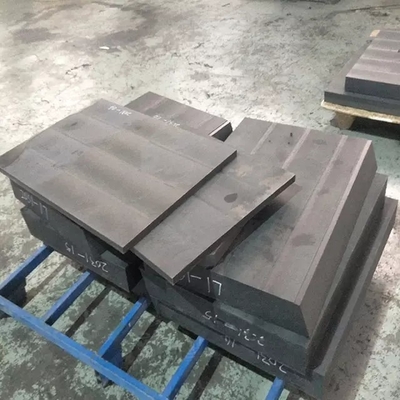
Tangyin Taixing Engineering Plastics Co., Ltd. records cutting and moulding as the processing service for the 5% Boron Polyethylene Sheets, so a plate can be supplied to a cut size rather than only at the recorded 1220 x 2440 mm. Tangyin Taixing Engineering Plastics Co., Ltd. also lists smaller cut plates in the source description, running from 700 x 500 mm to 1000 x 500 mm at a series of thicknesses, all inside the recorded 5-200 mm band.
Send the wall elevation with every penetration and joint marked to Tangyin Taixing Engineering Plastics Co., Ltd., and the 5% Boron Polyethylene Sheets cutting list can be built from it. A cut plate is still the same recorded material; what changes is the outline, and the outline is what determines how many joints the 5% Boron Polyethylene Sheets installation will have.
Tangyin Taixing Engineering Plastics Co., Ltd. records delivery at 15-20 days after deposit received for the 5% Boron Polyethylene Sheets, with payment by T/T or Western Union. The window starts when the deposit lands, so the deposit date is the point that fixes the shipment date.
On a shielded room programme the 5% Boron Polyethylene Sheets from Tangyin Taixing Engineering Plastics Co., Ltd. are installed late, after the substrate is built and the penetrations are formed. Sequence the 5% Boron Polyethylene Sheets order so that the 15-20 day window ends just before that installation slot, and allow the sea leg on top; plates arriving months early spend that time in store, where a 5% Boron Polyethylene Sheets stack can take a set if it is not kept flat.
At the dock
Four checks for a shield plate delivery, each tied to a value recorded for listing 37717251 and to the consequence of that value being wrong in a shielded space.
Contact Person: Mr. Sales
Tel: +86 152 1104 0646


 English