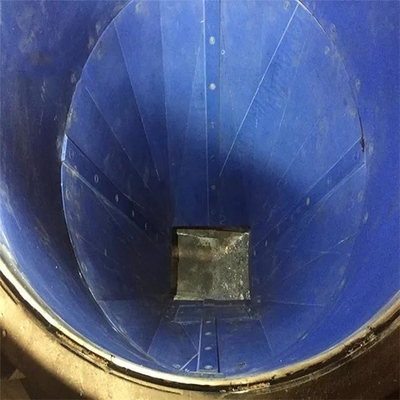

|
Product Details:
|
| Item:: | Coal Mine Chute Liner UHMWPE Coal Bunker Liner Plate | Material: | UHMW Polyethylene |
|---|---|---|---|
| Color:: | Natural White, Black, Yellow | Size:: | 1220*2440*15mm |
| Thickness:: | 5-200mm | Contraction Percentage: | <0.4% |
| Processing Service:: | Cutting, Moulding | Feature: | Self Lubricating ,Non-Sticking Plastic Bunker Lining |
| Highlight: | UHMWPE Coal Bunker Liner,Mine Chute Liner UHMWPE,Anti Sticking Blocking UHMWPE Liner |
||
Listing 37589462
This page covers one listing only: the anti-sticking coal mine chute and bunker liner plate recorded by Tangyin Taixing Engineering Plastics Co., Ltd. under the model number UHMWPE Coal Bunker Liner. Every figure below is taken from the attribute records of this listing; where the original description carries a different or damaged value, the attribute record has been used and the difference is stated.
| Recorded field | Value recorded for this listing |
|---|---|
| Manufacturer | Tangyin Taixing Engineering Plastics Co., Ltd. |
| Model Number | UHMWPE Coal Bunker Liner |
| Item record | Coal Mine Chute Liner UHMWPE Coal Bunker Liner Plate |
| Material | UHMW polyethylene (ultra-high molecular weight polyethylene) |
| Sheet size as recorded | 1220 x 2440 x 15 mm |
| Thickness range offered | 5 mm to 200 mm |
| Colour | Natural white, black, yellow |
| Recorded feature | Self-lubricating, non-sticking plastic bunker lining face |
| Contraction | Below 0.4 percent |
| Processing service | Cutting, moulding |
| Certification | ISO9001 quality management system (system certification) |
| Place of origin | China |
| Minimum order quantity | 10 pieces |
| Price basis | Negotiable |
| Payment terms | T/T, Western Union |
| Supply ability | 50000 pieces per month |
| Delivery time | 15 to 20 days after deposit received |
| Packaging | Wooden crate or pallet |
| Parameter | This listing as ordered at 1220 x 2440 x 15 mm | Recorded alternative on the same listing |
|---|---|---|
| Plate footprint | 1220 x 2440 mm, the size string on the attribute record | Cutting service allows smaller pieces to be produced from the plate |
| Plate thickness | 15 mm on the recorded size string | Any thickness from 5 mm to 200 mm within the recorded range |
| Face colour | Natural white, black or yellow, one colour per order line | The same three colours apply to the whole thickness range |
| Edge and outline | Rectangular plate, cut and moulded as recorded | Moulding service for shaped sections is recorded, geometry to be agreed per order |
| Face treatment | Self-lubricating, non-sticking UHMW polyethylene face as moulded | No other surface finish is recorded for this listing |
Conflict resolved: the attribute record gives 1220 x 2440 x 15 mm, while the original description lists 1200 x 2400 mm, 1200 x 4000 mm and a further string that reads 12100 x 3100 mm. The last entry is a transcription fault in the source text and cannot be a sheet size, so the attribute value 1220 x 2440 x 15 mm governs every statement on this page, and 5 mm to 200 mm is treated as the thickness range rather than a second size claim.
The original description of this listing includes a material table for the UHMW polyethylene sheet used in the liner. It is reproduced here as it was recorded, without addition: density 0.94 to 0.98 g/cm3, water absorption below 0.01 percent, impact strength 140 kJ/m2 or above, tensile strength 22 MPa at 23 deg C in air, breaking strength 42 MPa, and a temperature resistance band of -269 deg C to +90 deg C. These are the only material figures attached to this product record.
| Property as recorded on this listing | Recorded figure |
|---|---|
| Density | 0.94 to 0.98 g/cm3 |
| Water absorption | Below 0.01 percent |
| Impact strength | 140 kJ/m2 or above |
| Tensile strength at 23 deg C in air | 22 MPa |
| Breaking strength | 42 MPa |
| Temperature resistance band | -269 deg C to +90 deg C |
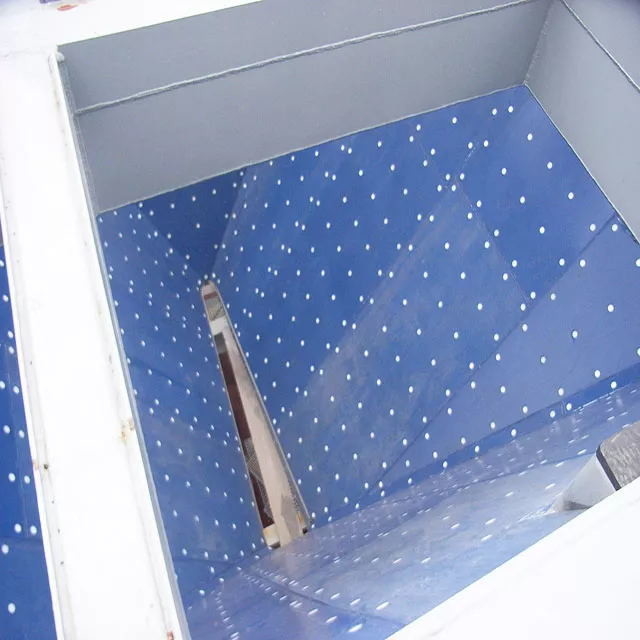
A coal bunker liner is not a flat sheet laid on a wall. It is a field of plates whose exposed face becomes the new sliding surface of the hopper, whose reverse face is pulled flat against the steel or concrete structure, and whose fasteners must disappear below the coal contact plane. The construction logic of the UHMWPE Coal Bunker Liner supplied by Tangyin Taixing Engineering Plastics Co., Ltd. follows from the recorded 15 mm plate thickness and the 1220 x 2440 mm footprint.
The liner is a solid UHMW polyethylene plate, not a laminated or coated panel, so the low-friction self-lubricating property recorded for this listing runs through the full 15 mm section rather than sitting in a skin. That matters in a bunker because the face is abraded by coal at the discharge throat and by dead-bed material in the corners. The plate can be re-faced or reversed in service without exposing a different substrate, and a local gouge does not open a path to a carrier material.
At 1220 x 2440 mm and 15 mm, one plate is a two-person or mechanical lift. The plate is flexible enough to be drawn onto a slightly out-of-plane steel wall by its fasteners, but it is stiff enough that a badly warped support will show as a rocking plate rather than conforming quietly. The construction therefore assumes the structure is brought to a fair surface before lining starts, with high spots ground back and deep hollows packed rather than bridged.
The working face of a bunker liner must be continuous. Fasteners are seated in counterbores so the head finishes at or below the coal contact plane, and the counterbore is opened from the exposed face of the 15 mm plate. Because the plate is 15 mm thick, the counterbore depth, the washer diameter and the head height have to be chosen together: too deep and the remaining section under the head is thin, too shallow and the head stands proud and becomes a wear point that coal catches on. The moulding and cutting service recorded for this listing allows the counterbore pattern to be produced at the factory rather than drilled on a scaffold, which keeps the bore depth consistent across the whole field.
Fastener spacing is set by the plate edges, not by the middle of the plate. The perimeter and any joint line carry the load path, and the interior fasteners only hold the plate against the wall. A plate fixed only at its corners will lift at mid-span when coal drags across it, and once the edge lifts, coal fines work behind the plate and jack it further.
Plates are laid in courses with the flow direction, and each course overlaps the one below it in the sense that the downstream plate edge sits under the upstream edge, so coal slides from one plate onto the next without meeting a raised lip. Where plates meet side by side, the joint is a controlled gap, not a tight butt: the recorded contraction of below 0.4 percent describes how little the material moves, but a gap is still left so that two plates cannot close on each other and buckle the field when the bunker is warm and loaded.
Butt joints in a chute are also the place where fine wet coal collects. A joint that is flush but open gathers a ridge of compacted fines along its length, and that ridge grows until it becomes the obstruction the liner was bought to remove. The construction answer is to keep the gap small, keep it on the downstream side of a lap where possible, and seal or back-fill the gap so there is no cavity for fines to enter.
Plates are cut square at the factory and can be cut and moulded to suit an outlet, a gate frame or a transition. Every cut edge is a fresh face of the same material, so a cut does no harm to the sliding property, but a cut edge that is left ragged or angled becomes a catch point. Outlet openings should be cut with a clean edge and the fastener row set back from the opening so that the plate is not relying on a narrow strip beside the hole.
| Construction element | How it is handled on this 15 mm plate |
|---|---|
| Sliding face | Self-lubricating, non-sticking UHMW polyethylene, continuous across the plate and across courses |
| Reverse face | Flat plate drawn onto the prepared steel or concrete wall by the fastener field |
| Fastener seating | Counterbored from the exposed face, head finished at or below the coal contact plane |
| Course joints | Downstream plate edge lapped under the upstream edge, small controlled gap retained |
| Outlet openings | Cut clean, fastener row set back from the opening edge |
| Plate size in the field | 1220 x 2440 mm as the handling unit, reduced by the recorded cutting service where access is tight |

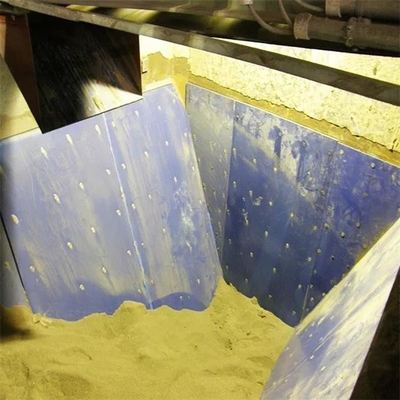
The UHMWPE Coal Bunker Liner from Tangyin Taixing Engineering Plastics Co., Ltd. is built for gravity flow of bulk solids: coal handling and storage chutes, bunker and silo walls, transfer points, and hopper outlets where damp or cohesive material sticks to steel. The same plate is recorded for cement raw and finished product silo lining, grain storage and chute lining, and sieve and wear parts in mineral processing.
A 15 mm plate suits a wall where coal slides rather than drops. On a chute wall, a bunker incline or a hopper throat, the plate sees sliding abrasion and a modest normal load, and 15 mm gives enough section for counterbored fasteners while keeping the plate light enough to install by hand. It is the middle of the recorded 5 mm to 200 mm range, so the same listing can be re-quoted thicker for a drop zone and thinner for a low-wear cover plate without changing supplier or material.
Where the plate is wrong is where the load is a direct impact rather than a slide. A plate under a free-falling coal stream at a transfer point, or at the lip of a truck dump, needs thickness chosen for impact rather than for sliding, and 15 mm is then a starting point to be reviewed against the drop height and lump size. Equally, a wall that is out of fair by more than the plate can be pulled flat will not be fixed by a thin liner; the structure has to be corrected first.
The material table on this listing records a temperature resistance band of -269 deg C to +90 deg C. In practice the upper end is the number that governs a bunker: a liner behind a hot-gas duct, a dryer discharge or a hot clinker path is outside the recorded band, and the plate should not be specified there without a separate review. At the cold end, the recorded band covers winter operation and freezer-side handling, but coal that freezes into a solid mass on the wall is a bridging problem, not a material problem: the liner reduces adhesion but cannot prevent a frozen arch from forming across a narrow throat.
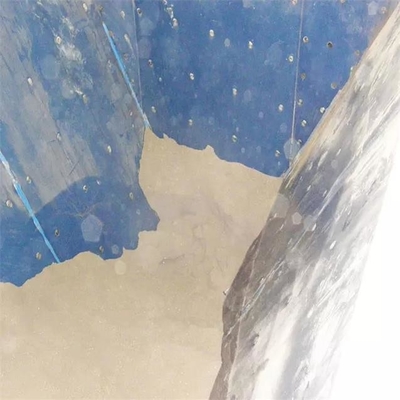
Wet coal is the hardest duty for any liner. Water carries fines into joints, and when the bunker cools the fines freeze and key the plates together with a ridge of ice and coal. The countermeasures are constructional: keep joints tight and on the downstream side of a lap, keep fastener counterbores filled so they do not become water traps, and avoid horizontal ledges where water can stand. The recording of water absorption below 0.01 percent means the plate itself does not take up water, so any moisture problem in service comes from the joints and the structure behind the plate, not from the liner body.
The wall is cleaned and brought to a fair surface, the fastener pattern is marked from the plate itself rather than from a nominal grid, and the plates are hung from the top course downward so each course can be adjusted before the next is fixed. Counterbores are opened, fasteners seated, and the counterbore caps or filler fitted after the plate is pulled down. Where a plate has to be cut on site, the cut is made with a straight edge and the edge is dressed, and the fastener row is moved back from the new edge rather than left at the original spacing.
Site cutting of UHMW polyethylene produces a continuous chip, not a dust cloud, and the cut face is slippery. Cut plates should be stacked on bearers, not on the ground, and carried with gloves because the fresh edge is sharp and the face gives no grip.
Confirm the wall geometry against the 1220 x 2440 mm plate module so the number of cut plates is known before the order is placed. Confirm the fastener type and head height against the counterbore depth available in a 15 mm plate. Confirm the flow direction so the laps run the right way. Confirm the outlet and gate openings and whether they are cut at the factory under the recorded cutting service or on site. Confirm the colour, because natural white, black and yellow behave the same in service but are ordered separately and cannot be mixed on one wall without a visible patchwork.
| Duty | Fits this 15 mm recorded plate | Needs a different review |
|---|---|---|
| Coal sliding on a chute or bunker incline | Yes, the recorded duty for this listing | - |
| Hopper throat with damp fines | Yes, with tight joints and filled counterbores | Bridging across a narrow throat is a geometry issue |
| Direct impact under a transfer point | Only after thickness review within 5 mm to 200 mm | 15 mm may be too thin for the drop height |
| Hot duct or dryer discharge | No | Outside the recorded +90 deg C upper limit |
| Wall out of fair by more than the plate can follow | No | Structure must be corrected before lining |
Tangyin Taixing Engineering Plastics Co., Ltd. is the manufacturer of the UHMWPE Coal Bunker Liner described on this page. The company operates as an engineering plastics manufacturer combining production, sales, design and processing, with more than 20 years of experience, a plant area of over 25,000 square meters and an annual output of more than 8,000 tons. Its stated product range covers UHMWPE board, synthetic ice rink, PE marine fender, outrigger pad, UHMWPE liner, plastic conveyor roller, UHMWPE special-shaped parts, HDPE sheet, HDPE ground protection mat and dual colour HDPE sheet.
The sheet body of this liner is formed on the company's moulding press line from UHMW polyethylene, then finished on the CNC precise finishing machine, carving machine, sander machine and CNC machining centres. For this listing the recorded processing service is cutting and moulding, which is the pair of operations that turns a pressed sheet into a plate of 1220 x 2440 x 15 mm with square edges and, where specified, pre-cut openings and counterbores. AutoCAD based design support is available for laying out a bunker wall from a structure drawing, so the plate module and the fastener pattern can be settled before production rather than on site.
The in-house laboratory holds an abrasion tester, a universal mechanical tester and an oxygen index tester. For a bunker liner the abrasion tester is the instrument that relates to the duty, the universal mechanical tester relates to the strength figures recorded on this listing, and the oxygen index tester relates to the material's combustion behaviour rather than to its wear life. None of these instruments produces a product certificate for a specific bunker.
The certification recorded for this listing is ISO9001, and it is presented here as a quality management system covering the manufacture of polyethylene sheet and machined plastic products. It is a system certification: it is not a product-by-product approval of this liner, not a material test report for this batch, and no certificate number, issuing body or scope statement is recorded on this listing.
| Term | Recorded value | What it means for a purchase plan |
|---|---|---|
| Minimum order quantity | 10 pieces | Ten plates of 1220 x 2440 mm is enough to line a small chute or to run a trial section on one bunker wall before committing the rest |
| Supply ability | 50000 pieces per month | A month of capacity is far above a single bunker reline, so a shutdown window can be supplied in one shipment instead of in phases |
| Delivery time | 15 to 20 days after deposit received | The clock starts at deposit, so a shutdown date should be set at least that window plus freight after payment |
| Price basis | Negotiable | Price is quoted against thickness, colour, plate count and the amount of cutting and moulding, so the layout should be fixed before asking for a figure |
| Payment terms | T/T, Western Union | Two recorded channels, both settled before shipment, which suits a first order and a repeat order alike |
| Packaging | Wooden crate or pallet | Rigid packing protects cut edges and keeps plates flat in transit; plate count per crate should be agreed so unloading matches the site lift capacity |
The company profile page and the site footer also name Beijing Silk Road Enterprise Management Services Co., which operates the same engineering plastics business. This is one manufacturing and export organisation trading under two recorded names, not two factories: an order for this liner is produced in the same plant and despatched through the same export channel whichever name appears on the document.
Tangyin Taixing Engineering Plastics Co., Ltd. counterbores the UHMWPE Coal Bunker Liner from the exposed sliding face, so the fastener head is drawn down into the 15 mm section and finishes at or below the plane the coal travels on. The counterbore depth, washer diameter and head height are chosen as one set: the aim is a head that is flush, with enough material left under the head to carry the pull of the plate.
Because the recorded processing service includes cutting and moulding, this pattern can be produced at the factory on the 1220 x 2440 mm plates rather than drilled on a scaffold. A field-drilled counterbore is where depth control is lost, and a head that stands a millimetre proud of the face becomes the point where coal catches and the plate edge starts to lift.
Tangyin Taixing Engineering Plastics Co., Ltd. lays the UHMWPE Coal Bunker Liner in courses so that the downstream plate sits under the upstream plate edge, which means coal crosses from one 1220 x 2440 mm plate onto the next without meeting a raised lip. A flush butt joint is geometrically correct on paper but in service it collects a ridge of compacted fines along its full length.
The lap also protects the gap. The recorded contraction of below 0.4 percent is small, but a gap still has to exist so two plates cannot close on each other and buckle the field; putting that gap on the downstream side of a lap keeps it out of the direct abrasion path and keeps the cavity where fines can enter as shallow as the construction allows.
The attribute record of Tangyin Taixing Engineering Plastics Co., Ltd. for the UHMWPE Coal Bunker Liner states a contraction of below 0.4 percent. That is a material behaviour figure, and its practical meaning is that a plate field moves little between a cold bunker and a warm one, so the joint gaps do not need to be generous to absorb movement.
The gap that remains is a construction allowance rather than a thermal one: it exists so plates can be placed without forcing, so a cut plate can be dropped in, and so two plate edges cannot bear on each other. On the recorded 1220 x 2440 mm module a small, consistent gap at every joint is easier to control than a mix of tight and open joints, and it keeps the whole wall on one setting.
Tangyin Taixing Engineering Plastics Co., Ltd. supplies the UHMWPE Coal Bunker Liner with a self-lubricating, non-sticking face that reduces adhesion between the coal and the wall, which is the mechanism that keeps a damp load sliding on a slope. Water absorption below 0.01 percent is recorded for the material, so the 15 mm plate body does not take up water and does not swell into the joint.
The limit is the frozen arch itself. Ice that forms across a narrow throat is a mass with its own strength, and no liner face can make a frozen arch fall; what the liner does is remove the adhesion that would otherwise hold a wet but unfrozen load. On a freezing bunker the construction work that matters is keeping joints tight, filling counterbores so they do not hold water, and avoiding horizontal ledges where water can stand and freeze.
Yes. The recorded processing service for this listing is cutting and moulding, and Tangyin Taixing Engineering Plastics Co., Ltd. applies it to the UHMWPE Coal Bunker Liner so a plate can be reduced or shaped to suit an outlet, a gate frame or a transition. The 1220 x 2440 x 15 mm plate is the handling unit; the delivered geometry is whatever the order drawing calls for within that footprint and the recorded 5 mm to 200 mm thickness range.
A shaped plate needs its fastener row set back from the new edge, because a narrow strip beside a cut opening carries little and will lift first. Send the outlet dimensions with the order so the counterbores and the cut outline are produced together, and check that the shaped piece can still be carried through the bunker access opening on site.
The minimum order quantity recorded by Tangyin Taixing Engineering Plastics Co., Ltd. for the UHMWPE Coal Bunker Liner is 10 pieces, which at 1220 x 2440 x 15 mm is a workable trial quantity rather than a container load. A buyer can line one chute, one transfer point or the worst-affected wall of a bunker and observe the plate under real coal before committing the rest of the structure.
The trial also settles the things that are hard to judge from a drawing: whether the 15 mm section is right for the drop at that point, whether the fastener spacing holds the plate flat, and whether the chosen colour suits the site's inspection routine. Ten pieces is small enough to be a test and large enough to give a real answer.
Tangyin Taixing Engineering Plastics Co., Ltd. packs the UHMWPE Coal Bunker Liner in a wooden crate or on a pallet as recorded on this listing. Rigid packing is the point: a 15 mm plate that is stacked flat and strapped stays flat, while a plate that is allowed to sag over a bearer takes a set that shows up as a rocking plate on the wall. Plate count per crate should be agreed so the site can unload with the lift it actually has.
Delivery is recorded as 15 to 20 days after deposit received, so the window starts at payment and does not include sea transit, port handling or inland delivery to the bunker. A shutdown date should be set from the deposit date plus that window plus freight, and the counterbore and cut drawings should be approved before the deposit so production is not waiting on a drawing.
The listing records T/T and Western Union as payment terms for the UHMWPE Coal Bunker Liner supplied by Tangyin Taixing Engineering Plastics Co., Ltd., and it records a supply ability of 50000 pieces per month. For a reline that needs a few hundred plates, that monthly figure means the whole set can be produced inside one delivery window instead of being released in phases.
Price is recorded as negotiable, which in practice means the figure follows the plate count, the thickness chosen within 5 mm to 200 mm, the colour and the amount of cutting and moulding. Fixing the wall layout first and then asking for a price gives a comparable quotation; asking for a price per piece before the layout is known gives a figure that will move.
Contact Person: Mr. Sales
Tel: +86 152 1104 0646


 English