
|
Product Details:
|
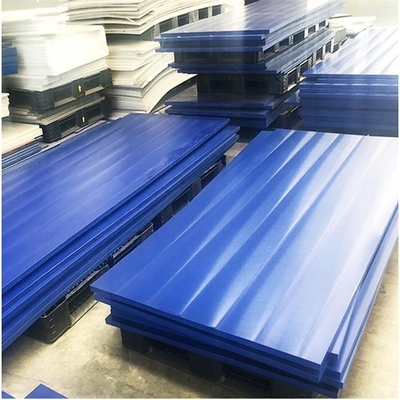
| Item:: | Fast Unload Polyethylene Composite Plastic UHMWPE Dump Truck Bed Liners | Material: | UHMW Polyethylene |
|---|---|---|---|
| Color:: | Natural White, Black, Yellow | Size:: | 1220*2440 |
| Thickness:: | 5-200mm | Density:: | 0.94-0.98 G/cm3 |
| Processing Service:: | Cutting, Moulding | Feature: | Self Lubricating ,Non-Sticking Plastic Bunker Lining |
| Highlight: | UHMWPE Dump Truck Bed Liners,Fast Unload Polyethylene Composite Plastic,UHMWPE Dump Truck Bed Liner |
||
Listing 37619791 - recorded values only
This listing is an ultra-high molecular weight polyethylene liner supplied as a 1220 x 2440 mm sheet in the recorded 5-200 mm thickness band, at 0.94-0.98 g/cm3, in natural white, black or yellow, with cutting and moulding recorded as the processing services and a self-lubricating, non-sticking sliding face recorded as the function.
The original description contained a corrupted size string: it printed 1200 x 2400 mm, 1200 x 4000 mm and 12100 x 3100 mm, and a size of 12100 mm is not a sheet format, so that figure is a typographical corruption and is discarded. The same description's prose paragraph gave 1250 x 3100 mm, 1220 x 2440 mm and 2100 x 3100 mm at 6-200 mm, which conflicts with the recorded 1220 x 2440 mm and 5-200 mm; the attribute record governs, so this page carries one recorded size and the 5-200 mm band.
| Item | Fast Unload Polyethylene Composite Plastic UHMWPE Dump Truck Bed Liners |
|---|---|
| Model Number | UHMWPE Dump Truck Bed Liners |
| Manufacturer | Tangyin Taixing Engineering Plastics Co., Ltd. |
| Material | UHMW Polyethylene |
| Size | 1220 x 2440 mm |
| Thickness | 5-200 mm |
| Density | 0.94-0.98 g/cm3 |
| Colour | Natural White, Black, Yellow |
| Processing Service | Cutting, Moulding |
| Feature | Self Lubricating, Non-Sticking Plastic Bunker Lining |
| Certification | ISO9001 (quality management system) |
| Place of Origin | China |
| Minimum Order Quantity | 10 pieces |
| Price | Negotiable |
| Payment Terms | T/T, Western Union |
| Supply Ability | 50000 pieces per month |
| Delivery Time | 15-20 days after deposit received |
| Packaging Details | Wooden crate or pallet |
These figures appear only in the original description of this listing. They are shown as description-sourced material values, not as values certified for a delivered sheet, and they are the reason a liner in this material is chosen where a mild steel plate would wear through.
| Property | Figure in original description |
|---|---|
| Water absorption | Less than 0.01 percent |
| Impact strength | At least 140 kJ/m2 |
| Tensile strength, 23 deg C in air | 22 MPa |
| Breaking strength | 42 MPa |
| Temperature resistance | -269 deg C to +90 deg C |
The lower bound of the recorded temperature range is a figure that belongs to laboratory material characterisation, not to a service limit for an installed liner, and it should not be read as a recommendation to line a vessel that operates at that temperature. The upper bound is the number that matters on a truck bed or a chute, because it is the point at which a load-bearing plastic face begins to soften.
Construction
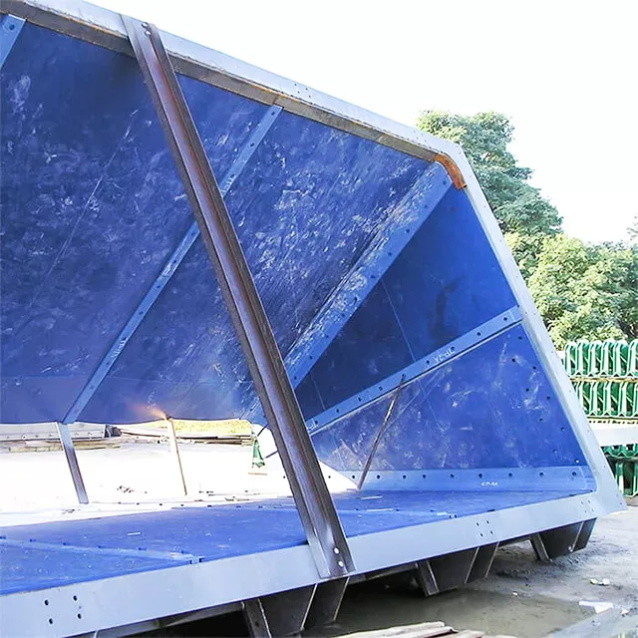
The liner is a solid UHMWPE plate, cut from 1220 x 2440 mm sheet stock in the recorded 5-200 mm band and either bolted in place or moulded to suit a bed, a chute or a hopper. There is no facing layer and no coating: the self-lubricating property recorded for this material is a property of the polymer itself, so it runs through the plate and does not wear off to expose a different substrate. That is the difference between this liner and a painted or sprayed low-friction coating, and it is why the wear life of the face is governed by the plate thickness rather than by adhesion.
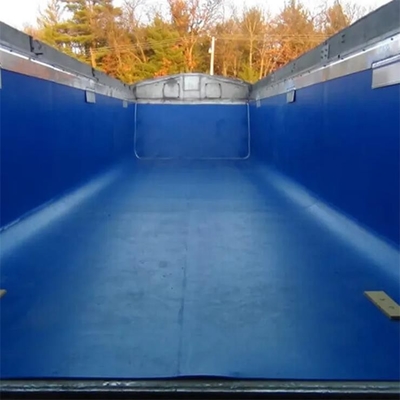
The sliding mechanism is straightforward. A bulk load of coal, grain, sand, cement or fertiliser presses down on the liner face; the friction between the load and that face decides whether the material slides as a mass or sits and arches. The recorded low friction of the UHMWPE face reduces the resistance at that interface, which is what allows a tipper body to discharge at a shallower angle than the same body would need with a steel floor, and what reduces the tendency of damp material to stick and build up at the corners.
At the thin end of the 5-200 mm band the liner is a wear-facing membrane that follows the contour of the steel bed beneath it and is renewed when it wears through. At the thick end it is a structural slab that can be machined, countersunk deeply and used where the liner also has to absorb impact from large lump sizes. The band is wide because the same model string is used across truck beds, chutes, hoppers and buckets, and the thickness, not the model string, states which of those the plate is intended for.
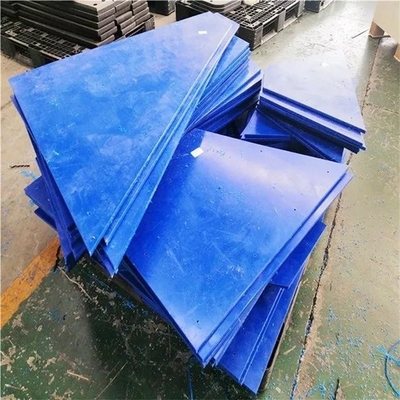
Because the sheet is 1220 x 2440 mm, most beds have to be lined in more than one piece. That makes the joint detail part of the construction rather than an afterthought: joints must run in the direction of flow, each panel must be fastened so that its leading edge cannot be lifted by material dragging over it, and the joint gap must be small enough that fine material cannot work into it and wedge the panels apart.
The description records several installation routes for this material: simple bolting, rubber backed stick-in liners, space frame construction and welded drop-in liners for manufactured chutes. For a dump truck bed, the practical one is the bolted liner. The correct detail is a fastener that sits below the sliding face, in a counterbore or a countersink, with the head never proud of the plate; a proud bolt head in a tipper body is a catch point that stops the load sliding and starts a wear ring around itself.
Edges are cut edges. They are square and clean off the saw or the router, but they are not radiused unless that is ordered, and a square edge at the top of a side wall gives a load something to catch on when the body is tipped. Where the liner terminates at a lip or a tailgate, the edge detail and the fastener spacing at that edge decide whether the plate stays flat under load.

Where it works, where it does not
The description lists this material for truck beds, dragline buckets, shovels, front loading buckets, scrapers, excavator buckets, chutes, hoppers, bunkers, launder parts, conveyor skirting and troughs, ship hold liners and rail car liners, and for bulk materials including grain, coal, sand, gravel, urea phosphates, wood chips, kaolin powder, soap powder, dry fertiliser, foundry sand, soda ash, gypsum, barite, dry cement, chemical powder, fly ash and bottom ash. The recorded feature field narrows the headline use to bunker lining, and the listing title narrows it to a dump truck bed.
Three boundaries apply. First, the upper end of the recorded temperature range is +90 deg C, so a liner handling material hotter than that loses the stiffness and the low-friction face that justify it; hot clinker, hot ash or hot process discharge is outside this record. Second, the liner is a wear and flow surface, not a structural floor: it does not replace a corroded steel bed, and where the steel underneath has lost section the liner will flex into the void and crack at the fasteners. Third, an abrasive load with a sharp, heavy lump at the top of the size range will dent and score any polymer face at the thin end of the band; at 5 mm the plate is a wear facing, and it should be treated as consumable.
Prepare the steel first. Wire-brush or blast the bed, remove any proud weld or rivet head that would hold the liner off the floor, and check that the bed is flat enough that the plate beds down without rocking. Lay out the panels dry, mark the joints against the direction of flow, and mark fastener positions so that no hole lands on a bed cross-member edge where there is no material to hold the bolt.
Then drill, allowing the hole in the liner to be slightly larger than the fastener so the plate can move with temperature against the steel. Fix from the centre of each panel outwards, so that the panel is pulled flat progressively rather than trapped in a wave. Keep a joint gap between panels and a gap at each wall abutment, and check that every fastener head finishes below the face. On a tipper body, run the plate up the sides as well as across the floor where the design allows, because the corner between floor and side is where damp material bridges first.
Confirm the bed's internal dimensions against the 1220 x 2440 mm sheet so the panel layout and the joint lines are decided before any cutting. Confirm the discharge angle and whether the existing body relies on shaking or on gravity, because the liner changes the friction at the load interface, not the geometry. Confirm which face is outward if the plate is moulded, and confirm the fastener type and head profile against the thickness chosen, since a 5 mm plate has very little material to counterbore and a thick plate needs a deeper recess.
Who makes it
Tangyin Taixing Engineering Plastics Co., Ltd. is an engineering plastics manufacturer combining production, sales, design and processing, with more than 20 years of experience, a plant area of more than 25,000 square metres and an annual output of more than 8,000 tons. The stated range covers UHMWPE board, UHMWPE liner, synthetic ice rink, PE marine fender, outrigger pad, plastic conveyor roller, UHMWPE special-shaped parts, HDPE sheet, HDPE ground protection mat and dual colour HDPE sheet. The same business also trades under the recorded export name Beijing Silk Road Enterprise Management Services Co.; this is one manufacturing and export organisation under two names, not two factories.
A liner in the 5-200 mm band is pressed on the imported production line and the moulding press machine, which is the stage at which plate thickness and surface are set. Cutting to the 1220 x 2440 mm sheet, or to the panel sizes a particular bed needs, belongs to the CNC precise finishing machine and the CNC machining centres, and moulded liner shapes for a chute or a hopper are formed rather than cut. AutoCAD based design support matters here because a bed liner is usually a panel layout rather than a stock sheet, and the layout has to be agreed before cutting starts. In the laboratory, the abrasion tester is the instrument that corresponds to the wear claim on a liner face, and the universal mechanical tester corresponds to the recorded tensile and impact values.
The ISO9001 record for this manufacturer is a quality management system certification covering the manufacture of polyethylene sheet and machined plastic products. It is not a product-by-product approval and it is not a material test report. No certificate number, issuing body or further scope is recorded, and the certificate does not certify the wear life of a liner in a particular truck.
| Commercial term | Recorded value | What it means for a fleet order |
|---|---|---|
| Minimum order quantity | 10 pieces | Ten pieces is a fleet-scale entry point rather than a single-truck order, so a first buy usually lines several bodies or covers one body plus spare panels. |
| Supply ability | 50000 pieces per month | Capacity supports a rolling replacement programme across a fleet, so liners can be bought as beds wear rather than in one campaign. |
| Delivery time | 15-20 days after deposit received | Order before a body is due to come out of service, not after, because the window starts at deposit and panel cutting adds to the work once the layout is agreed. |
| Packaging | Wooden crate or pallet | Cut liner panels ship flat and stacked, which protects the sliding face from scuffing in transit and keeps panels identifiable by bed. |
| Payment terms | T/T, Western Union | Two recorded channels; confirm which the order will use before sending the deposit that starts the delivery clock. |
| Price basis | Negotiable | Price follows thickness, colour and the amount of cutting, so a panel layout has to be settled before the order can be priced as this listing. |
Buyer FAQ
Match the thickness to what the plate has to survive, not to the body size. At the low end of the 5-200 mm band the liner is a wear facing: it follows the steel floor, it is light enough to handle in one piece, and it is expected to be replaced when it thins. At the high end it is a slab that absorbs impact from large lump sizes and can carry a deep counterbore for its fasteners, at the cost of weight and of stiffness that will not conform to an uneven floor.
For a body carrying abrasive bulk with no large lumps, the thin end of the band does the flow job at the lowest weight; for a body receiving run-of-mine material with heavy lumps, the thicker end is what stops the plate being punched through. Because the model string UHMWPE Dump Truck Bed Liners covers the whole band, state the thickness explicitly to Tangyin Taixing Engineering Plastics Co., Ltd. on the order and consider a spare set of panels at the same thickness for planned replacement.
Because a Tangyin Taixing Engineering Plastics Co., Ltd. liner works by being a continuous low-friction plane. A bolt head that stands proud of that plane is a physical stop: material catches on it as the body tips, a wedge of load builds up in front of it, and the plate wears in a ring around the fastener. The recorded function of this material is a self-lubricating, non-sticking face, and a proud fastener defeats that function locally no matter how good the polymer is.
The detail also protects the plate. A countersunk or counterbored head loads the fastener through the plate thickness rather than pulling a small head into the face, which is what causes the dishing and cracking seen around surface-mounted bolts in model UHMWPE Dump Truck Bed Liners. On the thin end of the 5-200 mm band there is little material for a recess, so the fastener type has to be chosen against the thickness rather than reused from a thicker installation.
A 1220 x 2440 mm sheet will not cover most tipper floors in one piece, so the layout is part of the design. Run every joint in the direction of flow, so that material sliding down the bed crosses the joint line along its length rather than catching the end of an upstream panel. Stagger the joints between the floor and the side panels so that a joint in one plane does not sit directly above a joint in the other.
Then decide the gap. The gap has to be small enough that fine material cannot enter and wedge the panels apart, and large enough that the plates can expand without butting. That is a layout decision to settle with Tangyin Taixing Engineering Plastics Co., Ltd. before cutting, because model UHMWPE Dump Truck Bed Liners is supplied as flat sheet and the joint geometry is created by the cut plan, not by the mould.
Moulding is recorded as a processing service for this listing alongside cutting, so a formed liner is within the recorded scope. The distinction matters because a flat bolted panel and a moulded drop-in liner behave differently: the flat panel is fastened through the plate into the structure, while a formed liner can be built as a self-supporting shape that sits inside a fabricated chute. The description also names rubber backed stick-in liners and space frame construction as installation routes for this material.
Which route applies is decided by the equipment, not by preference. Send the internal profile of the chute or hopper to Tangyin Taixing Engineering Plastics Co., Ltd. with the order for model UHMWPE Dump Truck Bed Liners and let the moulding route be quoted against it; a formed liner cannot be derived from the 1220 x 2440 mm sheet dimensions alone, and assuming it can is how projects lose a delivery window.
It means the minimum is above what one body normally needs. A single tipper floor and its side walls are lined from a handful of 1220 x 2440 mm panels, so a 10 piece order typically covers one body plus spares, or two bodies lined at the same time. Planning it as a fleet order rather than a one-off is the efficient way to buy.
There is an operational advantage in that: buying spare panels of model UHMWPE Dump Truck Bed Liners at the same time, in the same thickness and colour, gives you matched stock for replacement later, and a spare panel cut from the same batch is easier to fit than one cut from a different sheet. Confirm the panel count per body with Tangyin Taixing Engineering Plastics Co., Ltd. against your own bed dimensions before fixing the order quantity.
Three colours are recorded: natural white, black and yellow. Colour does not change the sliding behaviour of the face, which is a property of the polymer, but it does change what you can see. A natural white liner shows the wear pattern and any embedded material clearly, which is useful during the first months of a new installation. A black liner hides staining and looks tidier in a body that carries coal or dirt.
A bright colour is the practical choice where the liner is inspected from outside the body or where a site wants a visual indicator that a body has been relined. Whatever you choose, put it on the order with the thickness and the panel layout, because Tangyin Taixing Engineering Plastics Co., Ltd. prices model UHMWPE Dump Truck Bed Liners against a stated configuration and the 15-20 day window runs from the deposit, so a colour change after production starts costs time.
The description records a temperature resistance of -269 deg C to +90 deg C. The upper figure is the one to design against: above it the plate softens, loses stiffness and stops presenting the hard low-friction face that the liner depends on. The lower figure is a material characterisation value rather than an installed-service limit and should not be read as an operating recommendation.
In practice a tipper body carrying ambient-temperature bulk sits well inside the range, and the temperature question only becomes real with hot discharge, hot ash or a heated process vessel. If your material arrives hot, raise the actual temperature with Tangyin Taixing Engineering Plastics Co., Ltd. before ordering model UHMWPE Dump Truck Bed Liners, because a liner chosen for flow behaviour and then exposed above its softening range will deform under load instead of sliding.
The recorded packaging is a wooden crate or pallet, which keeps cut panels flat and protects the sliding face from scuffing. Store them the same way on site: flat, on a pallet, out of direct sun and off wet ground. A liner panel stood on edge against a wall for a week will take a set, and a panel with a set is harder to pull flat against a bed floor during fixing.
Keep the panels labelled by bed and by position until they are fitted. Because model UHMWPE Dump Truck Bed Liners is supplied as a cut panel rather than a marked part, the only identity a panel carries on site is the label you put on it, and a mixed stack of similar panels is how a side panel ends up being cut down to fit a floor. Tangyin Taixing Engineering Plastics Co., Ltd. ships against the agreed layout, so keep that layout drawing with the delivery paperwork.
Receiving checklist
Work through these four checks against the delivery paperwork before the crate is opened out on the workshop floor.
Contact Person: Mr. Sales
Tel: +86 152 1104 0646


 English