
|
Product Details:
|
| Item: | Blue Composite UHMWPE Cell Open Port Arch Fenders For Rubber Marine Fenders | Material: | 100% Virgin PE |
|---|---|---|---|
| Color: | Blue, Black, Yellow | Size: | 1220mm*2440 Mm |
| Thickness: | 5-200mm | Molecular Weigh: | 5 - 9 Million |
| Feature: | Corrosion Resistance, Impact Resistance | ||
| Highlight: | UHMWPE Cell Open Port Arch Fenders,Blue Composite Arch Fenders,UHMWPE Arch Fenders |
||
What this listing records about the facing
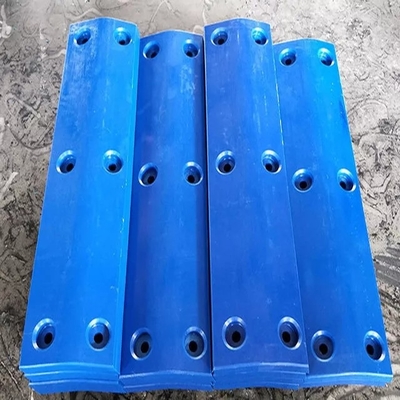
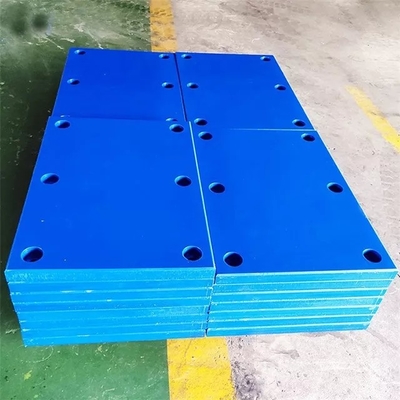
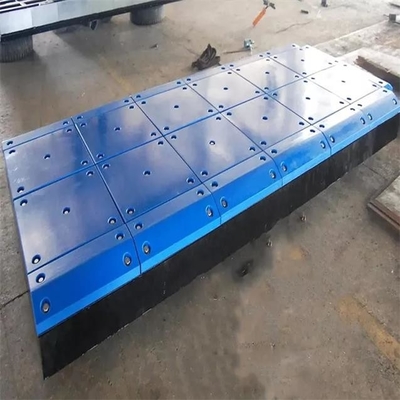
This listing covers the facing element of an arch fender unit, listed by Tangyin Taixing Engineering Plastics Co., Ltd. as the Composite UHMWPE Cell Open Port Arch Fenders. The facing is a 100 percent virgin PE panel in blue, black or yellow, on a 1220 x 2440 mm blank at 5-200 mm thickness, with a recorded molecular weight of 5 to 9 million and recorded corrosion resistance and impact resistance.
| Attribute | Recorded value |
|---|---|
| Product | Arch fender facing panel with open cell ports |
| Material | 100% virgin PE |
| Molecular weight | 5 to 9 million |
| Colour | Blue, black, yellow |
| Blank size | 1220 mm x 2440 mm |
| Thickness | 5-200 mm |
| Recorded feature | Corrosion resistance, impact resistance |
| Density | 0.94-0.98 g/cm3 |
| Water absorption | Less than 0.01% |
| Impact strength | 140 kJ/m2 and above |
| Compressive strength | 42 MPa and above |
| Friction coefficient | 0.11-0.17 |
| Certification | ISO9001, quality management system |
| Place of origin | China |
| Minimum order | 50 pieces |
| Price basis | Negotiable |
| Payment terms | T/T, Western Union |
| Supply ability | 50000 pieces per month |
| Delivery | 15-20 days after deposit received, 5-10 days from stock |
| Packaging | Wooden crate or pallet |
The description attached to this listing is not the description of an arch fender. Its specification table names a hard wharf front panel and a ship corner face fender pad, and the paragraphs describe a flat facing sheet, while the listing title and attribute record name the Composite UHMWPE Cell Open Port Arch Fenders. The attribute record governs the identity, so this page describes a flat UHMWPE facing that is machined and drilled to fit an arch fender body; the density, water absorption, impact, compressive and friction values in that description table are retained because they describe the same polyethylene facing material, and no arch fender body dimension is imported from it.
| Property | Recorded figure | Why a facing cares |
|---|---|---|
| Molecular weight | 5-9 million | Long chains resist abrasion and slow the wear that hollows a facing under a hull corner |
| Friction coefficient | 0.11-0.17 | Low sliding resistance lets the hull shear past the face instead of gripping and peeling it |
| Impact strength | 140 kJ/m2 and above | Absorbs the local knock of a hull plate landing on the face |
| Compressive strength | 42 MPa and above | Holds up under the bolt preload that pinches the facing to the fender body |
| Water absorption | Less than 0.01% | No swelling at the bolt holes in permanent immersion or splash |
Facing thickness, cell ports and the bolt pattern
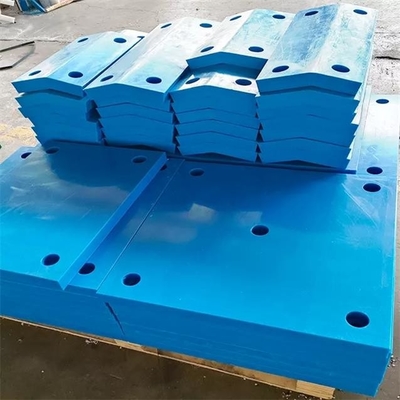
The Composite UHMWPE Cell Open Port Arch Fenders from Tangyin Taixing Engineering Plastics Co., Ltd. are built as a facing that is cut from flat UHMWPE stock and then machined and drilled to the arch fender it serves. The blank is 1220 x 2440 mm, which sets the largest single pad that can come out of one sheet without a joint, and the 5-200 mm thickness range is the variable that is chosen against the fender body, the bolt pattern and the abrasion duty at that berth.
The open port in the listing name is the governing geometric constraint. An arch fender works by deflecting, and the cells or ports through its body are part of how it does that; a facing laid across a port without a matching opening changes the way the unit behaves and traps water and grit in the cavity behind it. The facing therefore has to be cut so that its apertures line up with the ports in the fender body, and the pad outline has to follow the arch face rather than closing it off.
| Build variable | Recorded basis | Effect on the facing |
|---|---|---|
| Blank | 1220 x 2440 mm sheet | Sets the maximum one-piece pad; larger faces are made from two or more pads with a joint |
| Section | 5-200 mm thickness | Thick pads can be machined to a curved arch face; thin pads follow a curve by bending, which the description lists as a feature |
| Apertures | Cell open port layout | Ports are cut to the fender body pattern, not to a standard grid |
| Fastening | Buyer bolt pattern | Holes are drilled to the fender studs, with clearance for the pad to creep |
| Polymer | 5-9 million molecular weight | Wear resistance at the face, with slower creep under bolt preload |

Machining a 5 to 9 million molecular weight polyethylene is not the same as machining a commodity plastic. The material is notch sensitive in the sense that a sharp internal corner concentrates stress, so apertures and slots are better cut with a radius than with a square internal corner, and drilled holes should be free of tearing at the exit face. A pad with a torn hole will initiate a crack that runs to the nearest edge under repeated impact, and the crack will not be visible until the pad has already started to lift.
Thickness and curvature interact. A thick pad at the top of the 5-200 mm range holds its own shape and must be machined to the arch profile if the fender face is curved; a thin pad can follow a curve when it is pulled down on its bolts, and the description lists bendable as a feature of this material. What a thin pad cannot do is hide a badly matched curve: if the pad is pulled down onto a face with a hollow in it, the pad bridges and the bolts at the ends of the bridge carry everything.
The edges of the pad deserve the same attention as the ports. A square-cut edge on a facing that a hull can reach is a place where the pad can be lifted; a small chamfer or radius on the outer edge lets the hull slide off the pad instead of catching it. Because the pad is machined from flat stock, that edge treatment is a routing step at the outline, and it should be on the drawing rather than left to the fitter.
Berths that suit an arch facing and the limits of the pad
The description lists the duty of this facing family as jetties and wharves for small craft, tugs and workboats, pontoon protection, inland waterways and general purpose fendering, and describes arch fenders as the choice where simplicity and toughness matter, at general purpose berths and exposed sites, mounted horizontally or vertically with little maintenance. Those are the conditions the Composite UHMWPE Cell Open Port Arch Fenders are recorded for: a berth where a hull of modest size comes alongside repeatedly and where the fender unit is expected to work without attention.
The pad is a face, not the fender. It has no recorded energy absorption figure of its own, and it is not a substitute for the rubber arch body behind it; the description is explicit that the arch unit is the compliant element and the facing is what the hull touches. A berth that needs a defined energy absorption or a defined reaction force needs the fender unit specified for that duty, with this pad as its face. The pad is also not a structural spacer, a shim for a mis-set fender, or a packer behind a fender that does not sit flat.
Work from the fender body outwards. Record the stud or bolt pattern on the fender, record the port layout, and only then cut the pad outline. A pad cut first and drilled second will almost always have one hole that falls too close to an aperture, and that hole becomes the start of a crack.
Offer the pad up dry before bolting. Check that it sits on the fender face without rocking, that no port is partly covered, and that the pad edge does not stand proud of the fender outline where a hull could catch it. If the face is curved and the pad is at the thick end of the range, check the fit along the whole arc rather than at the two ends.
Bolt with a bearing washer under each head and tighten in a cross pattern. The recorded compressive strength of 42 MPa and above means the material will take a normal preload, but it will still creep under a washer that is too small, and a pad that creeps loses preload and starts to work against its bolts. On a facing that is immersed or splashed, use fasteners that suit the marine environment rather than relying on the pad to isolate them.
Confirm the pad outline against the fender drawing, including the corner radii. Confirm that every port in the fender body has a matching opening and that no opening is smaller than the port it serves. Confirm the bolt pattern in both directions, since a pattern that is right in one axis and wrong in the other will not fit and cannot be corrected by reaming. Confirm the colour, because all three recorded colours are used for visibility at a berth.
The plant behind the facing and the terms on this listing
Tangyin Taixing Engineering Plastics Co., Ltd. combines production, sales, design and processing in one engineering plastics operation, with more than 20 years of experience, a plant area above 25,000 square meters and an annual output above 8,000 tons. Its equipment list includes an imported production line, a moulding press machine, CNC precise finishing machines, a carving machine, a sander machine and CNC machining centres, and it offers AutoCAD based design support. The site also records an export-management name, Beijing Silk Road Enterprise Management Services Co., for the same engineering plastics business; the two names describe one manufacturing and export organisation, not two factories.
This facing is a machining job rather than a moulding job. The sheet is formed on the production line and press, then the CNC finishing machines and the carving machine cut the outline, the cell ports and the bolt holes to the fender pattern, with the sanding step available for edge finish. The in-house laboratory holds an abrasion tester, a universal mechanical tester and an oxygen index tester for the company's general material work; no test report is recorded for this listing, so none is claimed here.
The quality management certification recorded is ISO9001, a system certification covering the manufacture of polyethylene sheet and machined plastic products. It is not a product-by-product approval and not a material test report for a delivered pad.
| Recorded term | Reading for a fender facing order |
|---|---|
| 50 pieces minimum | Matches a small berth or a single fender line; a pad is a machined item, so the minimum is a piece count rather than a weight |
| 50000 pieces per month | Ample for a terminal programme released in one phase, so quantity is not the schedule constraint |
| 15-20 days after deposit | Production clock from deposit; 5-10 days is recorded where the goods are held in stock |
| Wooden crate or pallet | Machined outlines and drilled holes travel protected and do not rub against each other |
| Free sample, freight paid by buyer | Recorded in the description; a sample lets the fit be proven before the fender pattern is finalised |
| Price negotiable | Quoted per enquiry against pad outline, thickness and port pattern |
The sample route is worth using on this product specifically, because the fit is a combination of three things that are hard to check on paper: the arch curvature, the port layout and the bolt pattern. A physical pad on the actual fender body settles all three at once, and the recorded free-sample arrangement means the cost of doing that is the freight.
Facing questions from fender buyers
Holes are drilled to the stud or bolt pattern taken from the fender body, with clearance rather than an interference fit, and the pattern is checked in both axes before the pad is released. Tangyin Taixing Engineering Plastics Co., Ltd. machines the Composite UHMWPE Cell Open Port Arch Fenders outline and hole pattern on CNC equipment, so the drilling is a drawing-driven step rather than a site operation.
The sequence matters: outline, ports and holes are settled together against the fender drawing, because a hole that lands close to a port edge is a crack starter in a 5 to 9 million molecular weight material. A pattern supplied as a paper template is enough to quote from, but the physical fender face is what should be measured before production.
Very long polymer chains give the material its abrasion resistance and its ability to spread a local impact over a wider area instead of chipping. At the face of an arch fender this is what slows the wear groove that a hull corner cuts into a facing over years of berthing, and it is the reason a comparatively thin pad can survive where a lower molecular weight sheet would polish through.
The same long chains make the material slower to relax under load, which is helpful under bolt preload and unhelpful if a pad is forced onto a face that does not match it. A 200 mm pad of the Composite UHMWPE Cell Open Port Arch Fenders from Tangyin Taixing Engineering Plastics Co., Ltd. will not settle into a curved fender face by tightening its bolts; it has to be machined to the curve.
Thickness is set by the abrasion duty and by whether the pad has to hold a machined curve, not by the size of the cell. A thin pad at the 5 mm end follows the arch face when it is bolted down and is suited to a light, protected berth; a thick pad toward 200 mm is a sacrificial block that can be re-faced and that keeps its own shape across a port opening.
What must not happen is a pad so thin over a port that the fender's own deflection pushes the face into the opening. The Composite UHMWPE Cell Open Port Arch Fenders pad from Tangyin Taixing Engineering Plastics Co., Ltd. is fixed to the fender body around the port, so the span between fixings is the part that has to stay flat, and that span is what the thickness selection should be checked against.
The ports are part of how the arch unit deflects, and they are also where water drains. A continuous pad laid over them changes the stiffness of the face and creates a closed cavity that holds water, grit and marine growth against the fender body. Cutting the apertures to the recorded port layout keeps the unit behaving as designed and keeps the cavity able to drain.
There is also a maintenance reason. An open port lets an inspector see the fender body and the fastenings behind the facing, while a covered port hides exactly the area where a fender starts to fail. The Composite UHMWPE Cell Open Port Arch Fenders from Tangyin Taixing Engineering Plastics Co., Ltd. is supplied with the ports cut, not as a blank sheet to be opened on site.
The blank is 1220 x 2440 mm, so the number of pads depends entirely on the pad outline: a small corner facing yields several per sheet, a large arch face may take the whole sheet or need a joint. Because the yield is outline-driven, Tangyin Taixing Engineering Plastics Co., Ltd. quotes against the drawing rather than against a nominal pad count.
Blue, black and yellow are all recorded for the Composite UHMWPE Cell Open Port Arch Fenders. The choice is usually a visibility decision at the berth rather than a performance one, since the recorded properties apply to the material and not to the pigment; a bright face is easier to inspect for wear and for impact damage.
Fifty pieces is a machined-item minimum, not a weight. On a small jetty or a pontoon line it typically covers the pads for a run of arch fender units, which is why the number is workable for a single berth upgrade rather than only for a terminal programme.
If the first berth needs fewer than 50 pads, the sensible use of the minimum is to combine it with the next berth in the same programme, or to take the surplus as spares. Spare pads for the Composite UHMWPE Cell Open Port Arch Fenders from Tangyin Taixing Engineering Plastics Co., Ltd. are worth holding, because a damaged pad is a fast replacement while a new production lot is not.
The description records that samples are offered free of charge with the buyer paying the express freight, and that custom samples are charged. For a facing, the useful sample is a piece of the actual thickness so that the edge finish, the colour and the machining quality can be seen, or a full pad where the fender pattern has to be proven.
Tangyin Taixing Engineering Plastics Co., Ltd. treats the sample of the Composite UHMWPE Cell Open Port Arch Fenders as the point where the arch curvature and the bolt pattern are confirmed. A free material sample proves the sheet; a charged pad sample proves the fit, and on a berth with an unusual fender body the second is the one that prevents a rejected production lot.
The description records 5-10 days where goods are in stock and 15-20 days where they are not, in both cases according to quantity. A stock item is a standard blank or a standard outline; a pad drilled to a specific fender pattern is a production item and follows the longer clock, which starts when the deposit is received.
Planning on the short figure is only safe if the exact thickness and outline are confirmed as stocked, and that confirmation should be in writing on the quotation. For a berth that is closing for repair, the Composite UHMWPE Cell Open Port Arch Fenders from Tangyin Taixing Engineering Plastics Co., Ltd. should be ordered on the production clock with the layout frozen before deposit.
Acceptance checks for a machined facing
Contact Person: Mr. Sales
Tel: +86 152 1104 0646


 English