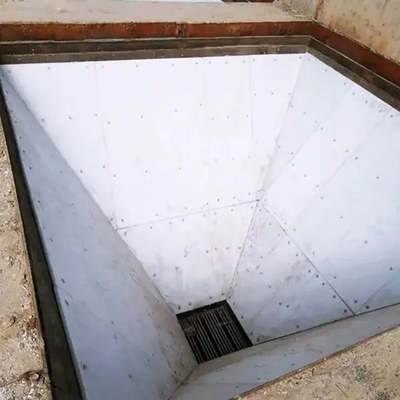

|
Product Details:
|
| Item:: | Coal Mine Chute Liner UHMWPE Coal Bunker Liner Plate | Material: | UHMW Polyethylene |
|---|---|---|---|
| Color:: | Natural White, Black, Yellow | Size:: | 1220*2440*15mm |
| Thickness:: | 5-200mm | Density:: | 0.94-0.98 G/cm3 |
| Processing Service:: | Cutting, Moulding | Feature: | Self Lubricating ,Non-Sticking Plastic Bunker Lining |
| Highlight: | PE Silo Chute Bunker Liner,Ultra High Molecular Weight Polyethylene Sheet,UHMWPE Silo Chute Wear Liners |
||
Section 1 - Recorded data
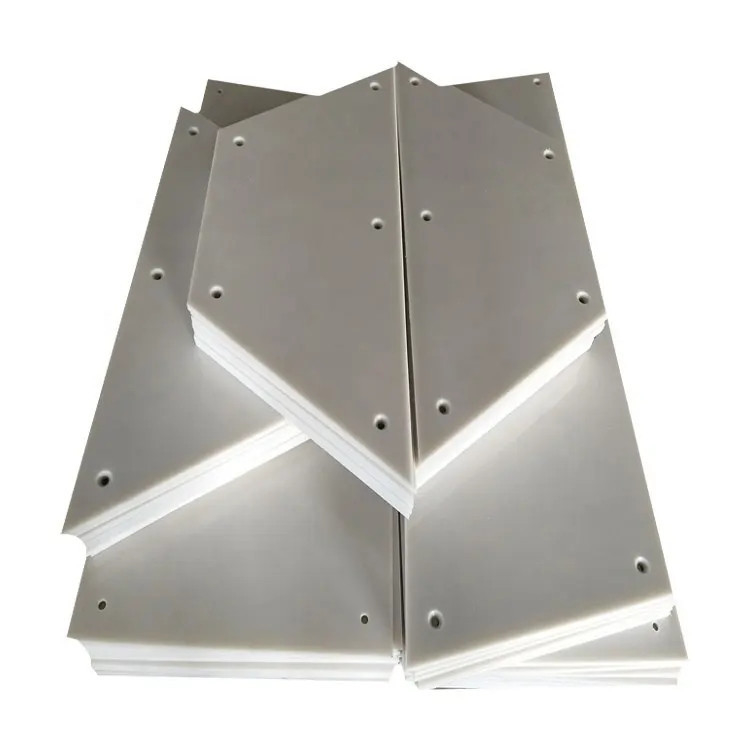
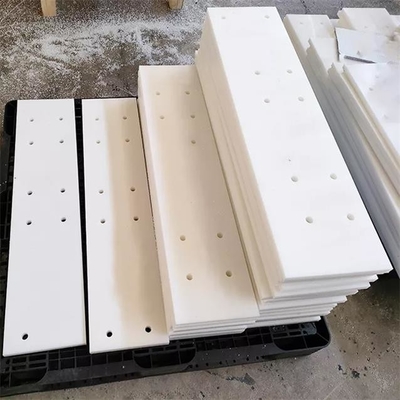
The PE Silo Chute Bunker Liner is a UHMW polyethylene wear panel that is cut and moulded to the wall it protects. This listing records one panel format, 1220 x 2440 mm at 15 mm thick, inside a general thickness range of 5 mm to 200 mm and a density band of 0.94 to 0.98 g/cm3. A liner buyer orders four things: panel size, thickness, colour and quantity. Every statement on this page is built on those four values and on the recorded material figures that follow.
| Attribute | Recorded value for this listing |
|---|---|
| Manufacturer | Tangyin Taixing Engineering Plastics Co., Ltd. |
| Model number | PE Silo Chute Bunker Liner |
| Material | UHMW polyethylene (ultra-high molecular weight polyethylene) |
| Panel size recorded for this listing | 1220 x 2440 mm |
| Panel thickness recorded for this listing | 15 mm |
| Thickness range in the attribute record | 5 mm to 200 mm |
| Density | 0.94 - 0.98 g/cm3 |
| Colour | Natural white, black, yellow |
| Face function | Self-lubricating, non-sticking bunker lining face |
| Processing service | Cutting, moulding |
| Certification | ISO9001 quality management system |
| Place of origin | China |
| Minimum order quantity | 10 pieces |
| Price basis | Negotiable |
| Payment terms | T/T, Western Union |
| Supply ability | 50,000 pieces per month |
| Delivery time | 15-20 days after deposit received |
| Packaging | Wooden crate or pallet |
| Record | Value as supplied | How it is used on this page |
|---|---|---|
| Attribute record, size | 1220 x 2440 x 15 mm | Governs the panel quoted under this model string. Thickness, panel area and handling weight all follow this row. |
| Original description, sheet size | 1200 x 2400 mm | A recorded alternative cut. It is 20 mm shorter on each edge than the attribute size, so it is not interchangeable on a pre-drilled wall. |
| Original description, sheet size | 1200 x 4000 mm | A recorded long panel for a tall chute wall run in one piece instead of two courses. |
| Original description, sheet size | 12100 x 3100 mm | Not used. The entry carries one digit too many and is read as the 2100 x 3100 mm format stated by the company. |
| Attribute record, thickness | 5 mm to 200 mm | Governs the thickness selection range. 15 mm is the value ordered on this listing. |
| Attribute record, colour | Natural white, black, yellow | Governs the delivered face colour. Colour is an order attribute, not a cosmetic detail. |
Conflict resolution in one sentence: where the original description lists a third sheet size of 12100 x 3100 mm and the attribute record lists 1220 x 2440 mm at 15 mm, the attribute record governs the panel on this listing, and the larger entry is discarded as a transcription error.

Section 2 - Construction
This part is not a free-standing board. It is a sacrificial sliding surface that is segmented over a steel or concrete wall, fixed through the face, and replaced panel by panel when the sliding face is worn through. The construction question is therefore never "how thick is the sheet" alone, but how thickness, panel size, fixing recess and joint gap work together on a wall that is rarely flat.
A 15 mm section is thick enough to bridge between countersunk fixings at a normal liner pitch without a continuous backing frame, and thin enough that a 1220 x 2440 mm panel can still be walked through a bunker access door and lifted by two people with a sling. That combination is why the listing records this format: it is a serviceable panel, not a structural plate. Where the wall behind the liner is out of flat, the panel will pull down to the wall at each fixing and stand off between them, so the wall is surveyed before panel size is fixed.
The 2440 mm edge is normally run with the slope and the 1220 mm edge across it. Running the long edge downhill means the joints between courses sit across the flow rather than along it, which keeps a leading edge from lifting under a sliding bed of coal. Panels are laid from the bottom course upward so that each upper panel overlaps the one below in the direction of travel, and so that a worn bottom course can be unbolted without dismantling the wall above it.
Density is recorded as a band, 0.94 to 0.98 g/cm3, not a single figure. At the same 15 mm thickness a panel at the top of the band carries more polymer per square metre than one at the bottom. The practical consequence is that panel mass varies between deliveries, which matters when the same fixing pitch and the same lifting plan are reused from one order to the next; the density value belongs on the inspection record, not only on the datasheet.
The recorded coefficient of friction for this material is 0.05 to 0.11. At the low end of that band the face sheds a coal or cement bed readily at a shallow chute angle; at the high end, a damp fine fraction on a shallow slope can still hold and then release in a slip, which is the stick-slip behaviour that shakes a chute and loosens fixings. Liner angle is set from the material being handled and from the moisture it carries, not from the friction figure alone.
The face is described as non-sticking and self-lubricating, meaning it has no tack to a wet bed and needs no applied lubricant. That is the property that stops a bunker from bridging: where a damp bed freezes or compacts against a steel wall it arches over the outlet, and a low-energy sliding face gives the arch nothing to key into. The source description records comparative abrasion figures of 4 to 6 times other plastics, 6 to 9 times steel and 26 times copper; those are supplier comparatives for the material, not a wear life for a particular chute.
Fixings pass through the liner into the structure, with the head recessed below the sliding face so that no head stands proud into the flow. On a 15 mm panel the countersink consumes a real part of the section, so the recess depth is checked against the head shape before drilling: a deep countersink in a 15 mm panel leaves too little material under the head and the panel pulls through at the first impact. A flat head with a shallow seat, or a washer seated in a spot-faced recess, keeps more section under load.
Panels are not butted hard against each other. A joint gap is left at every seam and at every wall penetration, because the sheet moves with temperature and because a closed joint with no relief buckles at mid-panel once the wall warms. The gap is small enough not to catch a lump of material and wide enough to close under expansion; the fastening pattern near a joint is denser than at mid-panel so the panel edge cannot lift and present a leading lip to the flow.
The liner is a wear item supplied in replaceable segments. Keeping one course per panel format, and keeping the bolt pattern identical from order to order, is what allows a single worn panel to be swapped without re-drilling the wall. That is the reason the recording of panel size and thickness matters more than the recording of the material grade.
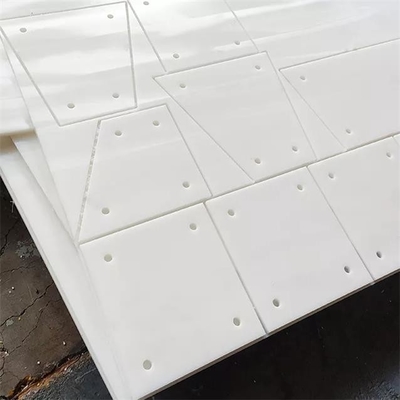
The recorded processing service for this listing is cutting and moulding, so panels arrive at the ordered size and the site work is layout, drilling and fixing. Field cuts are made with a saw that leaves a square edge; a torn or ragged edge on a liner collects fines and becomes the start of a lift. Holes are drilled, not punched, because a punched hole in a 15 mm section leaves a stress concentration that cracks out under a bolt head.
Cut edges are dressed so the panel sits flat against the wall. A burr left on the back face holds the panel off the structure by its own thickness at that point, and the panel then rocks on the burr with every load cycle until the fixing loosens.
| Property | Recorded value | Where it applies here |
|---|---|---|
| Density | 0.94 - 0.98 g/cm3 | Panel mass and inspection record |
| Coefficient of friction | 0.05 - 0.11 | Chute slope and discharge behaviour |
| Water absorption | Less than 0.01% | Wet coal, wash-down, freezing conditions |
| Impact strength | At least 140 KJ/m2 | Lump impact at the loading point |
| Tensile strength at 23 deg C in air | 22 Mpa | Material reference for the panel body |
| Breaking strength | 42 Mpa | Material reference for the panel body |
| Temperature resistance | -269 deg C to +90 deg C | Upper limit of the service window |
These are material figures taken from the source description of this product. They describe the polyethylene, not a permitted working load on a fixing or a design life for a chute.
Section 3 - Boundaries and installation
A 15 mm UHMW polyethylene panel is a good answer to one problem and a poor answer to several others. The boundary is set by what is being handled, how fast it arrives, and how hot it is.
The source records coal handling, coal storage and warehousing chute lining in thermal power; cement raw and finished product silo lining; grain storage and grain chute lining; mining sieve plates and chute linings; and corrosion and wear resistant mechanical parts in chemical engineering. What these have in common is a slow-moving or gravity-fed abrasive bed against a wall that the bed sticks to. The liner replaces the wall surface, not the wall.
It also suits retrofits. An existing steel chute that has worn thin or that bridges in wet weather can be lined over without rebuilding the chute body, because the panel is fixed through its face and adds only its own thickness to the flow path.
The recorded temperature resistance ends at +90 deg C. A chute carrying hot material above that ceiling is outside the recorded window, and the panel will soften and creep rather than wear. The same applies to a wall that is heated from behind, where the liner sees a temperature the flow itself does not show.
The panel is not a structural member. It carries no wall load, and it must not be used as a structural patch over a corroded section, because a liner that is asked to act as the wall will deflect between fixings and open at the joints. Where the wall is perforated, the wall is repaired first.
A very high drop point is a second boundary. The recorded impact strength is a material figure, and a chute receiving large lump material from height needs either a thicker section from the 5 mm to 200 mm range or a backed plate at the impact zone. A 15 mm panel at a high drop point will dish and then crack at the fixing line.
Survey the wall for flatness and for the position of every obstruction before any panel is cut. Set out the courses from the bottom, decide where the vertical joints fall relative to the flow, and check that each joint lands on sound structure rather than over a cavity. Then drill from a template taken off the wall rather than from the panel, so that the panel is not used as its own drilling jig.
Fix from the bottom course upward and from the centre of each panel outward, so that the panel is pulled flat progressively and trapped air or grit is pushed to the edge rather than locked under the face. Leave the recorded joint gap at every seam. Where the chute changes direction, a transition piece is cut to fit the corner rather than bending a panel into it.
Confirm the wall substrate is sound and dry at every fixing point; confirm the countersink depth against the actual bolt head on a 15 mm offcut; confirm the joint gap is present at all four edges of each 1220 x 2440 mm panel; confirm the flow direction relative to the lap of the courses; and confirm that no fixing head projects into the flow path.
Section 4 - Manufacturer
Tangyin Taixing Engineering Plastics Co., Ltd. is an engineering plastics manufacturer that combines production, sales, design and processing, with more than 20 years of experience, a plant area of 25,000 square metres and an annual output of more than 8,000 tons. The company produces UHMWPE board, UHMWPE liner, synthetic ice rink panel, PE marine fender, outrigger pad, plastic conveyor roller, UHMWPE special-shaped parts, HDPE sheet, HDPE ground protection mat and dual colour HDPE sheet. Liner board is one of the product families the plant is set up for, not a bought-in item.
The sheet body comes off the imported production line and the moulding press, which is what allows a 15 mm section to be pressed as one homogeneous panel rather than built up. Cutting to the 1220 x 2440 mm format is done on the plant's cutting equipment, and the CNC precise finishing machine and CNC machining centres handle edge trimming where a panel has to match an existing wall outline. AutoCAD based design support is available to convert a chute survey into a panel layout before the order is released.
In-house laboratory equipment is an abrasion tester, a universal mechanical tester and an oxygen index tester. For a liner order these instruments are used on the material rather than on the finished panel: the abrasion tester addresses the wear behaviour that the liner is bought for, and the universal mechanical tester addresses the tensile and breaking figures recorded for this material.
The site records ISO9001. That is a quality management system covering the manufacture of polyethylene sheet and machined plastic products. It is not a product-by-product approval and it is not a material test report, so a liner order that needs a test certificate on the delivered panel is specified separately rather than assumed from the system certificate.
The minimum order quantity is 10 pieces and supply ability is 50,000 pieces per month. A 10 piece minimum is low enough that a single chute section can be lined and inspected before a full bunker is committed, while the monthly figure means a full wall programme is a scheduling question rather than a capacity question. Delivery is 15-20 days after deposit received, so the deposit date, not the enquiry date, starts the clock; payment terms are T/T and Western Union and the price basis is negotiable against panel size, thickness and colour.
Panels are packed in a wooden crate or on a pallet. For sea freight this matters because a liner panel is ordered to a drilled pattern: a crate that lets panels slide against each other delivers scuffed faces and chipped edges that have to be dressed on site before fixing.
Tangyin Taixing Engineering Plastics Co., Ltd. and the export-management entity Beijing Silk Road Enterprise Management Services Co. are two recorded names for one manufacturing and export organisation handling the same engineering plastics business, so a quotation issued under either name refers to the same plant and the same liner.
Section 5 - Buyer FAQ
Tangyin Taixing Engineering Plastics Co., Ltd. supplies the PE Silo Chute Bunker Liner as a 1220 x 2440 mm panel at 15 mm, and at that thickness the fixing detail is the first thing to settle. The bolt passes through the panel into the structure with its head recessed below the sliding face. Because 15 mm is the whole section, the countersink is kept shallow and matched to the actual head: a deep cone removes most of the material under the head and the panel then pulls through when a lump lands on the face.
In practice Tangyin Taixing Engineering Plastics Co., Ltd. sees the same pattern on every bunker: a flat head with a shallow seat, a spot-faced recess where a washer is used, and a fixing pitch that is denser along the panel edge than at mid-panel. The PE Silo Chute Bunker Liner is a wear panel, so the fixing must be releasable years later without cutting the panel off the wall.
The recorded coefficient of friction for the PE Silo Chute Bunker Liner material is 0.05 to 0.11, and the face is described as non-sticking and self-lubricating. Tangyin Taixing Engineering Plastics Co., Ltd. records water absorption below 0.01%, so the face does not take up moisture and does not swell into the bed. That is what stops the arch: a damp bed needs a surface it can key into, and a low-friction, non-absorbing face gives it none.
The limit is geometry, not the material. At the top of the 0.05 to 0.11 band on a shallow chute, wet fines can still hold and release in a slip. Tangyin Taixing Engineering Plastics Co., Ltd. therefore treats the 15 mm PE Silo Chute Bunker Liner as one half of the answer and the chute angle as the other, and the angle is set from the material being handled rather than from the friction figure alone.
Panels of the PE Silo Chute Bunker Liner are not butted hard. Tangyin Taixing Engineering Plastics Co., Ltd. builds the 1220 x 2440 mm panel for a joint gap at every seam and at every penetration, because the sheet moves with temperature and a closed joint has nowhere to go. With no relief the panel buckles at mid-span once the wall warms, and a buckle in a liner is a lip that catches material.
The gap is sized between two failures: wide enough that it closes under expansion instead of crushing the panel edge, narrow enough that a lump of the handled material cannot drop into it and pry the joint open. Tangyin Taixing Engineering Plastics Co., Ltd. recommends confirming the gap on site against the actual wall temperature range before the first course of PE Silo Chute Bunker Liner is fixed, and keeping the same gap at the top and bottom of a tall chute run.
Yes, and the record supports it: the processing service for the PE Silo Chute Bunker Liner is cutting and moulding, so the panel arrives at the ordered size and the site work is layout, drilling and fixing. Tangyin Taixing Engineering Plastics Co., Ltd. supplies the 15 mm panel with a cut edge that is square enough to sit flat, and site cuts are made with a saw rather than a knife so the edge does not tear.
Two rules apply on site. Holes are drilled, not punched, because a punched hole in a 15 mm section leaves a notch that cracks out under a bolt head. Cut edges are dressed, because a burr on the back face holds the PE Silo Chute Bunker Liner off the wall at that point and the panel rocks on it until the fixing loosens.
Ten pieces is the recorded minimum order quantity for the PE Silo Chute Bunker Liner, and against a 1220 x 2440 mm panel that is roughly one chute section rather than a full bunker. Tangyin Taixing Engineering Plastics Co., Ltd. sets it there so a buyer can line a single transfer point, run it, and inspect the wear pattern before committing the whole wall.
The supply ability recorded alongside it is 50,000 pieces per month, so the 10 piece minimum is a trial quantity, not a capacity limit. Tangyin Taixing Engineering Plastics Co., Ltd. quotes the PE Silo Chute Bunker Liner on a negotiable price basis, which means the 10 piece order and the 500 piece order are priced differently against the same panel format.
The recorded packaging for the PE Silo Chute Bunker Liner is a wooden crate or a pallet, and delivery is 15-20 days after deposit received. Tangyin Taixing Engineering Plastics Co., Ltd. ships flat panels, and flat panels travel badly if they are allowed to slide: the face that has to slide coal is easily scuffed, and a scuffed face is a rougher face.
For a drilled liner order the packing list should carry the panel format and the thickness, because the PE Silo Chute Bunker Liner is fixed to a pattern and a panel that arrives with the wrong orientation wastes a site day. Tangyin Taixing Engineering Plastics Co., Ltd. packs against the ordered quantity, so the count on the crate is the count to check against the purchase order on arrival.
The attribute record for the PE Silo Chute Bunker Liner gives density as 0.94 to 0.98 g/cm3, which is a band rather than a single value. Tangyin Taixing Engineering Plastics Co., Ltd. works inside that band for UHMW polyethylene, and at the same 15 mm thickness a panel at the top of the band carries more polymer per square metre than one at the bottom, so panel mass varies between lots.
That variation is why the density figure belongs on the inspection record and not only on the datasheet. Tangyin Taixing Engineering Plastics Co., Ltd. can state the density of a delivered lot of PE Silo Chute Bunker Liner, and where a project has to demonstrate the material rather than the panel, the in-house universal mechanical tester and abrasion tester are the instruments that support the claim.
The recorded temperature resistance is -269 deg C to +90 deg C, so the PE Silo Chute Bunker Liner is a low-temperature material with a modest upper limit. Tangyin Taixing Engineering Plastics Co., Ltd. supplies it for coal, cement, grain and mining chutes where the handled material is at ambient temperature, and the cold end of the window is what makes it usable on an outdoor bunker in winter.
The upper limit is the one to watch. A chute carrying material above +90 deg C is outside the recorded window for the PE Silo Chute Bunker Liner, and the panel softens rather than wears. Tangyin Taixing Engineering Plastics Co., Ltd. asks for the maximum material temperature, not the average, before a 15 mm panel is specified for a hot transfer point.
Section 6 - Receiving
Contact Person: Mr. Sales
Tel: +86 152 1104 0646


 English