
|
Product Details:
|
| Item: | Durable HDPE Composite Truck Mounted Cranes Presssure Resistant Outrigger Pads | Material: | PE Virgin 100% |
|---|---|---|---|
| Color: | Yellow,Black,Customized | Size: | 400*400*40 Mm,500*500*50 Mm,600*600*60 Mm |
| Thickness: | 30-100 Mm | Tensile Strength: | 81~130MPa |
| Processing Service: | Cutting, Moulding, CNC | ||
| Highlight: | Durable PE Outrigger Pad,HDPE crane outrigger pads,Pressure Resistant Outrigger Pads |
||
Section 1
This page describes one listing: the truck mounted crane outrigger pad supplied by Tangyin Taixing Engineering Plastics Co., Ltd. under the model string PE Outrigger Pad, in the recorded three-size offer and the recorded 30-100 mm thickness band. Every value below is taken from this listing's own attribute record or from the specification table printed in this listing's source description. Where the two disagree, the attribute record governs and the disagreement is stated rather than smoothed over.
| Attribute | Recorded value for this listing |
|---|---|
| Manufacturer | Tangyin Taixing Engineering Plastics Co., Ltd. |
| Model Number | PE Outrigger Pad |
| Category | Plastic Outrigger Pads |
| Material | PE virgin 100% |
| Colour | Yellow, black, customized |
| Standard sizes recorded as attributes | 400 x 400 x 40 mm; 500 x 500 x 50 mm; 600 x 600 x 60 mm |
| Thickness band | 30 mm to 100 mm |
| Tensile strength | 81 MPa to 130 MPa |
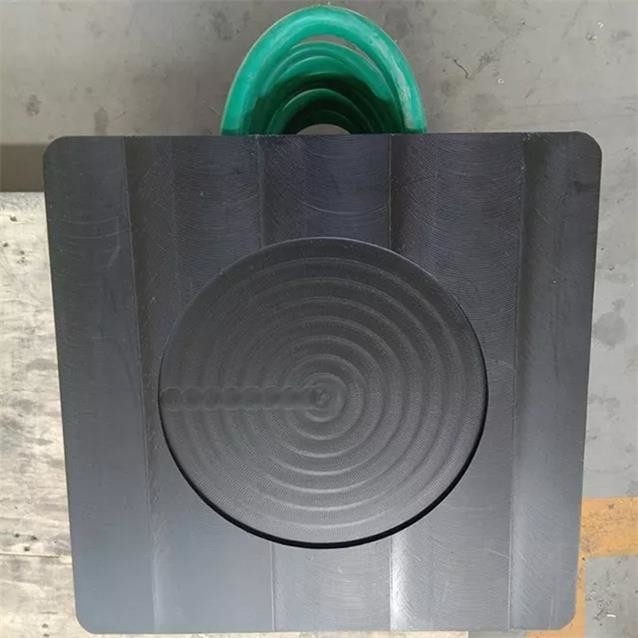
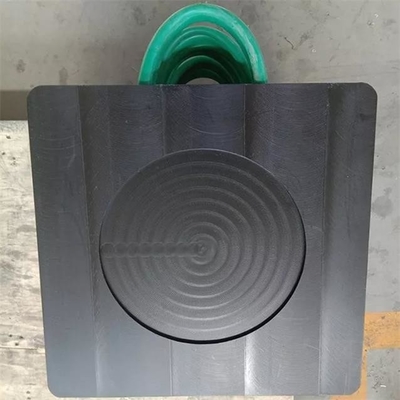
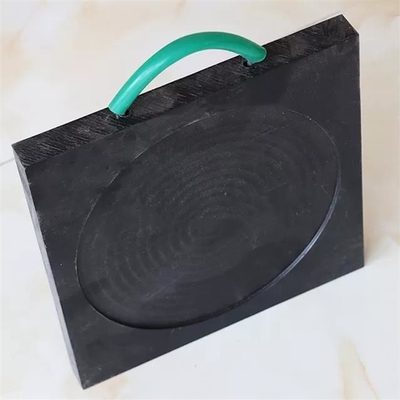
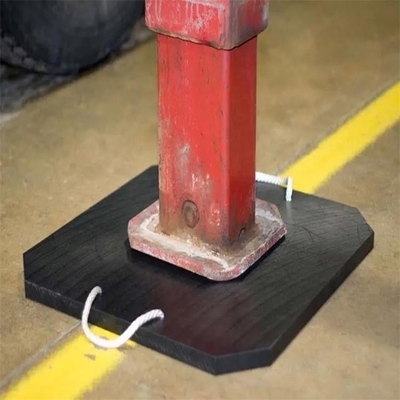
| Face and edge condition | Safety texturing on the contact face, radiused edges and corners, safety handles |
| Processing service | Cutting, moulding, CNC |
| Certification recorded | ISO9001 (quality management system) |
| Place of origin | China |
| Minimum order quantity | 100 pieces |
| Price basis | Negotiable |
| Payment terms | T/T, Western Union |
| Supply ability | 50,000 pieces per month |
| Delivery time | 15-20 days after deposit received |
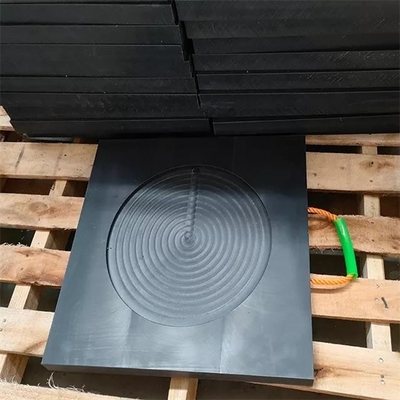
| Packaging | Wooden crate of pallet |
The attribute record registers three sizes as the offer this listing is built around. The specification table inside the same source description prints a wider ladder of sizes with a load capacity and a load spread area against each one. That wider ladder is reproduced below as recorded reference data, not as a claim that every rung is a stocked item; only the three attribute sizes are confirmed by the authoritative record. The same description also prints a delivery figure that is shorter than the attribute delivery window, and the attribute value of 15-20 days after deposit is the one used throughout this page.
| Configuration status | Size | How it is recorded |
|---|---|---|
| Attribute-confirmed | 400 x 400 x 40 mm | Named in the attribute Size field |
| Attribute-confirmed | 500 x 500 x 50 mm | Named in the attribute Size field |
| Attribute-confirmed | 600 x 600 x 60 mm | Named in the attribute Size field |
| Extended, source table only | 300 x 300 x 30 mm | Load reference table in the source description |
| Extended, source table only | 800 x 800 x 80 mm | Load reference table in the source description |
| Extended, source table only | 1000 x 1000 x 100 mm | Load reference table in the source description |
| Extended, source table only | 1200 x 1200 x 100 mm | Load reference table in the source description |
| Extended, source table only | 1500 x 1500 x 100 mm | Load reference table in the source description |
| Quotation-dependent | Any size inside the 30-100 mm thickness band | Cutting and moulding are recorded processing services; a size outside the three attribute values is quoted per order |
Size notation is written length x width x thickness in millimetres, exactly as the source data records it.
The figures in the next table are the ones printed in this listing's source description against each size. They are the basis a buyer should quote back when asking for a pad sized to a particular crane, and they explain why the ladder steps in two directions at once: both the footprint and the thickness grow as the load figure grows.
| Size (mm) | Recorded load capacity | Recorded load spread area | Reading of the recorded pair |
|---|---|---|---|
| 300 x 300 x 30 | 5 Ton | 0.09 m2 | Smallest recorded pad; the footprint is the binding limit, not the thickness |
| 400 x 400 x 40 | 10 Ton | 0.16 m2 | Attribute-confirmed size; one step up in both footprint and section |
| 500 x 500 x 50 | 18 Ton | 0.25 m2 | Attribute-confirmed size; middle of the recorded offer |
| 600 x 600 x 60 | 25 Ton | 0.36 m2 | Attribute-confirmed size; largest of the three standard values |
| 800 x 800 x 80 | 35 Ton | 0.64 m2 | Footprint roughly doubles against the 600 mm pad |
| 1000 x 1000 x 100 | 80 Ton | 1.00 m2 | Full square metre of bearing area at the top of the thickness band |
| 1200 x 1200 x 100 | 160 Ton | 1.44 m2 | Thickness held at 100 mm while footprint grows |
| 1500 x 1500 x 100 | 200 Ton | 2.25 m2 | Largest recorded pad; handling and transport become the practical constraint |
Load capacity and load spread area are transcribed from this listing's source description table unchanged. They describe the pad itself and do not account for the bearing capacity of the ground beneath it.

Section 2
The pad is a solid polyethylene block, not an assembly: PE virgin 100% consolidated by moulding, then cut and finished by CNC where the listing's processing service calls for it. Everything the construction does for a crane leg follows from three recorded things - the plan area, the thickness band of 30 mm to 100 mm, and the radiused, textured, handle-fitted geometry of the block itself.
An outrigger foot arrives on the ground as a small, hard contact patch. The pad's job is to carry that patch and hand it to the ground over its own plan area. The recorded pairs in the reference table above show the arithmetic the construction is built on: at 400 x 400 mm the pad presents 0.16 m2 and is recorded at 10 Ton, while at 600 x 600 mm it presents 0.36 m2 and is recorded at 25 Ton. Growing the footprint lowers the pressure the pad passes into the subgrade, which is the mechanism that keeps a leg from punching through soil, asphalt or concrete.
Thickness is the second half of the same mechanism. A 40 mm section at 400 x 400 mm and a 100 mm section at 1000 x 1000 mm are not interchangeable even where the plan area is similar, because the thicker section spreads the concentrated foot load through more material before it reaches the underside. This is why the recorded ladder raises thickness and footprint together rather than one at a time.
The listing records tensile strength across 81 MPa to 130 MPa. That band describes the polyethylene the block is moulded from; it is a material property, not a working load, and it does not replace the load capacity figures printed against each size. Its practical meaning for the construction is that the block can be drilled, slotted and machined at the handle and lifting points without the material itself becoming the weak element in the pad.
Three geometric features are recorded on this pad and each has a construction reason. Safety texturing on the face raises the friction between the pad and both the foot above it and the ground below it, which limits the lateral creep that a slightly inclined leg induces. Radiused edges and corners remove the sharp arris that would otherwise spall when the pad is dragged or dropped, and they stop the corner digging into a soft surface under load. Safety handles are moulded or cut into the block so that a two-person lift is possible without gripping the load-bearing face.
Because the block is solid polyethylene rather than a timber crib, the construction is also recorded as corrosion, moisture and chemical resistant, and as working in sub-zero temperatures. Those are the properties that let the same pad stay in service across wet ground and freezing conditions without the rot and delamination that end the life of a wood based pad.
Section 3
The recorded application field puts this pad under mobile cranes, aerial lifts, digger derricks, concrete pumpers and boom trucks, and the source description adds fire engines and tree shears to the same list. In every one of those cases the pad sits between a deployed leg and the ground. The boundaries below follow from the recorded size ladder and from what the pad can and cannot do.
The pad spreads load; it does not create bearing capacity. A 25 Ton pad on 0.36 m2 still fails if the ground under it cannot carry the resulting pressure, and a 200 Ton pad on a soft shoulder will simply sink as a unit. Before a pad size is chosen, the ground condition at each leg position is the first thing to establish, and the recorded load capacity should be read as the pad's own figure rather than as a site allowance.
The recorded size ladder makes the practical point: the two largest pads, at 1200 x 1200 mm and 1500 x 1500 mm, spread 1.44 m2 and 2.25 m2 respectively. On a confined carriageway or a finished surface those footprints may not be available at all, which is a siting constraint before it is a strength question.
Stacking two pads is a common field habit and it changes the load path. Every extra interface is a plane where the upper pad can slide against the lower one, and the recorded face texturing helps at that interface but does not eliminate it. If a stack is used, the pads should be aligned so that no edge overhangs, and the load figure should be treated as belonging to the stack as a whole rather than to each pad. The same applies to edge distance: a leg placed close to a pad edge loads the material with very little surrounding section, and the radiused corners give no extra bearing area at that point.
The recorded safety handles are the intended lifting point. A pad at the top of the recorded ladder is a large solid block and should be moved with equipment rather than by the handles alone. Storage flat, off the ground and out of standing water keeps the faces clean, and because the material is recorded as moisture and chemical resistant, a wet pad does not need drying before it goes back under a leg.
Cutting, moulding and CNC are recorded processing services, so a size that is not on the ladder is made rather than improvised on site. A pad cut down on site loses its radiused edge and its handle geometry, and the cut face is no longer the finished face the construction was built around.
Confirm that the pad under each leg matches the size printed on the quotation, that the textured face is facing the ground contact and the foot contact as intended, that no handle cut-out has cracked through to the load face, and that the ground under each pad is level enough that the pad sits fully rather than on one corner. A pad bearing on a corner behaves as a much smaller pad.
Section 4
Tangyin Taixing Engineering Plastics Co., Ltd. is the manufacturer of this pad. The company describes itself as an engineering plastics manufacturer combining production, sales, design and processing, with more than 20 years of experience, a plant area of over 25,000 square metres and an annual output of over 8,000 tons. Its stated product range covers UHMWPE board, synthetic ice rink, PE marine fender, outrigger pad, UHMWPE liner, plastic conveyor roller, UHMWPE special-shaped parts, HDPE sheet, HDPE ground protection mat and dual colour HDPE sheet, so the outrigger pad is a catalogue line rather than an outsourced item.
The listed equipment includes an imported production line, a moulding press machine, a CNC precise finishing machine, a carving machine, a sander machine, CNC machining centres and AutoCAD based design support. For this pad the sequence is direct: the moulding press consolidates the PE virgin 100% block, and the CNC precise finishing machine and machining centres produce the squareness, the radiused edges and corners and the safety handle cut-outs. The sander is the station that would dress a face, and the recorded safety texturing is a moulded or machined feature rather than a coating.
The in-house laboratory is recorded as holding an abrasion tester, a universal mechanical tester and an oxygen index tester. The universal mechanical tester is the instrument that speaks to the recorded tensile band of 81 MPa to 130 MPa on the incoming material; the abrasion tester speaks to the wear a pad sees when it is dragged across abrasive ground.
The certification recorded for this product is ISO9001. It is a quality management system certification covering the manufacture of polyethylene sheet and machined plastic products. It is not a product-by-product approval and it is not a material test report; no certificate number, issuing body or scope statement beyond that is recorded for this listing, and none should be assumed.
The site's company profile and footer additionally name Beijing Silk Road Enterprise Management Services Co. as the export-management entity operating the same engineering-plastics business. The two names describe one manufacturing and export organisation, not two factories.
Minimum order quantity is 100 pieces, price is negotiable, payment is by T/T or Western Union, supply ability is 50,000 pieces per month and delivery is 15-20 days after deposit is received, packed in a wooden crate on a pallet. Read together, those four values describe a supplier set up for repeat fleet orders rather than single-unit purchases: 100 pieces is a small share of a 50,000 piece monthly capacity, so the binding constraint on a first order is the 15-20 day production and packing window after the deposit clears, not capacity. The wooden crate on a pallet is the right packing for a heavy solid block and should be kept intact until the pads reach the point of use.
Company background is published on the site's company profile page.
Section 5
On the model PE Outrigger Pad supplied by Tangyin Taixing Engineering Plastics Co., Ltd. the 400 x 400 mm size is recorded with a load capacity of 10 Ton and a load spread area of 0.16 m2. A deployed outrigger foot contacts the ground over a patch much smaller than the pad, so the pad converts that small contact into a bearing area of 0.16 m2 before the load reaches the subgrade. The 40 mm section is what carries the concentrated foot load through the block to that wider underside.
The limit is not the pad's own figure but the ground under it. If the 0.16 m2 footprint cannot be fully loaded because the shoulder is soft, the pad sinks as a unit and the recorded capacity is never reached. That is why the recorded ladder raises footprint and thickness together: stepping to the 500 x 500 x 50 mm size moves the spread area to 0.25 m2 and the recorded figure to 18 Ton, and stepping to 600 x 600 x 60 mm moves them to 0.36 m2 and 25 Ton.
All three features are recorded on this model PE Outrigger Pad from Tangyin Taixing Engineering Plastics Co., Ltd., and each answers a different site problem. The radiused edges and corners remove the sharp arris that spalls when a solid polyethylene block is dragged across concrete or dropped from a truck bed; a squared corner would chip and the chip would become a crack origin. The safety texturing raises friction at both interfaces, between the pad and the foot above and between the pad and the ground below, which limits the lateral creep a slightly inclined leg induces.
The safety handles exist because the pad is a solid block. Even the attribute-confirmed 400 x 400 x 40 mm size is a heavy lift, and the recorded larger sizes at 1000 x 1000 x 100 mm and above are beyond manual handling altogether. The handles give a defined grip point so that lifting slings and hands do not load the bearing faces.
Stacking the PE Outrigger Pad from Tangyin Taixing Engineering Plastics Co., Ltd. is possible, but it changes the load path, and the recorded load capacity should then be treated as belonging to the stack rather than to each pad. Every added pad adds an interface plane where the upper block can slide on the lower one. The recorded face texturing helps at that plane, but it does not turn two pads into one continuous section.
If a stack is used on the model PE Outrigger Pad, align the pads so no edge overhangs and keep the stack on level ground so both pads sit fully. A stack that bears on one corner behaves as a much smaller pad than its recorded 0.16 m2 or 0.36 m2 spread area suggests. Where the load genuinely needs a bigger pad, the recorded size ladder is the correct route rather than a taller stack.
That band is a material property of the polyethylene the model PE Outrigger Pad from Tangyin Taixing Engineering Plastics Co., Ltd. is moulded from. It tells a buyer that the block can be drilled, slotted and machined at the handle and lifting points without the material becoming the weak element, and it is the figure the in-house universal mechanical tester is set up to check on incoming material.
It is not a working load and it does not replace the load capacity printed against each size. A 400 x 400 x 40 mm pad is recorded at 10 Ton and a 600 x 600 x 60 mm pad at 25 Ton on the same material; the difference comes from footprint and section, not from the tensile band. Using the tensile figure as a load rating would overstate what the pad does.
The recorded minimum order quantity for this model PE Outrigger Pad from Tangyin Taixing Engineering Plastics Co., Ltd. is 100 pieces, and the recorded supply ability is 50,000 pieces per month. The gap between those two numbers is the useful part: a first order at the minimum is a very small share of a month's capacity, so a buyer can place a mixed order across the three attribute-confirmed sizes without approaching any capacity limit.
Price is recorded as negotiable, so the 100 piece quantity is the floor for a quotation rather than a fixed price break. A buyer planning a fleet rollout across several vehicles should state the size split at enquiry stage, because the pad is packed in a wooden crate on a pallet and the crate layout depends on how the sizes are mixed.
The attribute record for this model PE Outrigger Pad from Tangyin Taixing Engineering Plastics Co., Ltd. states 15-20 days after deposit received, and the attribute record governs. The shorter figure in the source description's question and answer text is inconsistent with the recorded commercial terms and is not used on this page. A purchase plan should be built on 15-20 days after the deposit clears, not on the shorter number.
That window covers production and packing into the recorded wooden crate on a pallet, and it starts when the deposit is received rather than when the enquiry is sent. Payment is by T/T or Western Union, so the deposit timing is under the buyer's control and is the practical lever on when the 15-20 day clock starts.
The recorded packaging for this model PE Outrigger Pad from Tangyin Taixing Engineering Plastics Co., Ltd. is a wooden crate on a pallet. For a solid polyethylene block that packing is mainly about handling and surface protection rather than moisture, because the material is recorded as moisture and chemical resistant and a wet pad does not need drying before use. The crate is what keeps the radiused edges and the textured faces from being damaged in transit and what allows the consignment to be moved by forklift.
On arrival, check that the crate count matches the packing list, that the pads inside match the ordered size split, and that the textured face and the handle cut-outs are intact on every piece. A pad with a cracked handle cut-out should be rejected before it goes into service, because the crack sits in the same block that carries the leg load.
The recorded colour options for this model PE Outrigger Pad from Tangyin Taixing Engineering Plastics Co., Ltd. are yellow, black and customized. On a pad that lives in the back of a truck or on a site compound, colour is a visibility and identification feature first: a yellow pad under a leg is easier to see at dusk and easier to account for at the end of a shift, while a black pad shows ground contact marking less.
Colour does not change the recorded load capacity, thickness band or tensile band, and it is not recorded as a UV rating or a weathering class, so no service life should be inferred from it. A customized colour is quoted with the order and does not alter the 100 piece minimum order quantity or the 15-20 day delivery window.
Section 6
Contact Person: Mr. Sales
Tel: +86 152 1104 0646


 English