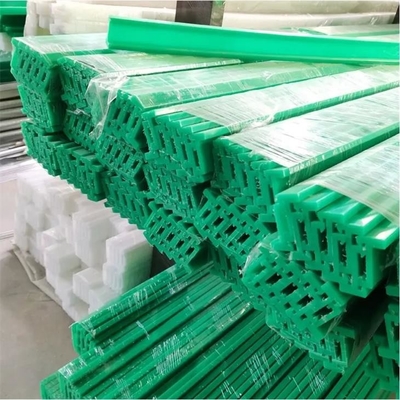

|
Product Details:
|
| Item:: | Conveyor Plastic UHMWPE Chain Guide Track Rail | Material: | PE Virgin 100% |
|---|---|---|---|
| Color:: | White,Green,Blue Customized | Size: | Customized |
| Thickness:: | 6-200mm | Feature: | Wear Resistance |
| Application:: | Corrosion-resistant And Wear-resistant Mechanical Parts | ||
| Highlight: | UHMWPE Linear Guide Rail,Polyethylene Linear Guide Rail,Polyethylene Conveyor Chain Guides |
||
Recorded attributes for this machined rail
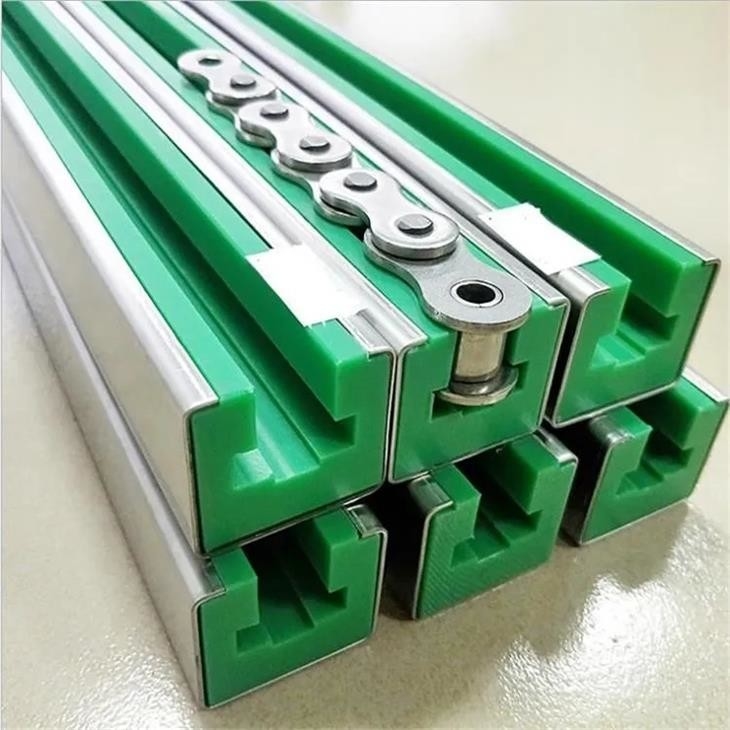
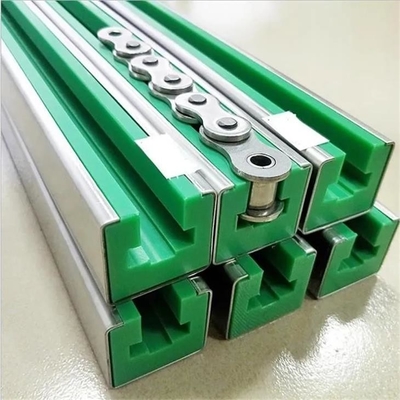
The UHMWPE Linear Guide Rail from Tangyin Taixing Engineering Plastics Co., Ltd. is a machined polyethylene profile for conveyor and machine wear duty, made from 100 percent virgin PE in white, green or blue, produced to a buyer size from stock thickness between 6 mm and 200 mm, and listed for corrosion-resistant and wear-resistant mechanical parts.
| Attribute | Recorded value |
|---|---|
| Product | Conveyor plastic chain guide track rail, machined wear profile |
| Material | PE virgin 100% |
| Colour | White, green, blue, customized |
| Size | Customized |
| Thickness | 6-200 mm |
| Recorded feature | Wear resistance |
| Application | Corrosion-resistant and wear-resistant mechanical parts |
| Impact strength | 140 kJ/m2 and above |
| Compressive strength | 30 MPa and above |
| Ball indentation hardness | 20 N/mm2 and above |
| Abrasion loss | 3.8 x 10⁻⁴ g/cm2 |
| Heat distortion temperature | 85 deg C |
| Water absorption | Less than 0.01% |
| Certification | ISO9001, quality management system |
| Place of origin | China |
| Minimum order | 100 kilograms |
| Price basis | Negotiable |
| Payment terms | T/T, Western Union |
| Supply ability | 500000 kilograms per month |
| Delivery | 15-20 days after deposit received |
| Packaging | Wooden crate or pallet |
The description's own specification table opens with the product name High Density Polyethylene Plastic HDPE Sheet and gives the material as UHMWPE/HDPE, which does not describe a machined rail. The attribute record governs: material is PE virgin 100 percent, size is customized, thickness is 6-200 mm. The description's mechanical rows are kept because they characterise the polyethylene the rail is machined from, but the sheet product name in that table is not carried onto this page.
| Variable | Recorded position | What the buyer must supply |
|---|---|---|
| Cross-section | Customized | A section drawing with the chain or belt groove and the fixing face |
| Length | Customized | The run length and the number of joints along the line |
| Thickness of stock | 6-200 mm | The section height, which decides the smallest stock thickness that can produce it |
| Hole pattern | Customized | Hole positions, slot direction and countersink or washer face |
| Colour | White, green, blue, customized | The colour code used on the machine for that rail position |
There is no standard catalogue section behind this page, and that is the point of the listing. Two rails with the same model string can have entirely different cross-sections, so the drawing is the specification and the quotation is written against it.
Machining the profile, the groove and the fixing slots
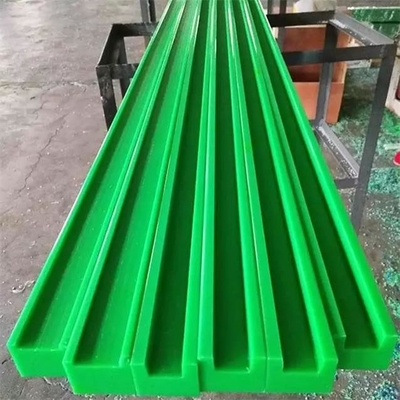
The UHMWPE Linear Guide Rail made by Tangyin Taixing Engineering Plastics Co., Ltd. starts as polyethylene stock between 6 mm and 200 mm thick and becomes a finished wear profile through machining. The section is routed or milled from the solid, which means the groove that carries a chain, a belt edge or a moving carriage is cut into the material rather than assembled from strips, and the fixing face is machined flat in the same set-up so that the rail seats on its support without rocking.
Machining from solid has one important consequence for the buyer: the section must fit inside the stock thickness. A rail whose finished height is close to the ordered thickness leaves no room for holding the part during machining or for removing the saw marks from the back face, so the stock thickness is normally chosen above the finished section height. The 6-200 mm range on this listing is the stock range, not a range of finished rail heights.
| Feature | How it is produced | What the buyer should control on the drawing |
|---|---|---|
| Sliding groove | Machined into the solid section | Groove width, depth and side wall angle, with the radius at the root |
| Fixing face | Machined flat and parallel to the running face | Which face is the datum and how flat it has to be |
| Holes and slots | Drilled or milled through the section | Position along the rail, slot direction and length for movement |
| Ends | Sawn or milled square | Whether ends butt to a neighbour or run out at the machine frame |
| Edges | Broken by machining or sanding | Any radius that stops a chain link or a carriage catching the edge |

The groove is the working surface, and its root radius is the detail that decides how long the rail lasts. A square internal corner at the bottom of a groove concentrates stress exactly where the chain load is highest, and in a material with a recorded impact strength of 140 kJ/m2 and above the failure mode is still a slow crack rather than a ductile yield. A radius at the root spreads that load, and it costs nothing at the drawing stage.
Fixing detail follows the application. A rail bolted rigidly at every hole with no allowance for movement will develop a wave along its length as the machine warms toward the recorded 85 deg C heat distortion temperature, because the rail grows against its fasteners and has nowhere to go. Slotted holes at intervals let the rail slide under its washers while the fixed holes hold position, which keeps the groove line straight instead of letting it buckle between fixings.
Because the material is self-lubricating and has a very low sliding resistance, the rail does not need a separate lubricant film to work, and the description records self-lubricating performance and a very low water absorption. That is useful on a conveyor that sees washdown or dust, but it also means the rail will not hold a grease layer in its groove; the wear face runs dry against the chain, and the groove geometry rather than lubrication is what controls the wear rate.
Where a plastic wear rail belongs on a machine
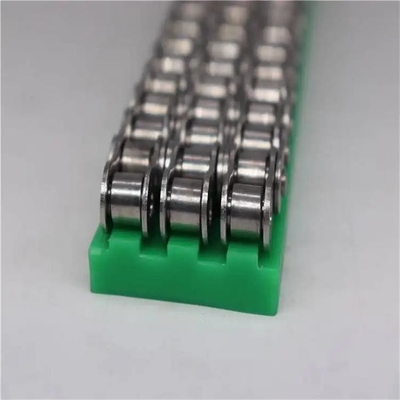
The recorded application for the UHMWPE Linear Guide Rail is corrosion-resistant and wear-resistant mechanical parts, and the description frames it as a conveyor chain guide track. In practice that means a rail that guides a moving chain, carries the edge of a belt, or provides a low-friction bearing surface for a carriage, in a machine where the rail is supported continuously along its length. Corrosion resistance and the very low water absorption make it a natural fit for wet, washed or chemically exposed machinery where a steel wear strip would rust and gall.
The boundary is support and load. The rail is a wear part, and it is at its best when the load passes through it into a continuous support below; it is not recorded as a structural beam, a cantilever, or a bridge across an unsupported span, and the recorded compressive strength of 30 MPa and above describes the material's resistance to local bearing, not its ability to span a gap. A rail that has to carry a load between two widely spaced fixings needs a backing bar, and the plastic should be treated as the sliding skin on that bar.
Temperature is the other boundary. The recorded heat distortion temperature is 85 deg C, which is a material property measured on the polymer and not a service limit for a loaded rail; a machine that runs hot has to be assessed against the temperature at the rail, with the fixing detail able to accommodate the movement that comes with it. No thermal expansion coefficient is recorded for this listing, so no expansion allowance is quoted here, and the slot length should be set from the machine's own measured growth rather than from a table.
Mount on a flat, clean support. A rail pulled down onto a support with a high spot will bow, and a bowed rail wears first at the ends of the bow. Check the support straightness before the rail is offered up, and check the rail for straightness on a flat bench before installation, since a long machined profile can take a set in storage.
Start at one end and work along the run, engaging the slots before final tightening so that each fastener has room to slide. Check the groove line with a straight edge or a tensioned line over the full length, because the groove is what the chain follows and a rail that is straight at each fixing but wavy between them will wear the chain rather than guide it.
Where two rails meet end to end, the joint should be tight and the two grooves aligned. A step at a rail joint is an impact point for every chain link that passes, and the recorded impact strength will absorb it for a while before the edge spalls.
Confirm the section drawing shows the datum face and the groove root radius. Confirm the stock thickness can produce the section with material left for machining. Confirm the slot direction runs along the rail and not across it. Confirm the end condition at both ends, since a rail that runs into a machine frame needs a different end than one that butts to a neighbour. Confirm the colour, because white, green and blue are all recorded and the colour is often how a maintenance fitter identifies a rail position.
Machining capacity behind a customized profile
Tangyin Taixing Engineering Plastics Co., Ltd. is an engineering plastics manufacturer combining production, sales, design and processing, with more than 20 years of experience, more than 25,000 square meters of plant and an annual output above 8,000 tons. The equipment list covers an imported production line, a moulding press machine, CNC precise finishing machines, a carving machine, a sander machine and CNC machining centres, with AutoCAD based design support for buyer drawings. The export-management name Beijing Silk Road Enterprise Management Services Co. is recorded alongside the company for the same engineering plastics business; it is a second recorded name for one manufacturing and export organisation, not a second factory.
This rail is a machining product from start to finish. The sheet is formed on the line and press, the section is cut on the CNC machining centres and precise finishing machines, and the sanding equipment is available where an edge or a groove needs a smoother finish than a cutter leaves. Because size is customized on this listing, the design support is part of the production route: the drawing has to be read into a section, a stock thickness and a machining sequence before a single rail is cut.
The in-house laboratory holds an abrasion tester, a universal mechanical tester and an oxygen index tester, which support the company's general material work. No test report for this listing is recorded, so no instrument is presented as certifying a delivered rail. The quality management certification recorded is ISO9001, a system certification covering the manufacture of polyethylene sheet and machined plastic products; it is not a product-by-product approval and not a material test report.
| Recorded term | What it changes in a purchase plan |
|---|---|
| 100 kilograms minimum | A rail is a dense machined part, so 100 kg is a short run of profile; a single machine rebuild can usually reach it without ordering surplus. |
| 500000 kilograms per month | Capacity is effectively open for a conveyor line refit; the limit is machining time on the custom section, not material supply. |
| 15-20 days after deposit | Production time for a custom section; the drawing has to be approved before the clock is useful, because machining cannot start on an unapproved profile. |
| Wooden crate or pallet | Long machined rails are supported along their length rather than bundled loose, which is what protects the groove from transit damage. |
| T/T or Western Union | Both recorded; the deposit and balance split is agreed on the quotation. |
| Price negotiable | Quoted on the section drawing, the stock thickness and the run length, so a per-metre figure only exists once the profile is fixed. |
The 100 kg minimum is best read as a production threshold rather than a stock boundary. On a customized section, the setup cost sits in the machining programme, so a run that clears the minimum in one release is cheaper per metre than the same total quantity split into two orders.
Questions from conveyor and machine builders
Because size is recorded as customized, the drawing is the specification. A usable drawing shows the cross-section with the groove width, depth and root radius, the overall section height against the 6-200 mm stock range, the run length, the fixing hole and slot positions, and the datum face that has to sit on the support.
A sketch with dimensions is enough to start, and the UHMWPE Linear Guide Rail from Tangyin Taixing Engineering Plastics Co., Ltd. can be quoted from it. What cannot be quoted is a rail described only as a guide for a certain chain, because the groove geometry and the stock thickness that produces it are the two variables that set the machining time.
No tolerance is recorded for this listing, so none is quoted here. What can be said is that the profile is machined on CNC equipment, and that a machined polyethylene section behaves differently from a metal one: it will spring back slightly after the cutter passes and it will move after machining as the cut faces relax.
The practical answer is to put the tolerance on the drawing and let it be confirmed for the UHMWPE Linear Guide Rail from Tangyin Taixing Engineering Plastics Co., Ltd. before production. A groove tolerance that is tighter than the material can hold will be quoted as a rejection risk, while a realistic one can be met by taking a finishing pass after the section has stabilised.
Fix the rail at one or more reference holes and let the remaining fasteners sit in slots that run along the rail, so the profile can slide under its washers as it grows. The recorded heat distortion temperature of 85 deg C tells you the material softens at the upper end of its range, but it does not tell you how much the rail will grow, because no expansion coefficient is recorded for this listing.
Set the slot length from the measured temperature rise at the rail on the actual machine, not from a catalogue figure. On the UHMWPE Linear Guide Rail from Tangyin Taixing Engineering Plastics Co., Ltd. a slot that is too short converts the growth into a wave between fixings, and a wave in the groove is what wears a chain.
Replacement is driven by groove depth, not by calendar time. The recorded abrasion loss of 3.8 x 10⁻⁴ g/cm2 describes how the material behaves under an abrasion test; what matters on a machine is how much of the groove wall has been removed, because once the chain starts bearing on the groove root the rail has stopped guiding and started carrying.
The measurable check is a depth reading across the groove at a fixed reference point, taken when the rail is new and repeated at service intervals. On the UHMWPE Linear Guide Rail from Tangyin Taixing Engineering Plastics Co., Ltd., that reading also shows whether wear is even along the run, which points to a support or alignment problem rather than to the material.
White, green, blue and customized colours are recorded for this listing. Colour is a pigment choice and no colour-dependent performance figure is recorded, so the section geometry and the stock thickness remain the variables that control wear.
The useful reason to choose a colour is identification. A white UHMWPE Linear Guide Rail from Tangyin Taixing Engineering Plastics Co., Ltd. shows dark wear debris and metal transfer clearly, while a green or blue rail distinguishes one rail position from another on a machine with several guide lines.
One hundred kilograms is a short production run of machined profile, which suits a single machine rebuild or a spare set. Because the rail is customized, the minimum is really about amortising the machining setup rather than about filling a container, and a run that clears it in one release is the cheapest way to buy.
The recorded monthly supply ability of 500000 kilograms is far beyond any single conveyor refit, so the UHMWPE Linear Guide Rail from Tangyin Taixing Engineering Plastics Co., Ltd. is not capacity limited. What limits a programme is machining time on each distinct section, which is why several different profiles in one order should be scheduled together.
Packaging is recorded as wooden crate or pallet. For a long machined profile the important part is support along the length: a rail that is bundled and allowed to sag will take a permanent set, and a set rail cannot be straightened on site without machining the groove again.
On receipt, the UHMWPE Linear Guide Rail from Tangyin Taixing Engineering Plastics Co., Ltd. should be checked on a flat surface before installation, with the groove line inspected along its full length. Transit damage on a rail usually shows as a polished or bruised edge where it has rubbed against its neighbour, which is exactly where a chain will catch.
The clock runs from deposit received, and machining cannot start until the section drawing is approved. If design work is still open when the deposit is paid, the delivery date for the UHMWPE Linear Guide Rail moves with the drawing approval rather than with the payment.
The clean sequence is drawing approval, then deposit, then machining. Tangyin Taixing Engineering Plastics Co., Ltd. offers AutoCAD based design support, so the profile can be settled before the deposit if the machine dimensions are supplied early enough.
Incoming checks for a machined profile
Contact Person: Mr. Sales
Tel: +86 152 1104 0646


 English