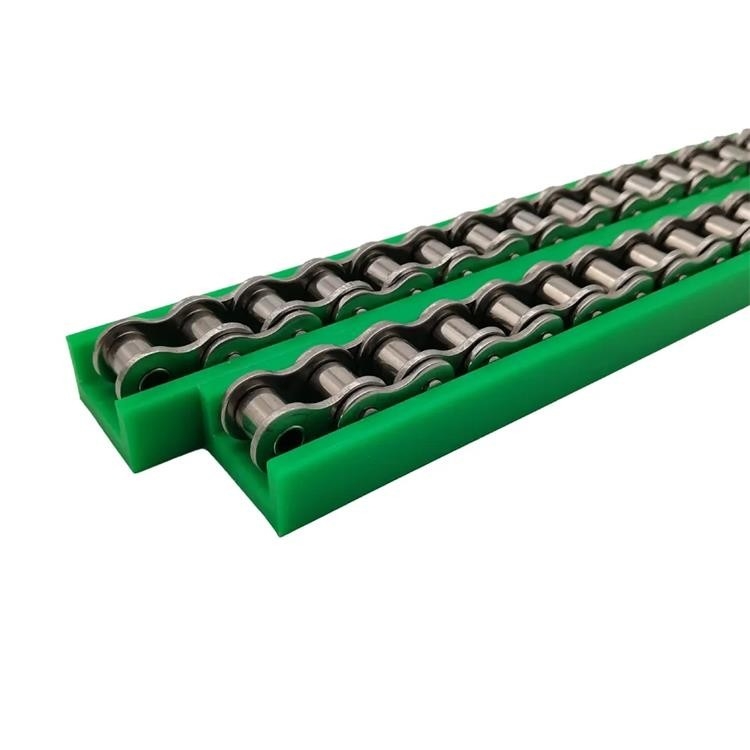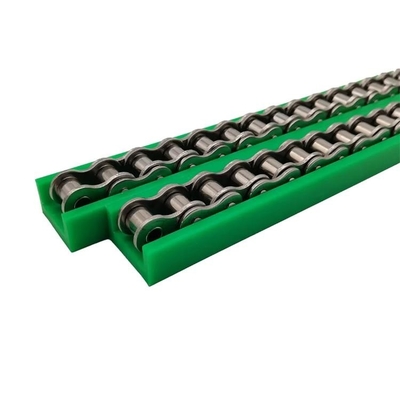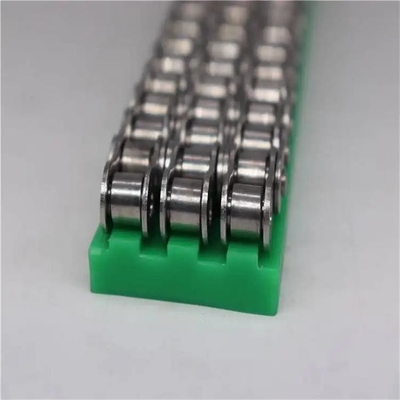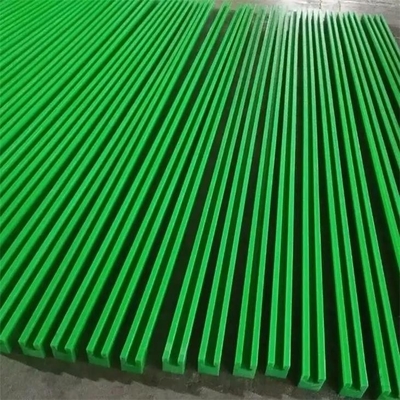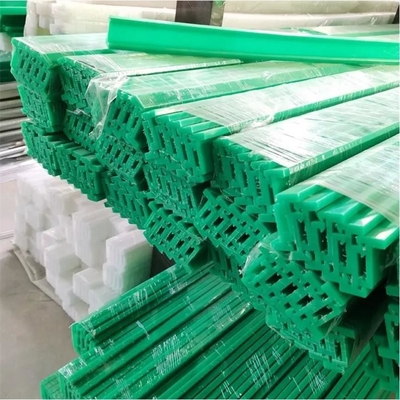

|
Product Details:
|
| Item:: | Conveyor Plastic UHMWPE Chain Guide Track Rail | Material: | PE Virgin 100% |
|---|---|---|---|
| Color:: | White,Green,Blue Customized | Size: | Customized |
| Thickness:: | 6-200mm | Feature: | Wear Resistance |
| Application:: | Corrosion-resistant And Wear-resistant Mechanical Parts | ||
| Highlight: | UHMWPE Plastic Chain Guide Track Rail,UHMWPE Linear Guide Rail,Polyethylene Conveyor Linear Guide Rail |
||
Recorded specification
This listing is the conveyor chain guide track rail supplied by Tangyin Taixing Engineering Plastics Co., Ltd. under the model Plastic UHMWPE Chain Guide Track Rail, machined from 100 percent virgin polyethylene feedstock, in white, green and blue with a customized colour route, with the size field recorded only as customized and the thickness field recorded as 6 mm to 200 mm.
The source description on the same page contradicts this part in two places and neither contradiction was carried into the page. Its specification table names the product as a high density polyethylene plastic sheet and answers the size question with a line about cutting sheet into small pieces, which describes a sheet listing rather than a machined rail; and it lists both UHMWPE and HDPE as the material although the attribute record gives one feedstock, 100 percent virgin PE. The attribute record governs both points, the rail is treated as a machined part made to a drawing, and the table's property figures are not restated as values for this rail because they belong to that sheet.
| Attribute | Value recorded for this listing |
|---|---|
| Manufacturer | Tangyin Taixing Engineering Plastics Co., Ltd. |
| Model number | Plastic UHMWPE Chain Guide Track Rail |
| Item description | Conveyor plastic UHMWPE chain guide track rail |
| Material | PE virgin 100 percent |
| Colour | White, green, blue, customized |
| Size | Customized, made to the buyer's profile drawing |
| Thickness | 6 mm to 200 mm |
| Feature field | Wear resistance |
| Application field | Corrosion-resistant and wear-resistant mechanical parts |
| Certification | ISO9001 quality management system |
| Place of origin | China |
| Minimum order quantity | 100 kilograms |
| Price basis | Negotiable |
| Payment terms | T/T, Western Union |
| Supply ability | 500000 kilograms per month |
| Delivery time | 15-20 days after deposit received |
| Packaging | Wooden crate or pallet |
A customized size field is not a specification; it is an instruction to send one. For this part the drawing is the specification, and the table below sets out the five inputs that turn the model Plastic UHMWPE Chain Guide Track Rail into a quotable item. Anything left off the drawing becomes a shop decision, and a shop decision is the most common reason two batches of the same rail do not interchange.
| Input required | Recorded basis on this listing | What happens if it is missing |
|---|---|---|
| Cross-section profile | Size recorded as customized | The groove width, land width and rail height are guessed, and the chain either binds or sits loose |
| Blank thickness | 6 mm to 200 mm | The rail is machined from whatever slab is on the press, and the section depth changes from batch to batch |
| Length per piece and total run | Not recorded | Joints get placed at the machining stage rather than planned against the conveyor frame |
| Fixing hole pattern | Not recorded | Holes are added on site, which puts the hole position outside the machined tolerance |
| Colour | White, green, blue, customized | The batch is made in a stock colour and cannot be used where colour identifies a line or a duty |
No tolerance, no surface finish, no load rating and no wear rate is recorded for the model Plastic UHMWPE Chain Guide Track Rail, so none appears on this page; the values that do appear are the thickness band, the three colours and the commercial terms.
Construction
A chain guide rail is a machined polyethylene profile, not a bought-in extrusion. The model Plastic UHMWPE Chain Guide Track Rail from Tangyin Taixing Engineering Plastics Co., Ltd. starts as a pressed slab between 6 mm and 200 mm thick and is reduced to the profile the conveyor needs, which means the profile accuracy and the material accuracy come from two different stages of the same job.
Every feature of the rail has to fit inside the slab it is cut from. A rail with a deep groove and tall side walls needs a thick blank; a flat wear strip needs only a thin one. Because the recorded band is 6 mm to 200 mm, the same nominal rail can be machined from very different starting sections, and the buyer's drawing should state the section depth so that the blank is chosen to suit it rather than the profile being scaled down to fit whatever slab is available.
Blank thickness also decides how the rail behaves in service. A thin section follows the conveyor frame and accommodates a small misalignment; a deep section holds its own line and resists the sideways thrust of a chain under tension. That is a design choice that has to be made on the drawing, because it cannot be corrected after machining.
The rail guides by presenting a groove or a ridge to the chain, and the fit between the two is the whole function of the part. Too tight and the chain wears the groove faces and runs hot; too loose and the chain lifts, tilts and wears the top of the rail instead of the flanks. The recorded material is a virgin polyethylene chosen for wear resistance, so the rail is intended to be the sacrificial element: it should wear before the chain does, and it should be replaceable.
That intent fixes the machining priority. The groove width and the flank angle are the two dimensions that matter most, the base and the fixing face matter next, and the outside of the rail matters least because nothing runs on it. A drawing that dimensions the outside carefully and the groove loosely has its priorities inverted.
| Machining stage | Recorded basis | What it decides on the finished rail |
|---|---|---|
| Slab pressing | Virgin PE, 6 mm to 200 mm | The thickness the profile is cut from, and how much material is left around the groove |
| Profile machining | Customized size, machined to drawing | Groove width, flank angle and rail height, which together set the sliding fit |
| Hole and counterbore work | No hole pattern recorded | Whether the fastener head sits below the running face or stands proud in the chain path |
| Edge finishing | No edge finish recorded | Whether the rail end is a clean butt or a burr that catches the chain at every pass |
| Batch repeatability | Same drawing, same thickness band | Whether a replacement rail drops into the frame without re-shimming the line |

A guide rail is consumed in service, so the drawing should carry a wear allowance: the groove is machined to the nominal chain fit and the rail has enough material around it that the groove can be re-cut or the rail flipped once before replacement. How much material that is depends on the section, which is why the 6 mm to 200 mm blank band is not a formality. No wear rate and no service life is recorded for this part, so the replacement point has to be set by the maintenance team from measured groove wear on the line, not from a figure on this page.
Where the rail is symmetrical, the cheapest wear allowance is a second running face: mount the rail one way, then invert it when the first face is worn. That only works if the profile and the fixing holes are symmetric, which is a drawing decision made at the quotation stage.
Rails arrive in lengths cut from the profile, and the joints between them are where a chain catches. A butt joint between two rails needs the ends cut square to each other, because a step of a fraction of a millimetre at the joint is felt by the chain at every pass and wears both the chain and the rail edge. A burr left on the running face does the same thing faster.
Long runs also need the joints staggered away from the highest-load point, which is usually where the chain is under tension rather than where it is slack. None of this is a material property; it is installation planning, and it has to be settled before the lengths are cut, because a rail cut to fit a frame at one end cannot be re-cut to fix a joint at the other.
Application boundaries and installation
The recorded application is corrosion-resistant and wear-resistant mechanical parts, and the description sets the working case more precisely: a guide that supports, fixes, guides and reduces the friction of a device in linear reciprocating motion, used where a chain or a carriage slides along a track. That is a sliding duty, and almost every boundary below follows from it.
It is the right element where a chain or a carriage has to be held on a line while it slides, where the load is carried on a broad face rather than on a point, where the environment is wet, dusty or chemically aggressive enough that a steel guide would corrode, and where noise is a nuisance worth removing. A polyethylene guide absorbs impact and damps vibration, which is why it is used at transfer points and at the ends of a run where a carriage strikes a stop.
It is also the right element where the guide is meant to be the wear item. Because the rail is machined from a solid slab and fixed with fasteners, it comes off and goes back on without disturbing the frame, which is the property that makes a wear guide economic over a long line.
The part is a sliding guide, not a rolling bearing: the description compares it favourably with linear bearings for rated load, but no load rating is recorded for this listing, so a rail carrying a calculated thrust has to be sized by the buyer's engineer from the actual bearing pressure and the section. No speed limit, no temperature range and no friction coefficient is recorded either, so a high-speed line or a hot process has to be put to Tangyin Taixing Engineering Plastics Co., Ltd. as a specific service condition rather than assumed.
No chemical compatibility list is recorded. The application field says the parts are corrosion resistant, which is a general statement and not a table of reagents; a conveyor carrying a salt, an acid or a solvent should name the medium in the enquiry. No UV rating is recorded, so an outdoor run in direct sun is outside the recorded basis.
First, check the frame before the rail: a guide machined to a good profile will still run badly on a frame that is twisted, because the rail follows the frame it is bolted to. Second, set the rail in position and check the chain fit by hand along the full length before any fastener is tightened, since tightening pulls a slightly stiff rail into line and hides a tight spot. Third, fix from the middle of the run outward so that the rail is not stretched between two fixed ends. Fourth, counterbore deep enough that no fastener head stands in the chain path. Fifth, leave the joint ends free until the neighbouring rail is set, then cut and fit the joint as a pair.
For a run that passes through a temperature change, leave the rail ends a working clearance at each joint rather than butting them hard; a rail that is trapped between two fixed ends buckles sideways and lifts off the frame, which shows up as a chain that jumps at one point on the line.
Confirm the groove width and flank angle against the actual chain, not against a catalogue figure. Confirm the section depth against the 6 mm to 200 mm blank band. Confirm the fixing hole pitch against the frame, since the frame exists and the drawing can be made to match it. Confirm the colour if the line uses colour to identify a duty. Confirm the delivery date against the shutdown, because 15-20 days after deposit is production time and a new profile needs a sample check before the run is released.
Manufacturer and supply position
Tangyin Taixing Engineering Plastics Co., Ltd. is an engineering plastics manufacturer combining production, sales, design and processing, with more than 20 years of experience, a plant area of more than 25,000 square meters and an annual output of more than 8,000 tons. Its stated range covers UHMWPE board, synthetic ice rink, PE marine fender, outrigger pad, UHMWPE liner, plastic conveyor roller, UHMWPE special-shaped parts, HDPE sheet, HDPE ground protection mat and dual colour HDPE sheet, and the special-shaped parts line is the one this rail belongs to.
The company profile and the site footer also name Beijing Silk Road Enterprise Management Services Co., which runs the same engineering-plastics business. That is one manufacturing and export organisation under two recorded names, not two plants, and the rail is machined in the same works as the sheet it is cut from.
The blank comes off the moulding press machine and the imported production line, which is what fixes the 6 mm to 200 mm section the profile is cut from. The profile itself is machined on the CNC machining centres and the carving machine, the ends and faces are finished on the CNC precise finishing machine and the sander machine, and the drawing is worked up with AutoCAD based design support. That sequence is why a customized size is a normal order for this part rather than an exception: the same equipment that makes a standard guide makes a new one, and the difference is the drawing and the setup.
The in-house laboratory lists an abrasion tester, a universal mechanical tester and an oxygen index tester. For a wear guide the abrasion tester is the relevant instrument, since wear is the duty the part is bought for, and the mechanical tester covers the strength questions a guide raises. No test result is recorded for this listing, so no figure is quoted; a buyer who needs wear data asks for it against the specific profile and batch.
The ISO9001 record on this listing is a quality management system certification covering the manufacture of polyethylene sheet and machined plastic products. It is a system certification and not a product approval for this rail, and it is not a material test report. No certificate number and no issuing body are recorded, so neither is stated here.
The minimum order quantity is 100 kilograms. A machined rail is a light part for its length, so 100 kilograms is a realistic first order for a trial profile rather than a container-scale commitment, and it is the right size for proving a groove fit on one line before the rest of the plant is converted. Supply ability is recorded at 500000 kilograms per month, which is far beyond any single conveyor project, so the schedule is driven by machining set-up rather than by material availability. Delivery is 15-20 days after deposit received, and for a new profile that window should be read as starting after the drawing is approved, not after the enquiry. Packaging is a wooden crate or a pallet; a rail is a long thin part, so the crate has to support it along its length or the rail arrives bowed. Payment is T/T or Western Union, and the price is negotiable, which for a machined part means the quotation follows the drawing: profile complexity, section depth and hole work are the cost drivers, not the model name.
Buyer FAQ
The size field on this listing is recorded as customized, so the drawing is the specification. At minimum it should show the cross-section with the groove width and flank angle, the overall rail height and base width, the length of each piece and the total run, the fixing hole pitch and counterbore depth, and the colour.
Without a section drawing the shop has to choose the groove, and a guessed groove is what makes a replacement rail from the Plastic UHMWPE Chain Guide Track Rail line fail to sit on an existing chain. A sketch with dimensions, a photograph of the old rail next to a rule, and the chain width is usually enough for Tangyin Taixing Engineering Plastics Co., Ltd. to quote and to confirm the fit back in writing.
The groove presents two flanks to the chain and the fit between them is what keeps the chain on line. If the groove is tight, the chain rubs both flanks continuously and the rail wears fast and runs warm; if it is loose, the chain rocks, lifts and starts wearing the top face instead of the flanks, and the guide stops guiding.
The correct basis is the measured chain width, not a nominal figure, because a worn chain is narrower than a new one and a line that mixes old and new chain needs the guide set for the case that actually runs. Send that measurement with the drawing and Tangyin Taixing Engineering Plastics Co., Ltd. can machine the Plastic UHMWPE Chain Guide Track Rail to it rather than to a default.
Because the profile has to fit inside the blank. A rail with a deep groove and tall side walls needs enough section around it, and a rail machined from a thin blank has to be shallow. The 6 mm to 200 mm band on this listing is the range of slabs available, not a range of rail sizes.
Section depth is also a behaviour choice: a deep section holds its own line on a long run and resists sideways thrust, while a shallow one follows the frame and tolerates a small misalignment. Both can be machined by Tangyin Taixing Engineering Plastics Co., Ltd. from the Plastic UHMWPE Chain Guide Track Rail drawing, but the drawing must state which one the line needs.
Fix through the base with a counterbored hole deep enough that the head sits below the running face, and bear the head on a washer rather than directly on the polyethylene. No hole pattern is recorded for this listing, so the counterbore detail is part of the drawing the buyer supplies, not something the shop can add on its own.
The pitch matters as much as the depth: holes spaced for the frame rather than for the rail pull a slightly stiff profile into line and hide a tight spot at the middle of the run. On the Plastic UHMWPE Chain Guide Track Rail from Tangyin Taixing Engineering Plastics Co., Ltd., fix from the middle of the run outward so the rail is not stretched between two fixed ends.
By measuring groove wear on the line, because no wear rate and no service life is recorded for this listing. The practical trigger is the point at which the chain starts to sit deeper than the groove was machined for, which shows as a change in chain height, a new noise, or visible polishing on the groove base.
The replacement is cheap if the drawing allows it: a symmetric profile can be inverted once, using the second face as the wear allowance. If the frame is the constraint, keep one spare length of the Plastic UHMWPE Chain Guide Track Rail in the store and swap the worn length at a planned stop rather than at a breakdown, and agree that spare with Tangyin Taixing Engineering Plastics Co., Ltd. when the drawing is released.
The minimum is recorded by weight, 100 kilograms, so the number of rails it buys depends on the section and the length. For a machined guide rail that is a modest quantity, which makes it usable as a trial order for a new profile before the rest of the line is converted.
It also means the order should state both the piece count and the profile, since the weight follows from them. On the Plastic UHMWPE Chain Guide Track Rail, Tangyin Taixing Engineering Plastics Co., Ltd. quotes from the drawing, so a mixed order of two profiles at one total weight is the practical way to prove a fit on two lines at once.
Packaging is a wooden crate or a pallet. A rail is long and thin, so the support along its length is what keeps it straight; a crate that holds it only at the ends lets it bow in the middle, and a bowed rail will not sit down on the frame no matter how hard the fasteners are pulled.
Delivery is recorded at 15-20 days after deposit received, which is production and dispatch time rather than arrival at site. For a shutdown, the order for the Plastic UHMWPE Chain Guide Track Rail placed with Tangyin Taixing Engineering Plastics Co., Ltd. should have the deposit paid, the drawing approved, and the crate opened for inspection before the line stops.
The recorded colours are white, green and blue, with customization accepted. The record attaches no mechanical difference to any of them, so colour is not a way to buy a harder or a slicker rail on this listing; it is a way to identify a rail visually.
That is still useful on a plant floor, where a green rail for one duty and a blue rail for another saves a wrong fit during a night shift. A customized colour for the Plastic UHMWPE Chain Guide Track Rail from Tangyin Taixing Engineering Plastics Co., Ltd. is made to order and should be fixed before the deposit, since a colour change afterwards re-opens the delivery window.
Receiving checklist
Contact Person: Mr. Sales
Tel: +86 152 1104 0646


 English