
|
Product Details:
|
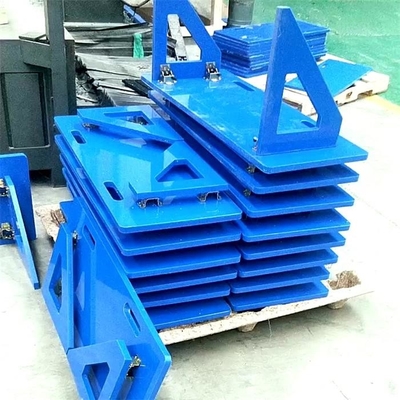
| Item:: | Impact Resistant Foldable Training Wall Football HDPE Soccer Rebound Board | Material: | 100% Virgin PE |
|---|---|---|---|
| Color:: | Black, Red, Yellow, Blue | Size:: | 100*40*40 Cm |
| Type: | Football Rebound Wall | Density:: | 0.94-0.98 G/cm3 |
| Function: | Sports Game.Sports Training | ||
| Highlight: | Tangyin Taixing PE Training Resilient Plate,Tangyin Taixing Training Resilient Plate HDPE,Tangyin Taixing HDPE Soccer Rebound Boards |
||
Section 1
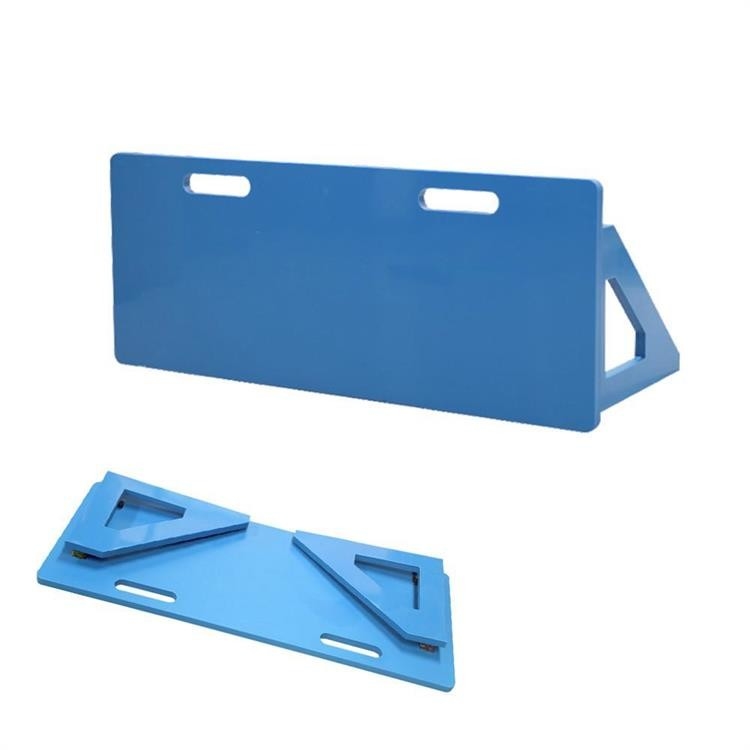
This listing is the portable football rebound training board made by Tangyin Taixing Engineering Plastics Co., Ltd. under the model string PE Training Resilient Plate: an HDPE panel with collapsible legs and a carry handle, in the recorded 1000 mm x 400 mm face, the recorded 20 mm, 25 mm or 30 mm thicknesses and the recorded black, red, yellow and blue colour set. The attribute record governs the specification. Two rows of the source specification table describe a different product and are identified below rather than copied into this page.
| Attribute | Recorded value for this listing |
|---|---|
| Manufacturer | Tangyin Taixing Engineering Plastics Co., Ltd. |
| Model Number | PE Training Resilient Plate |
| Category | HDPE Plastic Sheet |
| Material | 100% virgin PE, high density polyethylene |
| Type | Football rebound wall, impact resistant and foldable training wall |
| Colour | Black, red, yellow, blue |
| Recorded face size | 1000 mm x 400 mm |
| Recorded thickness options | 20 mm, 25 mm, 30 mm |
| Density | 0.94 to 0.98 g/cm3 |
| Function recorded | Sports game, sports training |
| Certification recorded | ISO9001 (quality management system) |
| Place of origin | China |
| Minimum order quantity | 100 kilograms |
| Price basis | Negotiable |
| Payment terms | T/T, Western Union |
| Supply ability | 50,000 kilograms per month |
| Delivery time | 15-20 days after deposit received |
| Packaging | Wooden crate of pallet |
The specification table in the source description records three panel faces and one handle size. The attribute record names only the 1000 mm x 400 mm face, which is the first size in that table, so it is the standard configuration for this listing and the other two faces are recorded options. The attribute Size field is written as 100 x 40 x 40 cm, and that third figure cannot be reconciled with the recorded 20 mm, 25 mm or 30 mm thicknesses; the first two figures convert exactly to the 1000 mm x 400 mm face, and the third is treated as a transcription fault rather than a 400 mm thickness.
| Face size (mm) | Inch equivalent as recorded | Status and reading |
|---|---|---|
| 1000 x 400 | 39 in x 16 in | Standard configuration; the face size carried in the attribute record |
| 1000 x 600 | 39 in x 24 in | Recorded option; wider face, same height, more rebound area per unit |
| 1500 x 400 | 59 in x 16 in | Recorded option; longer face for angled service and longer passing distances |
| Handle: 100 x 45 | 4 in x 2 in | Carry handle cut, recorded once for the whole size set |
The handle is recorded as 4 in x 2 in in the source table and as 10 cm x 4.5 cm in the parenthetical, which do not convert to the same pair. The millimetre pair above follows the source's own millimetre figures, and the cut should be confirmed against the sample rather than taken from this page.
The values below are printed in this listing's own specification table. They describe the HDPE the panel is cut from. The friction row is recorded with a percent sign against a coefficient, which is a unit fault; the numerical value is reproduced unchanged and the unit is not treated as valid.
| Property | Recorded value | Reading note |
|---|---|---|
| Tensile strength | Greater than 30 MPa | Material strength of the HDPE panel, not a rebound rating |
| Impact strength | At least 140 kJ/m2 | The property that lets the panel take a repeated ball strike without cracking |
| Compressive strength | At least 42 MPa | Governs how the panel behaves where it is clamped or bolted to its legs |
| Water absorption | Less than 0.01% | No swelling or mass change from rain or wet grass |
| Surface resistivity | 4.9 x 10^13 ohm | An insulating surface; relevant to ball contact and to static build-up, not to rebound |
| Friction coefficient | Less than 0.09 (recorded with a percent sign) | Unit as recorded is a percent, which a coefficient cannot be; value reproduced, unit not relied on |
The Product Name row of the source specification table reads as a plastic ice hockey training aid and puck shooting pad, and the introductory line calls the item a durable rebound board made from impact-resistant polyethylene composite. The first is a different sports product on the same sheet family and the second is a different material claim from the 100% virgin PE in the attribute record. Neither is used here: this page describes only the football rebound training board recorded by the attribute set, in 100% virgin PE, and no composite construction is claimed.

Section 2
This is not a sheet sold by area; it is a training device built from one HDPE panel plus three pieces of hardware - a carry handle cut through the panel, a pair of collapsible angled legs that hold the panel at a set angle to the ground, and an edge treatment that has to survive being thrown into a van. The construction question on this product is therefore not how thick the sheet is, but how the panel, its legs and the ground behave together when a ball arrives.
The recorded thickness options are 20 mm, 25 mm and 30 mm on a face of 1000 mm x 400 mm or one of the two recorded alternatives. Thickness is what the panel uses to resist the ball without local deformation: a ball striking a 20 mm panel loads a small area and the panel responds by flexing locally, which is why the 30 mm option exists. The recorded impact strength of at least 140 kJ/m2 is the property that keeps that repeated local loading from starting a crack at the edge or at the handle cut.
The face is HDPE in the recorded density band of 0.94 to 0.98 g/cm3, described in the source text as impact resistant and wear resistant. Those two properties are what a rebound board needs: impact resistance for the strike, wear resistance for the scuffing that the panel takes where it is dragged across tarmac and where boots catch it in close control practice.
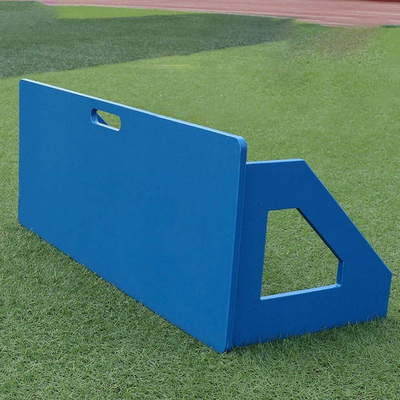
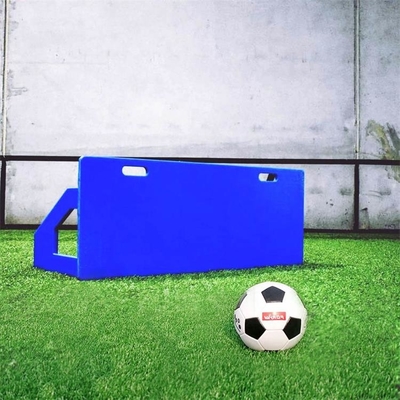
The source description states that the collapsible angular legs are used to hold the ground on all surfaces, and that the direction can be adjusted to control the bounce of the ball. That is the whole rebounding mechanism: the panel is held at an angle, the ball arrives and leaves at an angle set by that geometry, and the player receives it back on a different line. Change the leg angle and the return line changes, which is what makes the board usable for both outfield passing practice and goalkeeper handling work.
Because the legs hold the panel rather than the panel standing on its own edge, the ground contact is at the leg feet, and the panel's own mass plus the leg geometry is what keeps it from walking backwards under repeated impact. On a hard indoor floor that is a friction question; on grass it is a question of whether the feet dig in. Neither behaviour is recorded as a number, so the practical check is to strike the board hard before a session and see whether it moves.
The carry handle is cut through the panel, so the material around the cut is the load path when the board is lifted. At the recorded thicknesses the panel is stiff enough that the handle does not tear out under its own weight, but a lifted board dropped onto a corner will concentrate the load at that corner, and the recorded impact strength is what absorbs it. A radiused or eased edge is the difference between a board that can be carried against the body and one that cuts into a shoulder.
The recorded colour set of black, red, yellow and blue is a coaching aid as much as a finish: colour-coded boards let a session set different rebound angles and different drills without relabelling, and a bright panel is easier to find on a pitch at the end of a session. Colour is not recorded as a UV class, so nothing about outdoor life should be inferred from it.
Section 3
The recorded function is sports game and sports training, and the recorded type is a football rebound wall. The source description adds that the board can be used on the lawn or indoors. Those two settings are the boundaries this part is designed for, and each has its own failure mode.
On a sports hall floor the board is stable and the rebound line is repeatable, which is what makes it useful for individual technical work. Outdoors on grass the leg feet have to find purchase, and on a wet surface the board can shift under a hard strike. The recorded water absorption below 0.01% means rain does not swell the panel or change its mass, so a wet board behaves the same as a dry one; the ground under it is the variable, not the board.
On artificial turf and on hard court the board is being used on a surface it was not specifically described for. It will work, but the legs should be checked for movement after the first few strikes rather than assumed stable.
The source description states that the board can improve passing accuracy and ball control, and that a session can maximise touches and sharpen first touch. Those are training outcomes, not a measured rebound rating: no rebound coefficient, ball exit speed or angle figure is recorded for this product. A coach should therefore set the leg angle by trial on the day rather than by a specification number, and should expect the return line to change with the angle and with the ground.
Nothing recorded for this product supports use as a fixed wall, a goal frame, a barrier or a load-bearing structure. It is a portable training aid that is carried on and off the pitch.
Open the collapsible legs fully and set the panel angle before the first ball. Check that both legs bear on the ground rather than one leg and one panel edge, because a panel standing on an edge will tip on the first hard strike. Carry the board by the handle, not by the leg frame, and carry it flat rather than dragging it on a corner. Store it flat and off the ground between sessions so the legs are not loaded while the board is idle.
Where several boards are used in one session, set them at different angles along a line so that a player moving down the line meets a different return from each board. That is the training use the adjustable legs were designed for, and it is also the reason a club usually buys a set rather than a single board.
Confirm the face size matches the ordered option, confirm the thickness is the ordered value of the three recorded options, confirm the handle cut has no crack running from it, and confirm the legs lock in the open position. Then strike the board hard once from the intended distance and watch the feet.
Section 4
Tangyin Taixing Engineering Plastics Co., Ltd. manufactures this training board. The company describes itself as an engineering plastics manufacturer combining production, sales, design and processing, with more than 20 years of experience, a plant area of over 25,000 square metres and an annual output of over 8,000 tons. HDPE sheet is named in its stated product range, alongside UHMWPE board, PE marine fender, outrigger pad, UHMWPE liner, plastic conveyor roller, UHMWPE special-shaped parts, synthetic ice rink, HDPE ground protection mat and dual colour HDPE sheet.
The panel starts as HDPE sheet from the imported production line and the moulding press machine, in the recorded density band of 0.94 to 0.98 g/cm3. The CNC precise finishing machine and the CNC machining centres are the stations that cut the panel to the recorded 1000 mm x 400 mm face, produce the 4 in x 2 in handle cut, and finish the edges that a carried board is handled by. Because the source description records that size and thickness can be customised, the AutoCAD based design support is the route by which a club's own face size or a different thickness request is drawn and confirmed before cutting.
The in-house laboratory holds an abrasion tester, a universal mechanical tester and an oxygen index tester. The universal mechanical tester is the instrument behind the tensile, impact and compressive values in the property table above; the abrasion tester relates to the wear resistance the source description claims for a board that is dragged on and off a pitch.
The certification recorded for this product is ISO9001. It is a quality management system certification covering the manufacture of polyethylene sheet and machined plastic products. It is a system certification, not a product-by-product approval and not a material test report. No certificate number, issuing body or further scope is recorded for this listing, and no sports-equipment safety standard is recorded for this board.
The company profile page and the site footer additionally name Beijing Silk Road Enterprise Management Services Co. as the export-management entity for the same engineering-plastics business. That is one manufacturing and export organisation under two recorded names, not a separate factory.
Minimum order quantity is 100 kilograms, supply ability is 50,000 kilograms per month, price is negotiable, payment is by T/T or Western Union, delivery is 15-20 days after deposit received and packaging is a wooden crate on a pallet. The unit of sale is mass, which is unusual for a training aid and matters here: at the recorded 20 mm to 30 mm thicknesses a single 1000 mm x 400 mm board is a modest weight, so a 100 kg minimum is a club's set of boards rather than one board, and a coach buying a single unit for trial should plan around that minimum.
Against a 50,000 kg monthly capacity, 100 kg is a very small order, so the 15-20 day window is a scheduling and crating matter rather than a material constraint. The wooden crate on a pallet is the right packing for stacked panels and should be kept until the boards reach storage.
Company background is published on the site's company profile page.
Section 5
On the PE Training Resilient Plate from Tangyin Taixing Engineering Plastics Co., Ltd. the recorded thickness options are 20 mm, 25 mm and 30 mm on the 1000 mm x 400 mm face. A ball strike loads a small area of the panel, and a thinner panel deforms more locally at that area before it recovers. The 30 mm option is the one that holds its face flat under a hard strike, which is why it is the sensible choice for adult striking practice rather than close control work.
On a portable board the return comes from the panel angle set by the collapsible legs, not from the panel acting as a spring. Thickness therefore governs how consistent the face stays rather than how fast the ball comes back. With recorded impact strength of at least 140 kJ/m2 and tensile strength above 30 MPa, all three thicknesses sit on the same material; the difference is how much material sits behind the strike.
For the PE Training Resilient Plate from Tangyin Taixing Engineering Plastics Co., Ltd. the source description states that the collapsible angular legs hold the ground on all surfaces and that the direction can be adjusted to control the bounce of the ball. The panel is held at an angle, so the ball arrives and leaves on different lines, and changing the leg angle changes the return line. That is what allows one board to serve both outfield passing work and goalkeeper handling work.
No rebound coefficient or exit-angle figure is recorded for this product, so the angle has to be set by trial at the start of a session rather than from a table. Set the board, strike a few balls from the working distance, and adjust until the return arrives where the drill needs it. Several boards set at different angles along one line is the way the adjustable legs are meant to be used in a group session.
On the PE Training Resilient Plate from Tangyin Taixing Engineering Plastics Co., Ltd. the 1000 mm x 400 mm face is the size carried in the attribute record and it is the first of the three sizes in the source specification table, recorded there as 39 in x 16 in. It is a single-player board: wide enough for a ball to strike without the player having to aim, narrow enough to carry in one hand by the handle and to stand in a car boot.
The two recorded alternatives change the job. At 1000 mm x 600 mm the face is wider and takes more of a mis-hit, which suits younger players and close-range work; at 1500 mm x 400 mm the face is longer, which suits angled service and longer passing distances. All three use the same recorded thickness options and the same handle size, so the choice is about the drill rather than about the construction.
For the PE Training Resilient Plate from Tangyin Taixing Engineering Plastics Co., Ltd. the source description states the handle is designed for easy carrying, and the specification table records the handle size as 4 in x 2 in. The handle is cut through the HDPE panel itself rather than being a separate fitting, so the material around the cut becomes the load path every time the board is lifted, and that is the point where a portable board usually fails first.
Because the panel is 20 mm to 30 mm thick and the material is recorded with impact strength of at least 140 kJ/m2 and tensile strength above 30 MPa, a handle cut leaves enough material around it to carry the board's own weight. The failure mode to watch is not the lift but the drop: a board dropped onto a corner loads the handle cut in the same motion, so a crack running from the cut is the first thing to check after a knock.
The recorded minimum order quantity for this model PE Training Resilient Plate from Tangyin Taixing Engineering Plastics Co., Ltd. is 100 kilograms, and the recorded supply ability is 50,000 kilograms per month. Because the unit of sale is mass rather than pieces, 100 kg is a set of boards rather than a single unit at the recorded 20 mm to 30 mm thicknesses on a 1000 mm x 400 mm face.
For a club that wants one board to try, that minimum is the practical obstacle, and it is worth asking whether a mixed set of thicknesses and face sizes can be built from one 100 kg order - the answer depends on the mix, because a 30 mm board at 1500 mm x 400 mm uses far more material than a 20 mm board at 1000 mm x 400 mm. State the intended mix at enquiry so the 100 kg is filled with what the sessions actually need.
On the PE Training Resilient Plate from Tangyin Taixing Engineering Plastics Co., Ltd. the recorded water absorption is below 0.01%, and the material is 100% virgin PE in the recorded 0.94 to 0.98 g/cm3 density band, so a wet board does not swell, gain mass or change its face. The source description also states that the board can be used on the lawn, which is the outdoor setting it is designed around.
The variable outdoors is the ground, not the panel. On wet grass the leg feet can lose purchase and the board can shift under a hard strike, so the legs should be checked after the first few balls. Colour is recorded as black, red, yellow and blue, and none of the four is recorded as carrying a UV class, so no outdoor service life should be read from the colour.
The recorded packaging for this model PE Training Resilient Plate from Tangyin Taixing Engineering Plastics Co., Ltd. is a wooden crate on a pallet, and the boards are stacked inside it, so the first check is the count against the packing list and the face size mix against the order. The recorded delivery time is 15-20 days after deposit received and payment is by T/T or Western Union, so the crate should be expected on that schedule rather than held as a surprise arrival.
The boards themselves should be checked flat, since a panel that has been stored bowed will not sit true against its legs. Then check each handle cut for a crack and each leg for a lock that engages in the open position. A board with a cracked handle cut should not be issued to a session, because the failure shows up as the board dropping while it is being carried.
Section 6
Contact Person: Mr. Sales
Tel: +86 152 1104 0646


 English