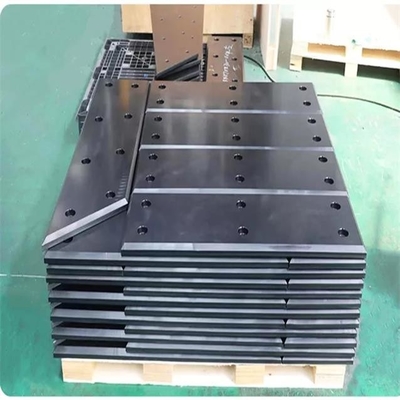

|
Product Details:
|
| Item: | Polyethylene Plastic Marine Fender Face Pad For Dock Bumper Boards | Material: | 100% Virgin PE |
|---|---|---|---|
| Color: | Blue, Black, Yellow | Size: | 1220mm*2440 Mm |
| Thickness: | 5-200mm | Tensile Strength: | 81~130MPa |
| Impact Strength: | ≥140 KJ/m2 | ||
| Highlight: | PE Marine Fender Face Pad,200mm Marine Fender Facing Pad,Anti Collision Marine Fender Face Pad |
||
Listing 37754126 - dock bumper face pad
This listing covers a dock bumper face pad cut from 100% virgin PE and supplied in a 1220 mm x 2440 mm sheet format with a thickness range of 5 mm to 200 mm. The values below are the recorded attribute set for this listing; they are the numbers a quotation and a packing list are checked against.
| Attribute | Recorded value |
|---|---|
| Item | Polyethylene Plastic Marine Fender Face Pad For Dock Bumper Boards |
| Model Number | PE Marine Fender Face Pad |
| Material | 100% virgin PE |
| Size | 1220 mm x 2440 mm |
| Thickness | 5-200 mm |
| Colour | Blue, Black, Yellow |
| Density | 0.94-0.98 g/cm3 |
| Tensile strength | 81-130 MPa |
| Impact strength | >=140 KJ/m2 |
| Compressive strength | >=42 MPa |
| Friction coefficient | 0.11-0.17 |
| Water absorption | <0.01% |
| Shape | Sheet, cut to the face-pad outline on the buyer drawing |
| Application | Dock bumper boards, fender panel face pads, quay and lock wall protection |
| Processing service | Cutting, pre-drilling, chamfering |
| Certification | ISO9001 |
| Place of origin | China |
| Minimum order quantity | 50 pieces |
| Price | Negotiable |
| Payment terms | T/T, Western Union |
| Supply ability | 50000 pieces per month |
| Delivery time | 15-20 days after deposit received |
| Packaging | Wooden crate or pallet |
| Configuration | Format | Status in this listing |
|---|---|---|
| Recorded size | 1220 mm x 2440 mm | The size held in the attribute records and used for all quantity and freight planning on this page. |
| Recorded thickness band | 5-200 mm | The full band is quotable; the exact figure is fixed per order because it drives pad mass and bolt length. |
| Plate sizes named in the source text | 1200 x 4000 mm, 1250 x 3100 mm, 2200 x 1000 mm | Named in the original description of this model family and quotable as alternatives, but not the size recorded against this listing. |
| Colour | Blue, Black, Yellow | All three are recorded; the colour is fixed at order stage and does not change the cut outline. |
Conflict note: the original description names the material as UHMW-PE in one paragraph and ultra-high molecular weight polyethylene in its specification table, while the attribute record states 100% virgin PE. The attribute record governs the material field above; the density band of 0.94-0.98 g/cm3 is reproduced from the description and is not restated as an attribute.
How a fender face pad is built to take the hit
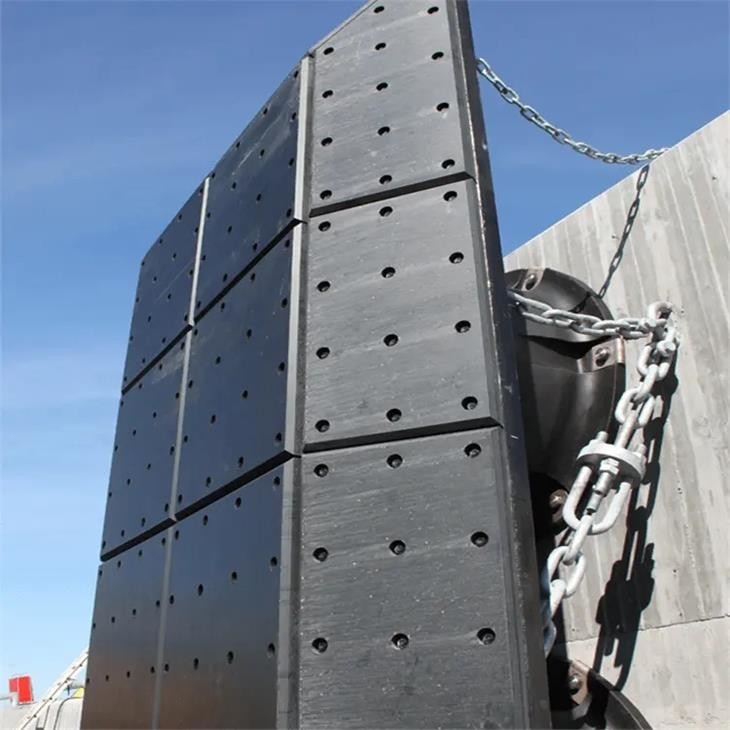
A marine fender face pad is not a flat plate hung on a wall. It is the sacrificial wearing surface bolted to the front of a rubber fender body or a dock bumper board, so the hull meets plastic rather than rubber or concrete. The construction question is therefore never just thickness: it is how the pad converts a berthing impact into a contact pressure the fender body can absorb, and how the fasteners hold that pad in place while the hull slides along it.
In this listing the pad is produced from 100% virgin PE sheet in the recorded 1220 mm x 2440 mm format and machined to the face outline required by the fender frame. The recorded impact strength of >=140 KJ/m2 describes the sheet's capacity to absorb a blow without brittle failure, and the recorded compressive strength of >=42 MPa describes how much pressure the material carries before it yields. Those two figures work together: impact strength governs what happens at the instant of contact, compressive strength governs what happens in the seconds after, when the full berthing load sits on the pad and is transferred into the fender body behind it.
| Property | Recorded | What it governs on a face pad |
|---|---|---|
| Tensile strength | 81-130 MPa | Resistance of the pad body to being pulled or torn at bolt holes and at the chamfered edge. |
| Impact strength | >=140 KJ/m2 | Behaviour at the instant a hull contacts the pad; a low figure would mean chipping and edge breakout. |
| Compressive strength | >=42 MPa | Load carried while the vessel rests against the pad, before the material starts to deform permanently. |
| Friction coefficient | 0.11-0.17 | Sliding resistance of the hull plate against the pad face during tidal rise and fall and during berthing drift. |
| Water absorption | <0.01% | Dimensional and mass stability of the pad in permanent seawater contact. |
The working face of this pad is the sheet surface as supplied: flat, with no applied coating and no bonded facing. The recorded friction coefficient of 0.11-0.17 is the reason the pad exists. A rubber fender body alone grips a steel hull and is dragged and abraded by every berthing; a PE face pad lets the hull slide across the contact area instead, so the fender body behind it is protected from shear and the hull coating is protected from scuffing. A flat face matters here as much as a low-friction one, because any bow or dish in the pad concentrates contact on a small area and defeats the load spreading the pad was fitted for.
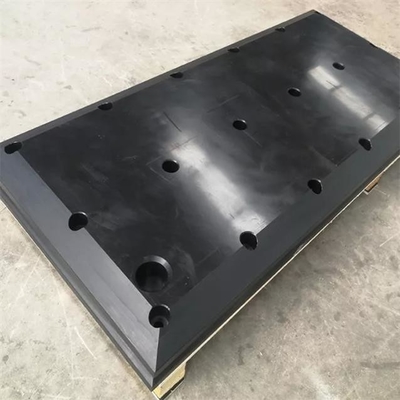
Pads of this type are supplied pre-drilled and chamfered. The pre-drilled holes are positioned to the fender frame or bumper board pattern rather than to a stock grid, so the hole pitch, hole diameter and edge distance are drawing-driven values and are not fixed by this listing. Chamfering at the perimeter removes the sharp arris that would otherwise catch a hull plate, a mooring line or a fender rope, and it also removes the most fragile part of the edge, which is where impact breakout normally starts.
The thickness range of 5 mm to 200 mm covers two different jobs within one model string. Thin pads in the lower part of the range act as a sliding skin over an existing fender face and add little to the stack height. Thick pads in the upper part of the range are structural in their own right: they stand off the fender body, absorb a larger share of the berthing energy in the pad itself, and require longer bolts and a wider countersink pocket. The transition from one behaviour to the other is a design decision for the berth, not a catalogue default.

The sheet is supplied flat and, in the recorded original text, described as very flat on the surface. Flatness is a construction requirement rather than a cosmetic one: a pad that rocks on its fender body loads two bolts and leaves the rest loose, and a loose bolt in a seawater splash zone works open quickly. Colour is recorded as blue, black or yellow, and colour is moulded through the sheet rather than applied, so a scuffed face does not expose a different substrate colour.
Where this pad works, where it does not, and how it is fixed
The recorded applications are dock bumper boards, fender panel face pads, bridge buttress protection, beltings on workboats, lock entrance and wall protection, rubbing strips and V-fender shields. All of them share one condition: the pad is a replaceable wearing surface in front of something more expensive. Where that condition does not hold, the pad is the wrong component. A pad used as a structural bearing between a pile and a deck, or as a standalone energy absorber with no fender body behind it, is outside the recorded application and outside what the recorded compressive strength of >=42 MPa can be expected to cover.
Mounting is a bolted connection through the pre-drilled holes into the fender frame, bumper board or steel backing. Three things govern whether that connection survives a tide cycle. The first is bolt length: a pad at the top of the 5-200 mm range needs a bolt long enough to develop full thread engagement in the backing while still allowing a countersunk head to sit at or below the wearing face. The second is countersink depth: the head must finish flush, because a proud head is struck by the hull on every berth and is eventually sheared. The third is hole clearance and edge distance, which must leave enough material around each hole that the recorded tensile strength of 81-130 MPa is available in the ligament rather than being consumed by a crack that started at the hole.
Because PE moves with temperature and the pad sits in direct sun and in cold water, the fixing detail should allow the sheet to move slightly rather than clamping it rigid at every hole. A pad bolted hard at all four corners of a 1220 mm x 2440 mm panel with no allowance for movement will dish or bow between fixings as the face temperature swings. The practical approach is to fix positively at a reference edge and leave the remaining holes with clearance so the sheet can breathe.
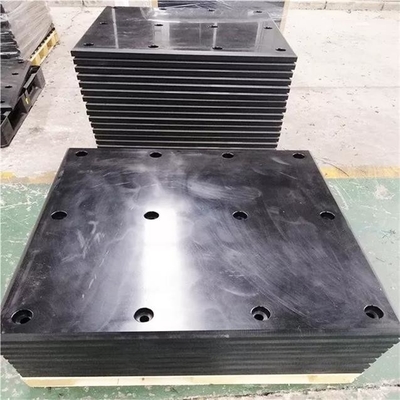
Handling is a real constraint at the top of the thickness band. A 1220 mm x 2440 mm pad at the thicker end of the range is a two-person lift with mechanical assistance at the quay, and the recorded packaging of wooden crate or pallet is there to let the pad be craned or forklifted to the fender rather than dragged. Lifting slings should pass through the crate or under the pallet, never through the pre-drilled holes, because a sling through a hole loads the edge of the hole in exactly the direction the material is weakest.
Seawater, UV and ozone are the recorded exposures, and the recorded water absorption of <0.01% is the property that makes the pad suitable for permanent immersion and splash. The pad does not rot, does not take up water and does not delaminate, because it is a solid sheet rather than a bonded laminate. What it does do is wear: sliding contact with a hull removes material slowly from the face, and the pad's service condition is judged by remaining thickness at the fixing points, not by appearance.
Confirm the fender frame hole pattern against the drawing, including hole diameter and countersink angle, before production starts. Confirm the pad thickness against the bolt length available, since changing thickness by even a few millimetres at the top of the range changes the fastener. Confirm the colour against the quay marking scheme if the pad is used for identification. Confirm that the fender body behind the pad is sound, because a face pad transfers load into it rather than replacing it.
Who makes this pad and what the recorded terms mean
Tangyin Taixing Engineering Plastics Co., Ltd. is the manufacturer of this face pad. The company operates as an engineering plastics manufacturer combining production, sales, design and processing, with more than 20 years of experience, a plant area of more than 25,000 square meters and an annual output of more than 8,000 tons. The site also records an export-management entity, Beijing Silk Road Enterprise Management Services Co., which operates the same engineering-plastics business; the two recorded names describe one manufacturing and export organisation rather than separate factories.
For this pad the relevant capability chain is short. The sheet is produced on the company's imported production line and moulding press, then finished on CNC precise finishing machines, carving machines and CNC machining centres to the face outline, the pre-drilled hole pattern and the chamfer recorded for the application. AutoCAD based design support is the route by which a fender frame pattern becomes a machined pad rather than a hand-marked one. In-house laboratory equipment includes an abrasion tester, a universal mechanical tester and an oxygen index tester, so sheet properties are checked in the plant rather than only at a third party.
The company's recorded product range covers UHMWPE board, PE marine fender, outrigger pad, UHMWPE liner, plastic conveyor roller, UHMWPE special-shaped parts, HDPE sheet, HDPE ground protection mat, dual colour HDPE sheet and synthetic ice rink, which means the marine fender pad is a standard line rather than a one-off fabrication. Standard polyethylene sheet formats stated by the company are 1250 x 3100 mm, 1220 x 2440 mm, 2100 x 3100 mm, with thickness from 6 mm to 200 mm and custom sizes accepted.
| Term | Recorded value and purchasing consequence |
|---|---|
| Minimum order quantity | 50 pieces. A single berth refit that needs a handful of pads will be buying a stock quantity, so the sensible plan is to combine several berths or hold the balance as spares rather than order twice. |
| Supply ability | 50000 pieces per month. A 50-piece order is a small fraction of monthly capacity, so the constraint on a refit is scheduling and finishing, not melt capacity. |
| Delivery time | 15-20 days after deposit received. The clock starts at deposit, and drilling and chamfering are the operations that set the tail of that window. |
| Packaging | Wooden crate or pallet. Rigid packaging matters because a chamfered edge that is dropped in transit arrives with a nick that becomes an impact-initiation point. |
| Payment terms | T/T, Western Union. |
| Price basis | Negotiable, quoted against thickness, colour and the drilling pattern of the order. |
Certification recorded on this site is ISO9001. It is a quality management system certification covering the manufacture of polyethylene sheet and machined plastic products; it is not a product-by-product approval and it is not a material test report, and no certificate number, issuing body or scope statement beyond that is recorded.
Impact, thickness, fastening and order terms
The pad does not absorb the whole berthing energy; it changes the surface the hull meets. A rubber fender body deflects under load but grips a steel hull, so the hull drags across it and the fender is abraded and sheared. A PE Marine Fender Face Pad from Tangyin Taixing Engineering Plastics Co., Ltd. in the recorded 1220 mm x 2440 mm format puts a flat, low-friction plate in front of that body, so the contact area stays large and the hull slides instead of gripping.
The recorded compressive strength of >=42 MPa is the figure that keeps that contact area honest. If the pad yields locally under a concentrated contact, the area shrinks and the pressure rises, which is how a face pad ends up indented in the middle and loose at the edges. Keeping the face flat and the thickness uniform is what preserves the load path into the fender body.
The recorded band runs from 5 mm to 200 mm, and the two ends do different work. At the thin end a PE Marine Fender Face Pad from Tangyin Taixing Engineering Plastics Co., Ltd. is a sliding skin over an existing fender face: it adds little stack height, uses the existing bolt length and is replaced as a wear item. At the thick end the pad becomes part of the energy-absorbing stack, stands off the fender body and needs longer bolts and a deeper countersink.
The choice is set by the fender design and the bolt length available at the berth, not by a preference for a round figure. Because mass rises with thickness across a 1220 mm x 2440 mm panel, the handling method at the quay also changes as the thickness moves up the band, and that is a cost a buyer should price in at order stage.
The holes are positioned to the fender frame or bumper board pattern on the buyer drawing, so hole pitch, diameter, countersink angle and edge distance are project values rather than stock values. A PE Marine Fender Face Pad from Tangyin Taixing Engineering Plastics Co., Ltd. is machined on CNC equipment to that pattern, which is why the drawing and not the model string carries the fixing geometry.
Chamfering is part of the same operation. On a pad cut to a 1220 mm x 2440 mm outline, the perimeter chamfer removes the sharp arris that would catch a hull plate or a mooring line, and it removes the thin edge section where impact breakout would begin. Both the drilling and the chamfer should be called out on the drawing before the order is placed, because neither is recoverable after machining.
The recorded friction coefficient of 0.11-0.17 is low enough that a steel hull slides across the pad face rather than locking onto it. That is the entire function of a PE Marine Fender Face Pad from Tangyin Taixing Engineering Plastics Co., Ltd.: during tidal rise and fall, and during the small lateral movements of a berthed vessel, the hull travels over the pad instead of dragging the fender body.
The consequence for the buyer is that wear appears as a slow thinning of the face rather than as torn rubber or sheared bolts. Inspection should therefore measure remaining thickness at the fixing points, where the pad is restrained and cannot slide, rather than judging the pad by how glossy the face looks.
50 pieces is the recorded minimum order quantity, and against a recorded supply ability of 50000 pieces per month it is a small run. For a buyer the practical reading is that a PE Marine Fender Face Pad from Tangyin Taixing Engineering Plastics Co., Ltd. is priced and scheduled as a production batch, so a refit needing a handful of pads will be buying more than the immediate job requires and should plan the balance as spares for the same berths.
Ordering the full 50 against a 1220 mm x 2440 mm format also fixes one thickness and one colour for the whole batch, which is an advantage: pads fitted at different times on the same fender line stay dimensionally matched, and a later replacement does not require re-drilling to suit a different stack height.
The recorded packaging is wooden crate or pallet, and the recorded delivery time is 15-20 days after deposit received. For a PE Marine Fender Face Pad from Tangyin Taixing Engineering Plastics Co., Ltd. the packaging is not just containment: a rigid crate keeps the chamfered perimeter from being nicked in transit, and a nick on a chamfer is where an impact crack starts on the quay.
The 15-20 day window runs from deposit, so the sequence to plan is drawing approval, then deposit, then machining of the hole pattern and chamfer, then crating. Sea freight transit time sits outside that window and should be added separately when the pads are scheduled against a berth closure.
Blue, black and yellow are the three recorded colours, and the colour is in the sheet rather than applied to the face, so a scuffed pad keeps its colour. A PE Marine Fender Face Pad from Tangyin Taixing Engineering Plastics Co., Ltd. ordered in yellow or blue is easier to see against a dark fender body or a shadowed lock wall, which is why the original text refers to high visibility colours for quay identification.
Colour does not change the recorded mechanical values: impact strength of >=140 KJ/m2, compressive strength of >=42 MPa and the 0.11-0.17 friction coefficient apply across the recorded colour set. What colour does change is the visual check at receiving, where a mixed batch is immediately obvious against the packing list.
ISO9001 is recorded for this listing and should be read as a quality management system covering the manufacture of polyethylene sheet and machined plastic products. For a PE Marine Fender Face Pad from Tangyin Taixing Engineering Plastics Co., Ltd. it is a system certification: it is not a product-by-product approval, it is not a material test report, and no certificate number, issuing body or wider scope is recorded for this listing.
That distinction sets what a buyer can reasonably ask for. The certificate speaks to how the plant controls its processes, while the recorded values on this page - 0.94-0.98 g/cm3 density, >=140 KJ/m2 impact strength, 0.11-0.17 friction coefficient - are the product data the pad is specified on. Where a project requires test certificates against a named standard, that requirement has to be raised at enquiry stage rather than assumed from the ISO9001 record.
Four checks before the pad goes onto the fender
Contact Person: Mr. Sales
Tel: +86 152 1104 0646


 English