
|
Product Details:
|
| Item:: | UHMWPE Self-lubricating Surface Hockey Artificial Ice Tiles Skating Rink | Material: | 100% Virgin PE |
|---|---|---|---|
| Color:: | Natural White | Size:: | 1220mm*2440 Mm |
| Thickness:: | 5-200mm | Water Absorption:: | <0.01% |
| Application:: | Indoor And Outdoor | ||
| Highlight: | UHMWPE Synthetic Ice Rink,UHMWPE indoor artificial ice rink,synthetic ice skating surface |
||
Listing 37629087
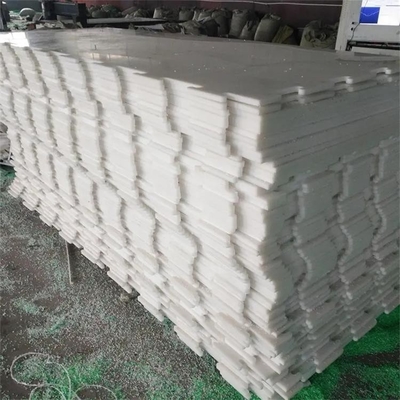
An interlocking natural white UHMWPE panel system that forms a skateable surface without refrigeration. The recorded model is Synthetic Ice Rink and the manufacturer is Tangyin Taixing Engineering Plastics Co., Ltd. Panels arrive as flat sheets in one size, 1220 x 2440 mm, and become the rink when they are joined edge to edge on a prepared floor.
| Field | Recorded value |
|---|---|
| Item | UHMWPE Self-lubricating Surface Hockey Artificial Ice Tiles Skating Rink |
| Model Number | Synthetic Ice Rink |
| Manufacturer | Tangyin Taixing Engineering Plastics Co., Ltd. |
| Material | 100 percent virgin PE |
| Colour | Natural white |
| Panel size | 1220 x 2440 mm |
| Thickness | 5-200 mm |
| Water absorption | Below 0.01 percent |
| Application | Indoor and outdoor |
| Certification | ISO9001 quality management system |
| Place of origin | China |
| Minimum order | 100 kilograms |
| Price | Negotiable |
| Payment | T/T, Western Union |
| Supply ability | 50,000 kilograms per month |
| Delivery | 15-20 days after deposit received |
| Packaging | Wooden crate or pallet |
The description's specification table gives two other sizes, 1200 x 2400 mm and 1000 x 2000 mm, and a thickness of 15-20 mm, none of which match the attribute record. The attribute record governs: this listing is 1220 x 2440 mm with a 5-200 mm thickness band, and the description's panel-size line is treated as text from a different configuration of the same product.
| Decision | Recorded position | Effect on the rink build |
|---|---|---|
| Panel size | 1220 x 2440 mm, one size | Every rink built from this listing is laid on a 1220 x 2440 mm grid, so rink dimensions follow that module. |
| Section | 5-200 mm band | Section selected for the skate load and the subfloor; the panel edge height is the visible result. |
| Colour | Natural white, no option | The rink reads as an ice surface; any colour coding must come from markings, not the panel. |
| Application | Indoor and outdoor | Outdoor use brings rain, sun and debris into the cleaning regime. |
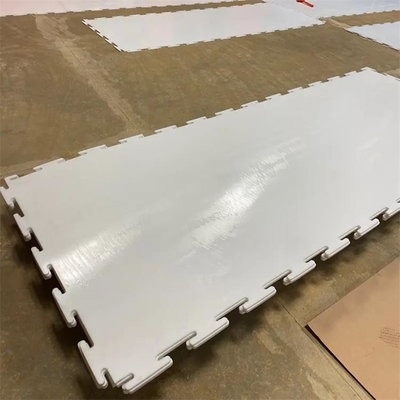
| Joint form | Edge-to-edge interlock, puzzle pattern | Panels locate against each other and hold the surface level across the seam. |
| Property | Published figure | Meaning for a rink |
|---|---|---|
| Tensile strength | Above 30 MPa | Resists the pull a skate edge applies as it turns and brakes. |
| Impact strength | 140 kJ/m2 or above | Absorbs a fall, a dropped skate or a puck strike without cracking the panel. |
| Compressive strength | 42 MPa or above | Carries the point load of a skater through a thin panel down to the subfloor. |
| Water absorption | Below 0.01 percent | Surface water from cleaning or rain does not swell the panel or lift a seam. |
| Friction coefficient | Below 0.09, as printed | The source prints this with a percent sign; the figure is quoted as published and describes the sliding face, not a percentage. |
| Surface resistivity | 4.9 x 10^13 ohm | Recorded as published; relevant where static build-up on a large plastic floor is a concern. |
The description states that no extra lubrication is required because the surface is self-lubricating. That is consistent with the published friction figure, and it is the reason the cleaning regime below matters more than any additive: whatever is left on the face becomes the sliding surface.
Construction
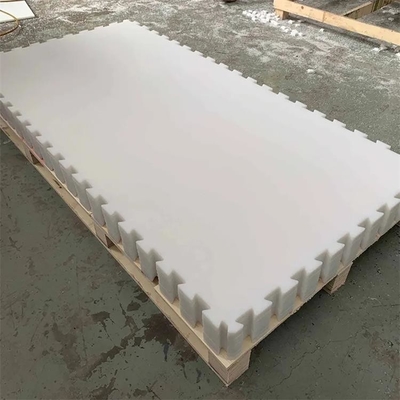
The rink is a grid of flat panels, not a poured surface. Each panel is a solid UHMWPE sheet, natural white through its full thickness, cut with an interlocking edge so that it locates against its neighbours and the joints close into a continuous plane. The description describes the panels as fitting together like puzzle pieces, and that is the whole structural idea: the interlock holds the panel in line while the subfloor carries the load.
Because the material is the same through the section, the white face is not a coating. It cannot flake, peel or wear through to a different colour underneath, which is why a rink of this construction keeps its appearance as the surface is skated in rather than showing a change of colour at the wear line.
The interlock keeps adjacent panels at the same height and stops them drifting apart under skating loads. It does not clamp the panels down, and it does not bridge an uneven floor. A panel that is laid on a hollow will rock on the interlock and the seam will open and close under a skater's weight, which is felt as a click under the blade and heard as a rattle in the hall.
For that reason the floor preparation is part of the construction. The panels must sit in continuous contact with a flat, clean, dry subfloor. Any high point becomes a pivot and any hollow becomes a gap that the interlock cannot close.
The recorded band runs from 5 mm to 200 mm, which is a wide range for a skating surface. A thin panel needs a very flat floor because it cannot absorb any unevenness; a thicker panel is more forgiving of a slightly wavy base and gives a longer wear life before the face is skated through, at the cost of a taller edge at the rink boundary and more weight per panel.
The edge height has to be dealt with either way. A rink built on a thick panel needs a ramp or a dasher at the perimeter, and that detail should be decided before the thickness is ordered, because it changes the finished floor level of the whole installation.
Lay the first row against a straight datum, then build outward from it. If the first row is not straight, the error accumulates across the rink and appears as open joints at the far side. Engage each interlock fully before stepping onto the panel; a partially engaged joint looks closed and separates on the first cold morning.
Stagger the joints between rows where the interlock pattern allows, so that four corners do not meet at one point. A cross-joint where four panels meet is the hardest place to keep level and the first place to show a step.
Leave a gap at the perimeter and at any fixed object such as a pillar or a barrier. The panels expand with temperature and, outdoors, with direct sun on a white surface; a rink laid tight to a wall will climb at the wall and lift a seam in the middle of the floor. The gap is the cheapest part of the installation and the most often omitted.

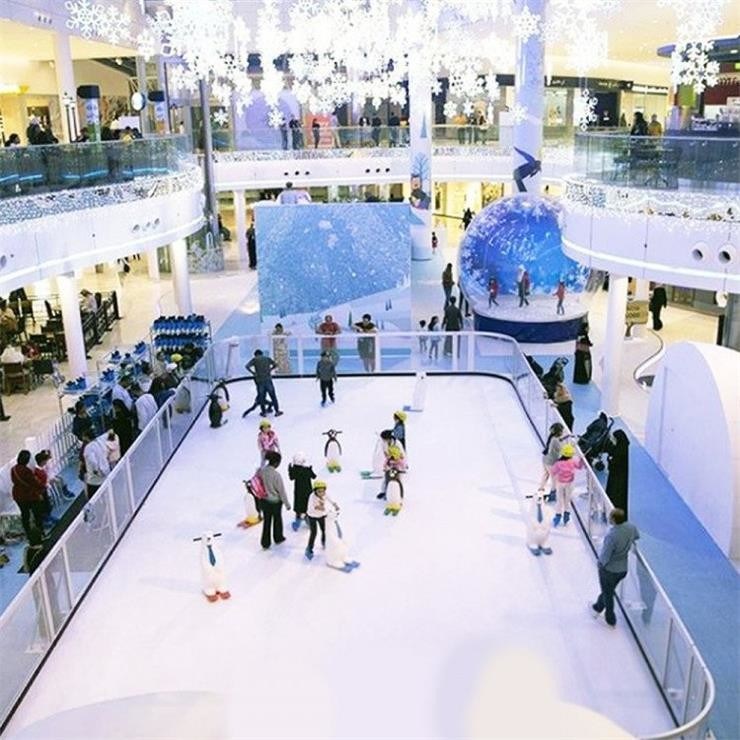
This surface is recorded for indoor and outdoor use, and the description lists skating rinks, figure skating, regular skating, carnival celebrations, hockey, shows and family entertainment. The common thread is a temporary or semi-permanent rink where refrigeration is not available and where the floor beneath is already flat.
It works on a shopping centre floor, a sports hall, a marquee with a levelled base or a paved yard, because in each case there is a hard flat substrate to lay onto and the rink can be assembled and taken up again. It works in warm weather and indoors, since the surface does not melt, and it works outdoors given a clean base and a perimeter that keeps grit off the panels.
It does not work on grass, gravel, sand or a slope. The interlock cannot hold a grid level over a soft or falling base, and a slope makes skaters drift to one end. It is not suitable over a suspended floor that deflects under a crowd, because the panels will follow the deflection and open at the joints.
It is also not a substitute for ice in competitive sport. The description compares the glide to real ice, but this page makes no claim about a specific glide performance, and no hardness, glide or ball-bounce figure is recorded for this listing. Any governing-body requirement for a competitive surface is outside what is recorded here.
Clean and level the base first, and let it dry. Sweep the area, then lay the first row to a chalk line or a straight edge. Work across the rink in rows, engaging each interlock and checking the seam height with a straight edge as you go. Cut the perimeter panels to fit, leaving the expansion gap, and finish with a ramp or barrier so skaters cannot catch a blade on the panel edge.
Sweep before every session. Grit that blows onto the surface is dragged under the blades and abrades the face, and a face full of grit is a slow face. Wipe with a damp mop rather than flooding the joints, because water pushed into a seam carries dirt with it and is difficult to remove once it dries.
Do not use an abrasive cleaner or a scraper on the face. The material works because the face is smooth; scoring it removes the very property the rink depends on, and the damage is not recoverable by polishing on site.
Confirm the base is flat and dry, confirm every interlock is fully engaged, confirm the perimeter gap exists, and confirm the edge ramp is fixed. Walk the whole grid and look for any seam that stands proud; a single raised edge is a trip point and a blade catcher, and it will be found by the first skater rather than by the installer.
Tangyin Taixing Engineering Plastics Co., Ltd. produces this rink panel. The company is an engineering plastics manufacturer combining production, sales, design and processing, with more than 20 years of experience, a plant area above 25,000 square meters and annual output above 8,000 tons, and synthetic ice rink is named in its stated product range. The same range covers UHMWPE board, UHMWPE liner, HDPE sheet, dual colour HDPE sheet, HDPE ground protection mat, outrigger pad, PE marine fender, plastic conveyor roller and UHMWPE special-shaped parts. The business also trades under the recorded name Beijing Silk Road Enterprise Management Services Co.; the two names describe one manufacturing and export organisation.
The sheet is pressed on the moulding press and the imported production line, which is how a 5-200 mm thickness band is available from one supplier. The interlocking edge and any perimeter cut are produced on the CNC precise finishing machine and the CNC machining centres, with the carving machine used where the interlock pattern requires a shaped edge and the sander available for face finishing. AutoCAD based design support is available where a rink outline has to be planned around columns or an irregular hall.
That design support matters more here than on a plain sheet order, because a rink is a layout problem as much as a material order: the panel grid has to be set out so that perimeter cuts are manageable and the joints fall in sensible places.
The in-house laboratory holds an abrasion tester, a universal mechanical tester and an oxygen index tester. Those instruments support the published figures in this page, such as the compressive strength above 42 MPa, and they are material-control instruments rather than a per-panel certificate service.
ISO9001 is recorded as a quality management system certification covering the manufacture of polyethylene sheet and machined plastic products. It is a system certification, not a product-by-product approval, and not a material test report. No certificate number, issuing body or scope statement is recorded, and none is claimed.
| Term | Recorded | Effect on a rink project |
|---|---|---|
| Minimum order | 100 kilograms | A small trial rink clears this easily; the practical question is panel count, not weight. |
| Supply ability | 50,000 kilograms per month | Supports a full rink plus replacement panels in one programme. |
| Delivery | 15-20 days after deposit | Set the opening date from the confirmed shipment, not from the enquiry. |
| Packaging | Wooden crate or pallet | Panels travel flat and the interlock edges stay intact, which is what keeps seams level on site. |
| Payment | T/T, Western Union | Both recorded; agree one before the deposit is raised. |
| Price | Negotiable | Follows thickness and layout, so quote from a rink plan with dimensions. |
Because a rink is skated in, the order should include spare panels in the same thickness. A replacement panel cut from a different thickness will not sit level with its neighbours, and the mismatch is visible at the seam from the first day.
The panels carry the skater and the interlock holds them in line, but neither can correct an uneven base. A Tangyin Taixing Engineering Plastics Co., Ltd. Synthetic Ice Rink panel laid over a high point pivots on it, and the seam beside it opens and closes under a blade, which is felt as a click rather than seen.
Sweep, level and dry the base before any panel goes down. Check with a straight edge across the largest area, and deal with any hollow rather than packing the panel itself, because packing under a seam moves when the panel expands.
Thickness has to cover the skate point load and give enough material for the surface to be skated in over time. The published compressive strength above 42 MPa describes the material, not a panel in service, so a thin panel at the 5 mm end relies heavily on a perfectly flat base, while a thicker Tangyin Taixing Engineering Plastics Co., Ltd. Synthetic Ice Rink panel tolerates more base variation and lasts longer before the face needs attention.
The upper end of the band brings a handling and edge problem: a very thick panel creates a step at the rink boundary that needs a ramp, and it is heavy enough to require more than two people per panel. Choose the section your base and your perimeter detail can support, and state it explicitly, because the description quotes 15-20 mm while this listing records 5-200 mm.
Engage each joint fully and then run a straight edge across the seam. A correctly engaged Tangyin Taixing Engineering Plastics Co., Ltd. Synthetic Ice Rink joint reads as one continuous plane; a joint that is only partly closed looks shut from above but sits slightly high, and it is the seam that opens under load.
Start from a straight datum row, because the interlock transmits alignment along the run and an error in the first row multiplies across the rink. Where the pattern allows, stagger joints between rows so that four panel corners never meet at one point.
Leave a gap at every wall, pillar and fixed barrier, and never butt a panel hard against them. A natural white Tangyin Taixing Engineering Plastics Co., Ltd. Synthetic Ice Rink panel in an outdoor setting warms in direct sun, and a rink that is closed tight at the perimeter has nowhere to grow except upward, which lifts a seam somewhere in the middle of the floor.
Cover the gap with the perimeter ramp or barrier rather than filling it, so the panel can still move underneath. Re-check the gap after the first warm day, because a rink that has already climbed at one wall will not settle back on its own.
Sweep before each session and wipe with a damp mop when the surface shows marks. The Tangyin Taixing Engineering Plastics Co., Ltd. Synthetic Ice Rink works because its face is smooth and self-lubricating, and grit left on the face is dragged under blades and abrades it, so removing grit is the whole maintenance regime.
Do not flood the joints and do not use abrasive pads or scrapers. Water pushed into a seam takes dirt with it, and a scored face loses glide in exactly the area where the damage was done. No coating or additive is required according to the description, and none should be applied.
The attribute record is authoritative and gives 1220 x 2440 mm for this listing, so that is the panel a Tangyin Taixing Engineering Plastics Co., Ltd. Synthetic Ice Rink order will be quoted against. The two other sizes in the description belong to a different configuration of the same product and are not offered here.
This matters when you plan the rink: 1220 x 2440 mm is the module your layout must follow, and a plan drawn on a 1200 x 2400 mm grid will need a different perimeter cut. Draw the rink on the recorded size before ordering.
The recorded minimum is 100 kilograms, which is a small share of the recorded 50,000 kilogram monthly supply and well below a full rink at any section in the 5-200 mm band. The practical planning question is therefore panel count, not the minimum, and the count follows directly from the 1220 x 2440 mm module.
Add spare Tangyin Taixing Engineering Plastics Co., Ltd. Synthetic Ice Rink panels in the same thickness. A damaged panel replaced from a different thickness will not sit level, and a rink that is short of one panel at the perimeter cannot be finished at all.
The window of 15-20 days runs from the deposit, so the opening date must be set from the confirmed shipment rather than from the day the enquiry is sent. A Tangyin Taixing Engineering Plastics Co., Ltd. Synthetic Ice Rink is usually installed to a fixed date, which makes the deposit timing the single controllable variable.
Wooden crate or pallet packing keeps the interlock edges undamaged and the panels flat, which is what allows the grid to close without lipping. Have the crate delivered to the installation floor or as close to it as access allows, and check the panel count before the crate is broken down.
Contact Person: Mr. Sales
Tel: +86 152 1104 0646


 English