
|
Product Details:
|
| Item:: | Plastic Temporary Ground Protection HDPE Track Construction Road Mats | Material: | High-Density Polyethylene |
|---|---|---|---|
| Color:: | Blue,Green,White,Black | Size:: | 610*1220 Mm And Customized |
| Thickness: | 12.7mm/15mm | Process Type:: | Extrude |
| Application:: | Temporary Road | ||
| Highlight: | Plastic Swamp Rig Mats,2×8ft Heavy Duty Road Mats,Blue HDPE Plastic Bog Rig Mats |
||
Temporary road panel, extruded HDPE
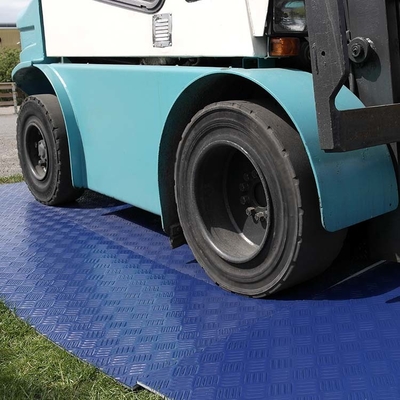
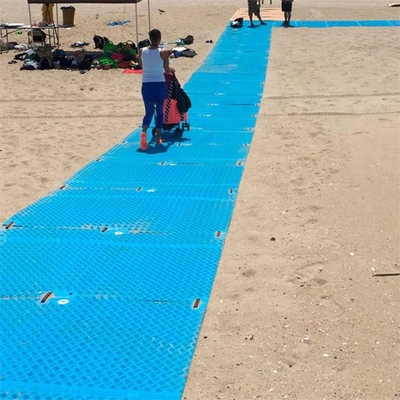
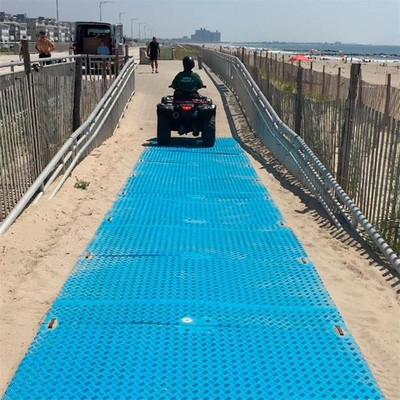
This is the 610 x 1220 mm blue HDPE track mat sold by Tangyin Taixing Engineering Plastics Co., Ltd. as the Plastic Swamp Rig Mats. It is an extruded high-density polyethylene panel laid loose on soft ground to give a wheel a running surface, joined to its neighbours into a temporary road, and lifted out again when the site closes. The values below are the attribute record of this listing.
| Model Number | Plastic Swamp Rig Mats |
|---|---|
| Item | Plastic Temporary Ground Protection HDPE Track Construction Road Mats |
| Material | High-Density Polyethylene |
| Size | 610 x 1220 mm, customized accepted |
| Thickness | 12.7 mm and 15 mm |
| Process type | Extrude |
| Colour | Blue, Green, White, Black |
| Application | Temporary Road |
| Water absorption rate | <0.01% |
| Compressive strength | >=27 MPa |
| Shore hardness | 65 Shore |
| Heat distortion temperature | 85 deg C |
| Embrittlement temperature | <-40 deg C |
| Certification | ISO9001 (quality management system) |
| Place of Origin | China |
| Minimum Order Quantity | 100 kilograms |
| Price basis | Negotiable |
| Payment terms | T/T, Western Union |
| Supply ability | 500000 kilograms per month |
| Delivery time | 15-20 days after deposit received |
| Packaging | Wooden crate of pallet |
| Format | Recorded size | Position relative to this listing |
|---|---|---|
| This listing | 610 x 1220 mm, 12.7 mm or 15 mm, extruded | The attribute record for Plastic Swamp Rig Mats; orders are placed against this size and these two thicknesses |
| Sizes listed in the source description | 1220 x 2440, 910 x 2440, 610 x 2440, 910 x 1830, 610 x 1830, 610 x 1220, 1250 x 3100 mm | A family size chart printed in the original text, not the configuration of this item |
| Custom size | Customized accepted | Non-standard lengths and widths are quoted as a cutting scope on top of the base size |
Two conflicts in the source resolved against the attribute record: the listing title describes a 2 x 8 ft mat while the attribute record and the item field both give 610 x 1220 mm, which is the 2 x 4 ft panel in the description's own size chart; and the description's load table is written for 12, 15 and 20 mm plate while the attribute record fixes this listing at 12.7 mm and 15 mm. The page therefore describes a 610 x 1220 mm panel in 12.7 mm or 15 mm, and treats the other sizes and the 20 mm reference line as belonging to separate formats.
Cleat pattern, overlap and load path
The Plastic Swamp Rig Mats panel is an extruded high-density polyethylene plate, 610 x 1220 mm, in 12.7 mm or 15 mm. Extrusion is the recorded process, which suits a constant-section panel produced in long runs and then cut to the 1220 mm length. The panel is not a structural slab: it works by spreading a wheel load sideways into the subgrade over a wider footprint than the tyre contact patch, and by staying in one piece while the ground beneath it deforms.
| Feature | Recorded value | Engineering effect on a temporary road |
|---|---|---|
| Compressive strength | >=27 MPa | Sets the local crushing margin under a wheel or outrigger foot bearing on a small contact patch |
| Shore hardness | 65 Shore | A mid-range hardness: the cleat keeps its shape under a tyre while the panel still conforms to a soft, uneven surface |
| Water absorption | <0.01% | The panel does not take up water, so it does not gain mass or soften in a flooded track |
| Heat distortion temperature | 85 deg C | Defines the upper service condition for a panel left in direct summer sun on dark ground |
| Embrittlement temperature | <-40 deg C | Allows winter deployment without the panel becoming brittle at the lifting points |
| Load reference in the description | 60 ton at 12 mm, 80 ton at 15 mm, 100 ton at 20 mm | Reference values printed against thickness; the 15 mm figure is the one that maps onto this listing, and it is a reference, not a certified capacity |
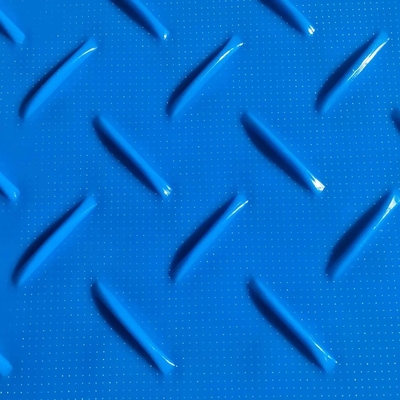
The description records two surface options for the ground mat family, cleated and smooth, and states that both may be incorporated into one design. That combination is the working configuration for a temporary road: a cleated or textured face upward gives the tyre something to bite on when the panel is wet, and a flatter face downward sits against the subgrade without the studs punching local failures into soft clay.
The same paragraph states that the mats have cleats and textured tops to help vehicles move across the temporary road. Read together with the 65 Shore hardness, the cleat is a traction feature rather than a load-bearing key: it does not interlock with the ground, and it should not be relied on to stop a panel from sliding downhill on a slope.
The mats are recorded as connectable and interlockable indefinitely, which is what turns individual 610 x 1220 mm panels into a road. Two consequences follow from the panel size. First, a 610 mm width means a road is built from parallel runs of panels rather than from one wide sheet, so the number of longitudinal joints per metre of road is high and each joint is a potential step. Second, because the panels are laid loose and joined, the joint is the weak line in the running surface, and the joining sequence decides whether a wheel meets a ramp or a lip.
Lay the road from the far end back toward the site entrance, so that each new panel overlaps the one already down on the side the traffic arrives from. Where a joint must run across the wheel path, stagger it against the joint in the parallel run - a continuous transverse line across the full road width is the classic place a panel lifts and a corner peels.
A 610 x 1220 mm panel in 12.7 mm or 15 mm is a one or two person lift, which is the reason this format exists next to the larger 1220 x 2440 mm sheets. Small panels are slower to lay per square metre but can be carried across soft ground by hand without a telehandler, and a single damaged panel can be swapped without opening the whole road. That trade is the main field decision between this listing and a larger mat.

Ground conditions and laying sequence
The Plastic Swamp Rig Mats is recorded for temporary road use: soft ground, grass, swamp and sites that are otherwise difficult to reach, carrying trucks, trailers and tractors. The boundary of the part is the subgrade, not the panel. An HDPE mat spreads load; it does not create bearing capacity where there is none, and the recorded reference figures for load are tied to ground conditions in the description itself.
Clear the line of stumps, boulders and protruding steel before laying, then grade the soft spots so water runs off rather than standing under the road. Water trapped under a mat is what produces mud pumping: the wheel pushes the panel down, the saturated subgrade squirts sideways, and the panel returns with a void beneath it. A crowned or drained line is worth more than an extra millimetre of thickness.
Lay the first panel square to the intended direction of travel and check it before laying twenty more. Panels are joined into runs; a run that starts one cleat out of square will not close at the far end, and the usual field fix - dragging a panel with a machine - damages the very edge that has to interlock. Where the route curves, use the joint to turn the line rather than bending a panel.
On a slope, rely on the joins and on end restraint, not on the cleat face. A loaded panel on a wet slope will creep, and a creeping run pulls its joints apart from the top down. Inspect the road after the first twenty loaded passes: that is when a soft spot shows as a rut, and a rut caught at that point can be re-graded before the panel is permanently deformed.
Confirm the route width against the 610 mm panel width so that the number of parallel runs is known. Confirm the loaded axle mass against the thickness chosen, treating the description's load table as a reference. Confirm the joint direction against the traffic direction. Confirm the colour ordered, because a mixed-colour road laid from several crates cannot be inventoried by sight when panels are recovered at the end of the job.
Plant, extrusion and supply terms
Tangyin Taixing Engineering Plastics Co., Ltd. manufactures the Plastic Swamp Rig Mats. The company states more than 20 years of production experience, a plant area of 25,000+ square meters and an annual output of 8,000+ tons, and describes itself as an engineering plastics manufacturer combining production, sales, design and processing. The recorded export name Beijing Silk Road Enterprise Management Services Co. belongs to the same engineering-plastics business; the two names are one manufacturing and export organisation, not two factories.
HDPE ground protection mat appears in the company's own product range alongside UHMWPE board, HDPE sheet, dual colour HDPE sheet, UHMWPE liner, outrigger pad, PE marine fender, plastic conveyor roller, synthetic ice rink and UHMWPE special-shaped parts, so the mat is a catalogue item of the plant rather than a traded-in article.
The recorded process type for this listing is extrusion, which produces the constant-section plate that the 610 x 1220 mm mat is cut from. Cutting and edge finishing run on the recorded CNC precise finishing machine, carving machine, sander machine and CNC machining centres, and the AutoCAD-based design support is what a customized size or a specific cleat layout is drawn against.
In-house checking uses the recorded laboratory instruments: abrasion tester, universal mechanical tester and oxygen index tester. The universal mechanical tester is the instrument that relates to the recorded compressive strength of >=27 MPa; the oxygen index tester is listed as site equipment, and no oxygen index result is recorded for this mat, so none is quoted here.
ISO9001 is recorded for this listing as a quality management system covering the manufacture of polyethylene sheet and machined plastic products. It is a system certification, not a product-by-product approval and not a material test report; no certificate number, issuing body or wider scope is recorded.
| Term | Recorded value | What it means for a purchase plan |
|---|---|---|
| Minimum order | 100 kilograms | A weight threshold, not a panel count: the number of mats in a minimum order changes with the thickness selected |
| Supply ability | 500000 kilograms per month | Large road programmes can be supplied in successive drops rather than one shipment |
| Delivery | 15-20 days after deposit received | Timed from deposit; a customized size adds drawing approval before that clock starts usefully |
| Packaging | Wooden crate of pallet | Panels travel flat and crated, which matters because a warped mat will not close its joints on site |
| Price and payment | Negotiable, T/T or Western Union | Thickness, colour and the customized cutting scope set the price, so all three belong in the enquiry |
Buyer questions
The attribute record of this listing gives 610 x 1220 mm, which is the 2 x 4 ft panel, and that is what is quoted and shipped as the Plastic Swamp Rig Mats from Tangyin Taixing Engineering Plastics Co., Ltd. The listing title says 2 x 8 ft, and the description's size chart does list a 610 x 2440 mm panel, but that is a different format in the same family.
Order by the dimension, not by the foot size in the title. 610 x 2440 mm and 610 x 1220 mm differ by a full panel length, and a road planned on one basis will come out short or long if the other arrives. If you need the longer panel, ask for it explicitly and expect it to be quoted as a separate format.
Tangyin Taixing Engineering Plastics Co., Ltd. records the Plastic Swamp Rig Mats at 12.7 mm and 15 mm, with a compressive strength of >=27 MPa and a Shore hardness of 65 Shore. The original description prints load reference values against thickness - 60 ton at 12 mm, 80 ton at 15 mm and 100 ton at 20 mm - and states that the working figure depends on ground conditions.
Treat those as reference, not as a rating. The panel carries load by spreading it, so the same mat on firm graded clay and on a swamp will behave differently, and the 15 mm reference is the line that maps onto this listing while 12.7 mm sits just above the 12 mm line. For a specific axle load, state the ground condition and the axle mass together.
The description of the Plastic Swamp Rig Mats records cleats and textured tops that help vehicles move across the temporary road, and records two surface options, cleated and smooth, which may be combined in one design. Tangyin Taixing Engineering Plastics Co., Ltd. supplies the panel with those faces; the cleat is a traction feature for the wheel.
That means the cleat should not be counted on as ground anchorage. On a slope, a loaded cleated panel can still creep, and the restraint has to come from the joints and from end fixing. It also means the cleated face belongs up and the flatter face down, where a studded face would punch into soft clay and lose contact area.
The Plastic Swamp Rig Mats are recorded as connectable and interlockable indefinitely, so a road is built as parallel runs of 610 x 1220 mm panels joined end to end. Because Tangyin Taixing Engineering Plastics Co., Ltd. supplies this listing at 610 mm width, a road of any width is a set of narrow runs, and every one of those longitudinal joints is a line where a wheel can meet a step.
Two rules keep the running surface flat: lay from the far end back toward the entrance so each new panel overlaps in the direction traffic arrives, and stagger the transverse joints between adjacent runs so no continuous line of joints crosses the full road width. A continuous transverse joint is where panels lift and corners peel.
Tangyin Taixing Engineering Plastics Co., Ltd. records the minimum order for the Plastic Swamp Rig Mats as 100 kilograms and the supply ability as 500000 kilograms per month, both by weight. Because the listing is sold by weight while the panel is 610 x 1220 mm in either 12.7 mm or 15 mm, the number of mats that makes up a minimum order is not a fixed figure - the thicker panel reaches the threshold with fewer pieces.
For planning, convert your road length into panels first, then let the supplier confirm the weight against the thickness chosen. Quote the thickness, the colour and the total panel count in the same message; a weight-only enquiry leaves the thickness open, and thickness is what the load behaviour depends on.
Tangyin Taixing Engineering Plastics Co., Ltd. records wooden crate of pallet packaging for the Plastic Swamp Rig Mats, with delivery at 15-20 days after deposit received. Crated pallets keep the panels flat and off the container floor, and they keep the cut edges away from the container walls.
Flatness is a functional requirement here, not a cosmetic one. A panel that has taken a set in storage will not sit down on the subgrade, and its joints will not close against the next panel, so a road built from warped mats has lips at every join. Stack crates on level ground on site as well, and do not leave a part-used crate with panels leaning on edge.
Tangyin Taixing Engineering Plastics Co., Ltd. records a heat distortion temperature of 85 deg C and an embrittlement temperature below -40 deg C for the Plastic Swamp Rig Mats. The low figure is the one that governs winter work: it describes the point at which the polyethylene becomes brittle, and a panel used above that point keeps its toughness when it is lifted and dropped in the cold.
The 85 deg C figure is the upper bound, and it is a material property rather than an allowance for hot work. Do not lay panels against hot plant, under hot discharge or as a heat shield. In service the panel is also UV stable according to the description, which is what allows a road to stay down for a season rather than being taken up each night.
Tangyin Taixing Engineering Plastics Co., Ltd. records ISO9001 for the Plastic Swamp Rig Mats as a quality management system covering the manufacture of polyethylene sheet and machined plastic products. It is a system certification; it is not a product-by-product approval and not a material test report for the panels in your container.
If the compressive strength of >=27 MPa or the 65 Shore hardness has to be evidenced for a project, ask for those values to be checked against your batch rather than quoting the system certificate as proof. The plant's recorded universal mechanical tester is the instrument for a mechanical check; the certificate alone will not answer a specification clause.
Goods-in verification
Contact Person: Mr. Sales
Tel: +86 152 1104 0646


 English